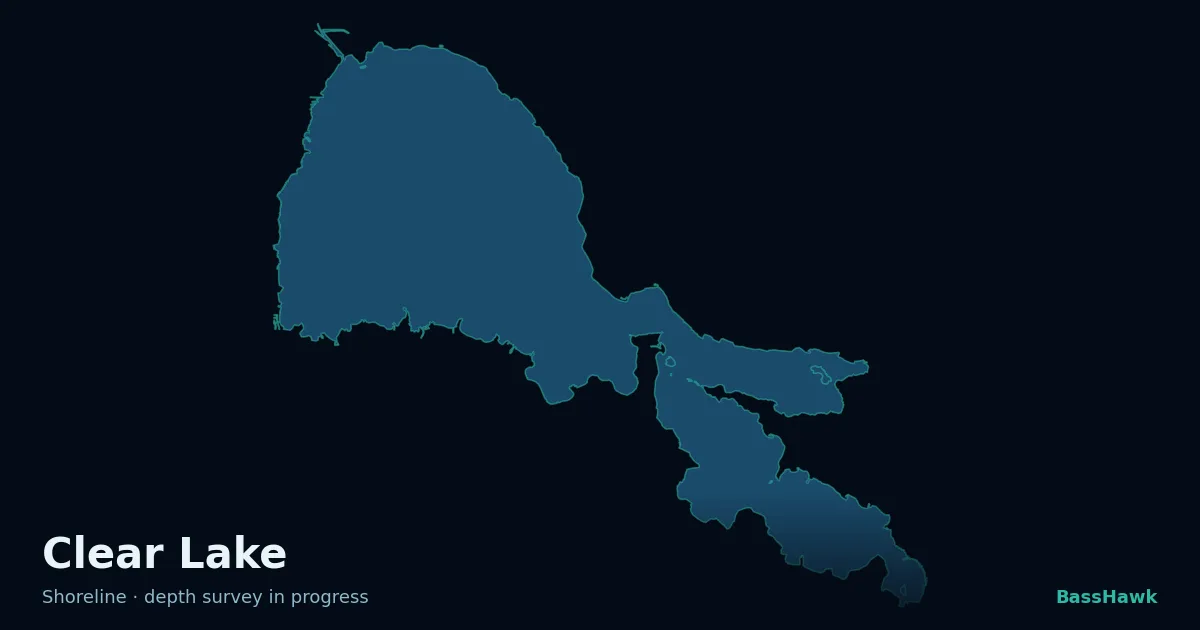
Hot water, falling pressure, and no cloud cover mean tight windows at dawn and dusk. Work the deep sanctuaries between light periods.
It's peak summer heat at 91 degrees. The water's too warm and the sun is too bright for bass to stay shallow, so they're locked into deeper ledges, rock piles, and the channel all day long. The pressure's dropping ahead of some weather coming in, which should fire them up a bit, but right now the clear sky and intense sun keep them buried. Your bite windows are tight: first light before the sun gets mean, and the last couple hours before dark. In between, you're hunting deep structure and soft plastics to stay connected. The lake's got that green summer tint, so drop-shots and darker finesse baits will stand out. This is a grind-and-run day where you cover water and pick apart deep spots methodically rather than camp on one place.
The day's game plan
Where to fish
- Point Lakeview, Baylis Point, and Luebow Point — Shallow edge 3 to 6 feet, ledge breakline 12 to 18 feet, deep drop-off 20+ feet · Hard-bottom points with rocky edges, baitfish staging on the slope, deep water access 100+ feet away
South-facing points warm first in the day and hold both shallow and deep bass. The ledge is where summer bass stage before moving deep or shallow based on light. The hard bottom attracts baitfish, and the depth change funnels bass. - Tule flats on the north end, Rocky Point to Long Tule Point, and Corinthian Bay entrance — Shallow water 3 to 12 feet, tule edge transitions from 8 to 15 feet · Dense tule reed beds with open-water pockets, submerged wood, depth changes meeting tule
Tules provide shade and structure for bass in hot water. The north end is more protected from bright sun, especially morning and afternoon. Corinthian Bay and Shirley Slough have deep-water access nearby. Tule edges concentrate bass year-round. - Mid-lake basin ledges and humps near Mount Konocti — 20 to 28 feet, sharp breaklines where depth drops 10+ feet in a short distance · Rock piles, hard-bottom humps, channel swings, baitfish on the deep edge
Summer bass retreat to the deepest sanctuaries with baitfish and structure. Forward-facing sonar tournaments have proven that giant prespawn and summer bass school on deep mid-lake structure. The proximity to 40+ feet of water gives them an escape route. - Dock pilings on Rattlesnake Arm and Highway 20 near Kona Tayee — 8 to 15 feet under docks, 15 to 25 feet at the dock edges · Wooden dock pilings with shade, shallow flats leading to deeper channels, baitfish sanctuary
Docks stay cooler and hold baitfish. Bass position underneath to ambush. Tournament winners have pulled giant summer fish on blind casts to established dock lines. The shade and structure make docks a reliable pattern all summer.
What to throw
- Drop-shot finesse worm — 4 in · Green pumpkin, watermelon red flake, or black/blue · 3/8 oz jighead (Early morning, midday, and when bass are inactive. Works all day in summer.)
Vertical shaking on bottom and ledges. Cast to structure, shake 2 to 3 times, pause, repeat. Let it fall on semi-slack line. - Wacky-rigged finesse worm — 5 in · Green pumpkin, black/blue, or watermelon · n/a (light jighead or unweighted) (Morning and early afternoon when bass are 8 to 12 feet deep around cover.)
Cast to tule edges and dock pilings, let it fall on slack line, shake subtly as it sinks, retrieve with small rod twitches and pauses. - Swimbait and jighead combo — 3 to 4 in · Reservoir Shad, Golden Shiner, or natural Shad pattern · 3/8 to 1/2 oz (Midday deep water and mid-lake sanctuary spots. Also effective around dock pilings in afternoon.)
Drag slowly across bottom on deep ledges and breaks. Lift and pause every 10 to 15 feet. Let it sit on the drop-off for 3 to 5 seconds between movements. - Glide bait (13 inch) — 13 in · Shad pattern or natural minnow · n/a (Late afternoon around docks and dock pilings when bass begin to feed again.)
Cast parallel to docks and structure, work on a slow, steady retrieve with occasional twitches. Let it pause near cover. - Topwater walking bait (Super Spook style) — 3 to 4 in · Black, dark shad, or pearl · n/a (Dusk and early evening when bass are shallow and feeding. Last 90 minutes before full dark.)
Walk it side to side with 2 to 3-inch rod twitches every second or two. Steady retrieve, pause at cover, then walk again. Keep the rod tip at 9 o'clock.
How to work it
- Drop-shot on deep structure — All day in summer, especially early morning, midday, and when bite slows. Most reliable technique in hot water. · Ledges 12 to 28 feet, rock piles, and mid-lake structure. Work the sharpest breaks where depth changes 5+ feet.
Rig a 4-inch finesse worm on a drop-shot with 3 to 4 feet of fluorocarbon leader below a small swivel. Jighead weight 3/8 ounce. Cast to depth breaks and ledges, shake vertically for 2 to 3 shakes, pause for 2 seconds, repeat. Use braided main line for feel on bottom. - Running and gunning shallow structure — Morning and late afternoon. Summer bass scatter more than spring, so finding concentration is key. · Tule flats 8 to 12 feet, dock lines, shallow rock piles, and point breaklines on the north end and around Corinthian Bay.
Pick a 2 to 5-mile stretch of tule edges, docks, or shallow points. Work each spot for 5 to 10 minutes with finesse worms or wacky-rigged baits. Move every 10 minutes if you don't get a bite or if you land one. Cover water fast and find where the school is concentrated. - Blind-casting deep docks with large baits — Late afternoon when dock shadows expand and bass become less lethargic. Also effective early morning if docks are accessible. · Rattlesnake Arm docks, Highway 20 side near Kona Tayee, and any established boat dock line in 8 to 15 feet.
Work a 13-inch glide bait or 5 to 6-inch swimbait on medium-heavy gear. Cast parallel to dock pilings, retrieve slowly with subtle twitches. Work the shade line and underneath structure. Move to the next dock every 10 to 15 casts. - Topwater in the last light — Dusk and early evening only. The narrow window before full dark is when most evening bass commit to feed. · Shallow flats 3 to 8 feet, tule edges, dock lines, and coves with overhead cover.
Switch to a walking bait or popper 60 to 90 minutes before sunset. Work it methodically along tule edges, dock pilings, and shallow structure. Walk it slowly, pause at cover, pop it near structure. This is a confidence bait in clear conditions and new-moon darkness.
Pro tips
- Bring two rigs rigged and ready: a drop-shot on a medium-light spinning rod and a topwater on a medium-heavy rod. Switching baits in the boat is fast. The moment dusk hits, swap off the drop-shot and pick up topwater. You'll be ready when the window opens. Most anglers waste 5 to 10 minutes retying and miss the dusk bite.
- Use a high-quality fish finder or forward-facing sonar to locate the deep mid-lake baitfish schools, especially around Mount Konocti basin. If you can see a tight ball of shad at 22 to 28 feet, drop a jighead and swimbait on top of it. Summer tournament winners rely on sonar to find the giant schools that shallow-water anglers miss. The green algae water makes visual spotting nearly impossible, so electronics are essential.
- Leave the dock at first light. The bite window from 6:21 to 8:30 AM is tight, and the minor solunar at 7:02 AM can add a brief surge. If you're launching at 7:30 AM, you've already lost the best 70 minutes. Start in the dark if you can and be on your first deep ledge as the sun breaks the horizon.
If conditions change
If the pressure continues to fall and a front rolls in tonight or tomorrow, expect a brief feeding surge during the next 12 to 24 hours before conditions turn tough. Fish reaction baits (crankbaits, spinnerbaits, jigs) this evening and tomorrow morning. If the front passes and high pressure follows with clear skies, the bite will shut down hard and move even deeper. Move to 20 to 28-foot structure and slow everything down. If afternoon wind kicks up from the west, shallow rock piles and docks on the windward side can stay productive longer as wind breaks up the surface and provides shade. If unexpected clouds roll in or humidity builds, the shallow topwater window may extend 30 to 60 minutes later into the evening. If water clarity drops from algae blooms, shift to darker, wider-vibration lures like dark crankbaits and black/chartreuse jigs. If clarity improves unexpectedly, downsize to finesse worms and use longer fluorocarbon leaders on your drop-shots.
Find more fish. This is a real report from that day's conditions — open the app for today's · free account