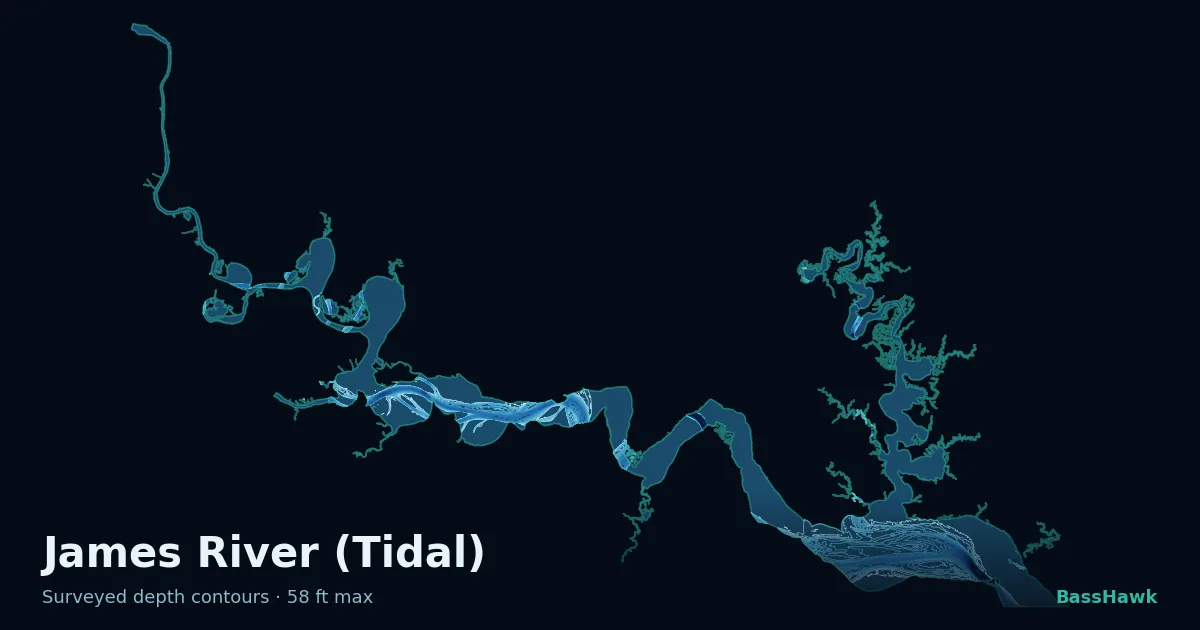
Pressure dropping and water's in the comfort zone — work the tidal push on shallow wood and expect bites early, late, and any time the water's moving in.
Water's at 81 degrees, warm and comfortable for summer largemouth, but the stained mainstem water keeps them tied to cover instead of roaming. The Chickahominy's cleaner tannin water is a plus. Pressure's falling ahead of weather rolling in, and that drop fires up the bite — bass sense it and feed harder before conditions change. The tide is the biggest lever today. Incoming water slides bass onto cypress knees, duck blinds, and shallow wood in the 3-6 foot range; outgoing water pulls them back to the edges and drains. Light's bright and harsh early, so count on shallow topwater and dark-colored reaction baits in the first 90 minutes after sunrise. As the sun climbs and glare sets in, bass move to shade and the transition points where timber meets open water. The bite won't shut down completely like it does on the lakes, because this tidal current keeps refreshing oxygen and repositioning bait, but the best window closes hard by late morning unless you're fishing inside creeks where structure is denser.
The day's game plan
Where to fish
- Chickahominy inside bends and cypress-lined banks — 2-6 feet on incoming tide; 6-12 feet on outgoing · Cypress knees, duck blinds, downed timber, shallow clay banks, lily pad edges
Cleaner water and protected banks make this the premium shallow-water zone. Incoming tide slides bass onto the cypress and blinds at 3-5 feet. Inside bends create current breaks where baitfish stage. Topwater and chatterbait dominate here early and late. - James mainstem channel swings and outside bends — 12-20 feet at the break, 6-12 feet on the flats adjacent · Sunken cypress, channel ledges, hard-bottom drops, timber in the flow
The main river's deepest structure and strongest current. Bass use these swings as migration highways and feeding zones. Outside bends have the steepest drops and best concentration of baitfish. Blade baits and shakey heads excel here midday and during low-light periods. - Tributary creek mouths on outgoing tide — 3-8 feet in the mouth, 15+ feet in the drainage · Grass beds, clay banks, submerged logs, current breaks where creek flow meets river
As water drains, bass funnel toward the deeper channels. Creek mouths concentrate both bait and bass. Incoming tide pushes baitfish up the creeks, and bass follow. These are transition zones that stay active even when the main flats go quiet. - Docks and boat slips on the main river — 3-8 feet directly under and adjacent to structure · Pilings, under-dock shade, boat slips, riprap, floating docks
Shade and current combine to hold bass all day. Docks stay cooler in the heat and attract baitfish. The pilings and slip edges create ambush points. Work these during midday glare when shallow open water is too bright.
What to throw
- Topwater walking plug — 2-3 in · white or chartreuse-and-white early and late; black or dark patterns at dusk · n/a (Early morning before 8 AM and late evening after 5 PM. Peak at sunrise and sunset when light is soft. Fish it over cypress knees, duck blinds, and shallow wood.)
Walk it side-to-side with short twitches and 1-3 second pauses. Let the ripples settle between twitches in low light. - Chatterbait — 3/8 in · black or dark blue · 3/8 oz (Morning to midday when sun is high and glare is bright. Works all day if tide is active. Especially during slack water when bass are stalling on wood.)
Steady retrieve with the blade working, drag it along grass edges, timber edges, and channel transitions. Let it fall on slack water and work it with sharp twitches. - Shakey head rig with soft plastic worm — 3-4 in worm · watermelon, watermelon/red flake, or black grape · 1/8 oz jighead (Midday when bass are deep and transition zones are quiet. All day in stained water. Especially productive in the channel swings.)
Drag it along the bottom with a slow, vertical shake. Work the grass edges and channel breaks 8-12 feet deep. Let it settle after a twitch. - Swimbait on light jig head — 4-5 in · natural shad silver, ghost minnow, or chartreuse-back · 3/16 oz jig (Late afternoon and evening when tide is switching or active. Works all day on the Chickahominy where water is cleaner.)
Swim it steady over timber and through grass. Maintain contact and a natural glide. Work creeks and shallow flats on the incoming push. - Blade bait — n/a · white or chrome · 1/4-3/8 oz (Midday and any time in the channel swings when bass are deep. All day if pressure is low and bite is soft.)
Cast and work on the drop with sharp snaps and pauses. Vertical jig in deep channels if you locate fish. Slow, methodical cadence in stained water.
How to work it
- Tide-stage sequencing — All day. This is the single biggest lever on the tidal James. A good area fished on the right tide produces; the same spot on the wrong tide may be dead. · Chickahominy creeks and James mainstem inside bends for incoming; main channel edges and tributary mouths for outgoing.
Plan your morning to fish incoming water first on the shallow flats and wood. As tide peaks and turns, slide toward the edges and transitions. Once outgoing sets in, fish the channel breaks and timber outside bends where bass concentrate on the drain. - Low-light aggressive fishing — 6:30-8:00 AM and 6:00-8:05 PM. Peak is sunrise and sunset when light is soft and bass are most aggressive. · Any shallow wood, cypress clusters, and grass edges where bass are positioned for feeding.
Fish topwater and fast, reaction baits in the first 90 minutes after sunrise and the last 90 minutes before dark. Use contrast colors (white, chartreuse-and-white early; black or dark late). Work it with confidence and speed, covering water to trigger strikes. - Glare-time deep shift — 8:00 AM to 5:00 PM on bright days. Switch back shallow if clouds roll in or if tide is aggressively incoming. · Channel edges, timber lines, grass-to-open-water transitions, docks.
As sun climbs and glare hardens, downsize baits, slow your retrieve, and move to transition zones 6-12 feet deep. Fish near shade (docks, inside timber). Use natural colors and finesse presentations. Patience over speed. - Pressure-drop feeding trigger — All day, but especially early and late when the light window is already favorable. The falling pressure amplifies what's already working. · Any shallow and transition structure where bass can position quickly.
When pressure drops before a front, bass feed harder and more willing to chase. Use faster, more aggressive presentations: topwater, chatterbait, swimming crankbait. Reaction baits outproduce finesse. Cover water quickly and dial in the pattern.
Pro tips
- The mainstem clarity is fighting you, but the Chickahominy's tannic water is your advantage. If the main river bite is slow midday, run to the Chick and fish the cypress clusters on the incoming push. Cleaner water means bass see baits from farther away, so natural colors and longer casts work better. The creek access is worth the run.
- Pressure is dropping hard, so commit to the bite tomorrow morning before the front arrives. This evening and tonight, the low-light bite will be genuine. If you fish dusk and dark, you'll catch fish most people miss. Topwater and dark lures after sunset will outproduce morning grind fishing on normal days. This is a rare high-confidence evening window.
If conditions change
If clouds move in and glare softens, shallow topwater and chatterbait will stay active 30-60 minutes longer. Move back to the cypress and duck blinds instead of dropping to transition zones. If the wind picks up and whitecaps form, the bite toughens but current becomes more defined. Focus the lee banks and inside creeks where water is calmer; bass will pile into current breaks for comfort. If a heavy front blows through and pressure spikes fast, the bite will crash. Abandon topwater and go small and slow. Fish the densest cover available — under docks, inside thick timber. Use 1/8 oz drop shots and 3-inch worms near the bottom in 8-15 feet. If water clears unexpectedly (unlikely given the stain today), upsize your leader to 8 lb fluorocarbon and fish natural colors in the deeper zones. If water gets muddier from rain, go darker — black and dark blue chatterbaits and dark topwater — and slow your retrieve. The bite will stay shallow longer because bass won't see into stained water far enough to hunt deep.
Find more fish. This is a real report from that day's conditions — open the app for today's · free account