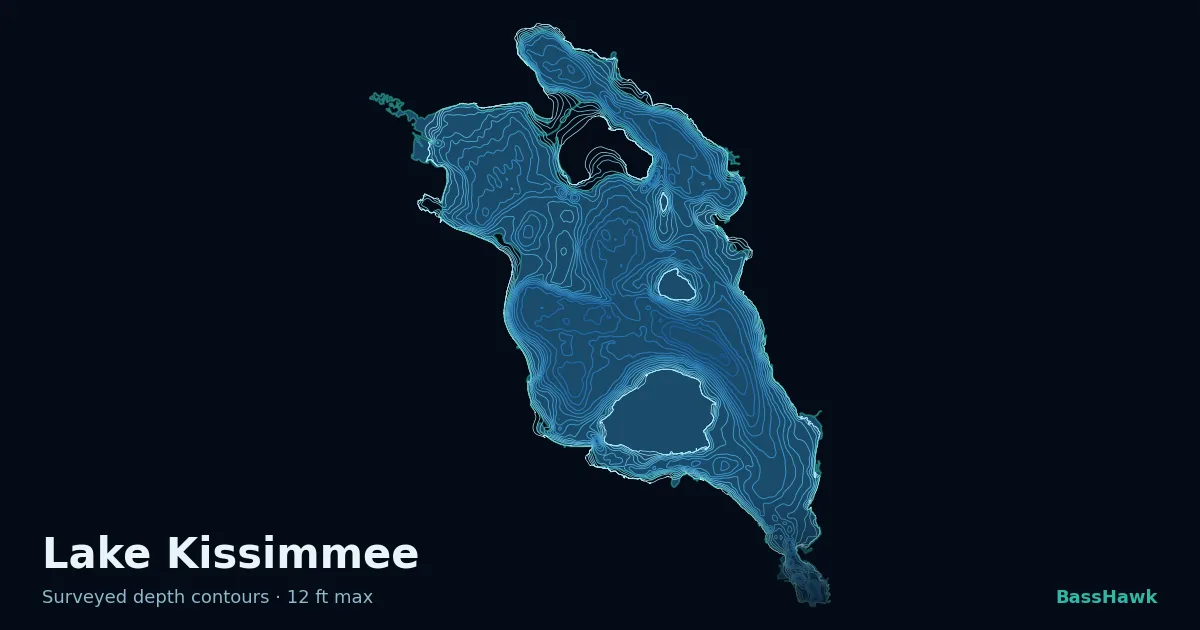
Heat's on hard, work the margins early and late, then go deep to the brush and mussel bars when the sun climbs.
Water's sitting 82 degrees in the heat of summer, stained and uncomfortable for bass out in open water. This is survival mode. Bass are tight to shade and deep structure most of the day, feeding only at first and last light when cooler water and baitfish movement give them a window. Pressure's dropping ahead of some weather rolling in, so you'll see a slight uptick in aggression before the front hits, but don't count on it lasting all day. Early morning is your golden ticket. Get on the flats and margins before the sun pins everything deep, then transition to off-shore brush piles and mussel bars where the bigger fish are hiding in the cooler depths. The stained water means you can get away with darker colors and wider blade profiles without spooking fish, and vibration matters more than finesse right now.
The day's game plan
Where to fish
- Brahma Island Flats and Edges — 2 to 6 feet on the flats, 8 to 15 feet at the dropoff edges. · Shallow flat surrounded by deeper channels. Grass, lily pads, maidencane, bulrush, and isolated submerged wood. Mussel bars and brush piles on the deeper perimeter.
Brahma Island is the signature structure on Kissimmee. Bigger fish pull to the offshore mussel bars and brush during heat, while keeper-class fish stay tight to inside grass and pad edges. The perimeter dropoffs are where bass position to feed and rest. Early and late light, work the inside flats. Midday, hit the deeper offshore structure. - Philadelphia Point and Lemon Point — 3 to 8 feet on the approach, 10 to 15 feet at the drop. · Hard-bottom drop-off edges with firmer substratum meeting grass beds and hydrilla. Maidencane and Kissimmee grass prevalent.
These are proven staging and feeding areas with solid drop-off structure that concentrates bass. The hard bottom provides good holding cover and the grass edges funnel baitfish. Evening and dusk are prime times. - North Cove — 2 to 6 feet shallow, 10 to 12 feet at edges. · Shallow cove with knotgrass, maidencane, lily pads, bulrush, and hydrilla. Submerged wood and isolated cover scattered throughout.
North Cove holds numbers of keeper-class fish and some trophies, especially around the replanted native grasses. Good for working flats in early and late light. Safe fallback if the main lake is too quiet. - Outside Grass Lanes and Hydrilla Edges — 3 to 8 feet. · Open-water lanes through dense vegetation with hard-bottom transitions where grass edges drop off. Isolated submerged wood and deeper grass channels.
Outside grass edges are ambush points. Bass set up here to hunt baitfish moving through the lanes. Evening and night fishing along these edges produces consistent bites, especially with big worms and topwater baits.
What to throw
- Frog or Buzz Bait — n/a · Chartreuse or dark bluegill · 3/8 oz to 1/2 oz (Early morning and dusk, first half hour after sunrise and last hour before sunset.)
Cast to mats and floating vegetation, steady fast retrieve skated across the surface. Stop and let it sit for a beat, then continue. - Dark Craw or Creature Bait (Tungsten) — 1.5 in to 2.5 in · Watermelon-red, junebug, or black · 1 oz to 1.25 oz (tungsten) (Mid-morning through midday, when bass pull into shade on the flats.)
Flip into shaded pockets, submerged wood, and under mats. Keep tension on the line and work vertically with short hops. - Wild Golden Shiner — 4 in to 6 in · Natural silver · n/a (Midday through late afternoon, over deep brush and mussel bars.)
Slow-troll on a light rig near bottom structure, or free-line along grass edges and mussel bars. Keep tension light and let the shiner swim naturally. - Lipless Crankbait — 2 in to 2.5 in · Shad, chartreuse-blue, or river-shad · 3/4 oz (Midday deep structure, and evening and dusk grass edges.)
Rip through brush, mussel bars, and along grass edges with short, aggressive pops. Pause briefly between pops. Around dusk, steady retrieve along the outside edge of vegetation. - Dark Worm (8 to 10 in) — 8 in to 10 in · Black, junebug, or watermelon-red · 3/8 oz (Evening, dusk, and night.)
Drag slowly along grass edges and over deep structure. Pause 3 to 5 seconds and let it settle. Creep it through the strike zone deliberately.
How to work it
- Flipping into Dense Cover — Mid-morning through early afternoon when bass pull into shade but haven't committed to deep offshore structure. · Grass fields, lily-pad pockets, submerged wood, and dark holes inside mats on the flats in 3 to 6 feet.
Use a 7-foot medium-heavy rod with 65-pound braid. Hold the line in your hand, shorten the rod slightly, and pitch a 1 to 1.25 oz tungsten rig with a creature bait into shaded pockets and submerged wood. Keep tension and work vertically with short hops. - Slow-Trolling Live Shiners — Midday through late afternoon. Ideal over deeper offshore structure where trophy bass stage during heat. · Mussel bars, brush piles, and submerged grass edges off Brahma Island in 12 to 18 feet.
Use a light rig, keep the shiner on a steady trolling path near bottom structure at idle speed or slightly faster. Let the shiner swim naturally and maintain light tension on the line. - Ripping Lipless Cranks — Midday over deep structure, and evening along grass edges from 5:30 PM onward. · Mussel bars, brush piles, grass edges, and transitions from shallow to deep water in 6 to 18 feet.
Cast to the structure, rip with short, sharp pops of the rod tip followed by quick cranking. Pause briefly between pops to let the bait sink. Work methodically through the strike zone. - Dragging Big Worms at Night — Evening, dusk, and night from 5:30 PM onward. Prime time 8:30 PM to 10:30 PM. · Grass edges, hydrilla banks, outside vegetation lines, and submerged humps in 3 to 8 feet.
Use a 6 to 7 foot medium rod with 15 to 20 pound fluorocarbon. Pitch the worm just ahead of your target structure, let it sink to bottom, then drag it slowly with pauses. Pause 3 to 5 seconds frequently and feel for strikes.
Pro tips
- Pressure's dropping ahead of weather, so you'll see a slight bite uptick in the next 12 to 24 hours before the front arrives. Use that window hard in the early morning. After the front blows through, bass will bury tighter in cover, so be ready to downsize and slow down even more.
- Stained water is your friend today. Dark colors and wider blade profiles create contrast and vibration that bass can't ignore. Don't overthink the finesse game. Go darker, go louder, go confident.
- If you find schooling shad at the boat-run entrance or near water flow from the gates at first light, throw a small topwater or beetle-spin immediately. Schooling shad mean bass are feeding aggressively and the window is narrow, maybe 15 to 30 minutes. Cover water fast.
If conditions change
If clouds move in and a breeze picks up, the shallow bite will stretch later into the morning and restart earlier in the evening. If the sun stays brutal and clear all day, commit harder to the deep mussel bars and brush piles midday and don't waste time on the flats. If water clarity improves after rain, scale back to natural shad colors and downsize your offerings; if it muddies even more, go black and maximize vibration. If wind picks up and blows hard onto the shoreline, work that wind-blown bank because baitfish push there and bass follow. After the front passes and pressure rises, expect a 24 to 36 hour slowdown. Shift to the thickest cover available, go slow, and fish small dark plastics on a tight Texas rig right on the structure. Patience and precision beat aggression on the back side of a front.
Find more fish. This is a real report from that day's conditions — open the app for today's · free account