Pressure dropping before weather rolls in, mats are firing with creature baits and bladed jigs. Fish heavy and punch the canopy.
Water's sitting at a comfortable 80 degrees in midsummer, stained and dark the way Orange Lake always is this time of year. The drought's got the lake squeezed down, which means the bass and forage are concentrated thick in the spatterdock fields and hydrilla mats where they can stay shaded and cool. Pressure's falling ahead of some weather coming in, so the bite should be active. Cloud cover's solid today, which helps keep the shallow bite going longer into the middle of the day. Wind's light out of the southwest. The bass are sitting in and around that matted vegetation in the shallower bays and creek mouths, using the canopy for shade. This time of year they're not chasing far, so you need to get the bait right in front of them, in the thickest cover you can work.
The day's game plan
Where to fish
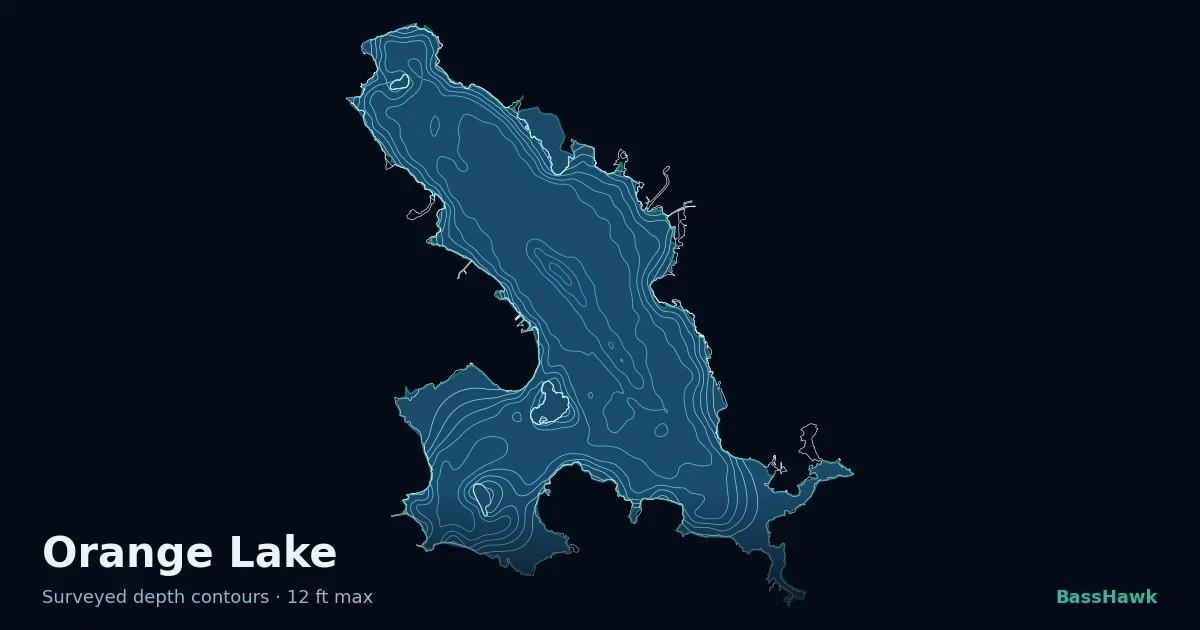
- McIntosh Bay — 3 to 8 feet · Thick hydrilla canopy with open-water pockets and shallow mat edges
FWC reports describe this zone as holding very thick hydrilla, the prime summer refuge for big females. The drought concentrates bass here. Early morning and late evening punching or bladed jigs excel. This is where 10-pound bass have been a near-daily event this season. - Southern Shoreline Hydrilla Fields — 3 to 12 feet · Mat edges transitioning to open water, inside bends of shallow creek channels, slight depressions and ditches on the mat perimeter
Extended hydrilla along the south shore provides continuous shade and cooler microzones. Tour the edges with bladed jigs from early light through midday. Bass stage on these edges before committing to the thick canopy or pulling deep. - Eastern Shoreline Transitions — 4 to 15 feet · Where hydrilla mat meets defined channel swing, secondary points, outside edges with hard bottom
These transitions funnel bass between shallow mats and deeper channel relief. Bladed jigs work the shallow edge early, channel dragging works the deeper edge midday. Less pressure than McIntosh, same holding pattern. - Creek Channel and Main Lake Bends — 8 to 20 feet · Outside bends with drop-off, inside bends with slack water, channel swings with hard-bottom transitions
When heat peaks and bass retreat from shallow mats, these channels become the primary holding zone. Drop shot and dark finesse are effective here. Bigger fish use channels as relief and hunting highways. Less dramatic action than the mats but more consistent deeper bass.
What to throw
- Bladed Jig — 3/8 to 1/2 inch · Black and blue, dark green, or chartreuse and black · 3/8 to 1/2 oz (All day, especially mat edges and transitions. Primary early morning and evening.)
Cast to mat edges and structure, hop and drag along transitions, dead-stick deeper zones, work shallow edges with steady retrieves. Let the blade thump the water for vibration in stain. - Dark Creature Bait (Craw or Beaver Style) — 4 to 5 inches · Black, junebug, dark green, or dark brown · 3/8 to 3/4 oz (punch through thick mats with heavier weight) (Punching the thick canopy early and late, dragging deeper channels midday, confidence bait after topwater shorts.)
Texas rigged, punch straight down through canopy if mats are thick, or drag along open bottom near structure. Short controlled drags, minimal movement. Let it sit and breathe in deeper zones. - Dark Finesse Worm — 4 to 5 inches · Black, junebug, dark blue, or dark green · 1/4 to 3/8 oz drop shot weight (Midday deeper zones, post-front selectivity, transitions when bass have pulled offshore.)
Rig on drop shot. Fish vertically or with small horizontal drags tight to structure and channel edges. Minimal movement, high precision. Effective when bass are tight to bottom and less reactive. - Walking Topwater — 4 to 5 inches · Black or dark shad · n/a (Dusk and night, especially if water is still cloudy from weather pressure. Last 90 minutes of light and after dark.)
Walk side-to-side on steady retrieve with slight pauses. Work mat edges and shallow bays during low light. If you get short strikes, replace with a dark creature bait or drop shot to cover the follow-up bite. - Chartreuse or White Bladed Jig — 3/8 inch · Chartreuse and black, white and chartreuse, or all white · 3/8 oz (Morning light when some visibility increases slightly, or if the water muddies dramatically from weather runoff.)
Cast and hop along visible mat edges and structure. Stained water visibility play. Work faster and shallower than dark jigs.
How to work it
- Punching Mats — Early morning, late evening, anytime the mats are accessible. Pressure dropping amplifies this bite. · Thick hydrilla canopy in McIntosh Bay and southern mat fields, 3 to 6 feet
Heavy Texas rig (1/2 to 3/4 ounce) with a dark creature bait or beaver, cast directly into the thickest canopy. Drive the rod tip down hard on the hook set, keeping the boat parallel to the mat. Work short, controlled drags along the bottom. - Bladed Jig Edge Work — All day, especially early morning and evening. This is the most consistent all-around technique for Orange in summer. · Hydrilla and spatterdock edges along the southern and eastern shorelines, creek-mouth transitions, channel bends
Cast to the defined edge where the mat meets open water. Work it with steady hops and pauses, keeping the blade in contact with the transition zone. Fish shallow to deep edge, not in the thick of the mat. - Channel Dragging — Midday and early afternoon when heat pushes bass deeper. Post-front patterns when bass are locked down. · Main lake channel bends, secondary creek channels with defined edge structure, the outside edge of hydrilla transitioning to open water
Cast a Texas rig or drop shot along the outside bend and channel swing of creek channels. Drag slowly along the bottom, feeling for structure change and depth breaks. Work depths of 8 to 15 feet with methodical, precise movements. - Topwater at Dusk and Night — Last 90 minutes of light through full night, especially waning moon (minimal moonlight). Most productive if cloud cover persists into evening. · Shallow spatterdock and hydrilla mats, 2 to 6 feet, especially in bays and creek mouths near structure
Walk a dark topwater with steady cadence along mat edges and open-water pockets. Pause occasionally to create disturbance. Allow for reaction takes and follow-up bites. If strikes are short or boils with no hook-up, switch to a dark creature bait immediately.
Pro tips
- Falling pressure before weather rolls in is firing the bite, especially the reactionary window from early light through mid-morning. Bladed jigs and topwater triggers work best when pressure is moving. Fish aggressively during the next 8 to 10 hours before the front passes and pressure starts rising. Expect the bite to lock down after the system moves through.
- The drought's concentration play is real: big females are stacked in the thickest mats you can reach. If you punch through three feet of canopy and connect with bass, keep working that exact depth and canopy thickness throughout the bay. You've found the pattern. Replicate it at other mats with similar structure and shade. Don't waste time on sparse vegetation or open water unless you're transitioning between zones.
- Stained water and thick cloud cover make dark colors and vibration your baseline. If you start a day with bright or natural colors and the bite is slow, switch to black, junebug, or dark green immediately. Also: keep your leader short (18 to 24 inches) and your knots tight. Heavy cover and heavy weights put strain on equipment, and a break costs you fish.
If conditions change
If the weather front rolls through and pressure rises sharply, the bite will shut down for 24 to 36 hours. Shift to the thickest cover available, downsize to 4-inch dark finesse worms on drop shot, and fish very slow right on the mat edge or inside the canopy. Avoid open water and shallow edges; bass will bury in the densest vegetation. If the front brings heavy rain and runoff, water will darken further; shift to black and junebug colors only, maximize vibration with bladed jigs, and upsize slightly to 3/8 to 1/2 ounce if visibility drops below 2 feet. If winds strengthen from the southwest, the wind-blown banks (northern and western shorelines) will oxygenate and concentrate baitfish; work those banks with bladed jigs and topwater if the water stays cloudy. If cloud cover breaks and sun dominates, bass will pull deeper and tighter to the thickest mat interior; punch harder, work slower, and expect a slower but more selective bite. Fish early (first 90 minutes of light) and late (last 90 minutes) when shallow zones remain viable.
Find more fish. This is a real report from that day's conditions — open the app for today's · free account