Pressure steady, water too hot to hunt. Fish deep and dark at first light, then offshore structure on the fluke.
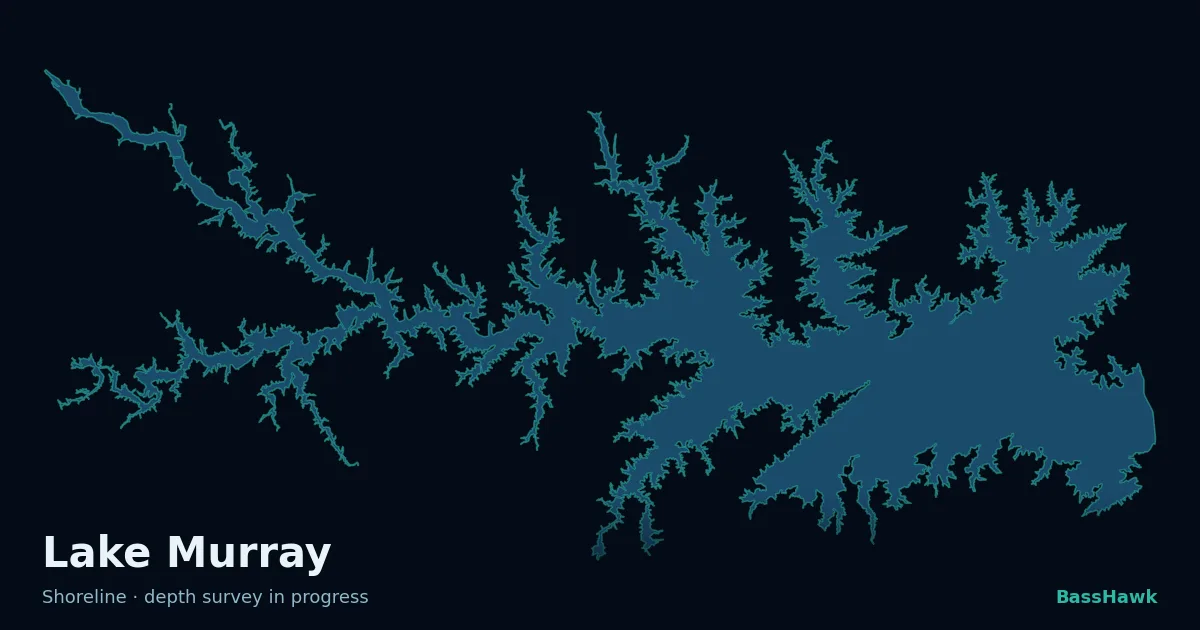
We are in full summer grind on Lake Murray with water holding steady at 85 degrees. At this heat the largemouth are not comfortable shallow during the day, they pull down to cooler, deeper structure and stay tucked. The pressure is holding flat, which means the fish will hold their pattern without shifting. Clarity is clean on the lower lake near the dam and stained upstream, which lets you dial in colors and presentation depth. Pool is down about four feet, so your usual shallow haunts have moved. The bite compresses into the first two hours of light and then again into the evening window. After sunrise the fish go quiet until something changes, either the sun slides lower or the pressure drops before a storm rolls in.
The day's game plan
Where to fish
- Main-lake points and secondary creek points — 8 to 20 feet · Hard bottom, sand or gravel, with nearby grass edge or stumps, positioned to funnel fish between deep and shallow water
Points are the highways bass use to move between shallow feeding grounds and deep safety zones. At summer water temps the bass sit on these points during the warm daylight and stage there before moving shallow at low light. Points adjacent to creek channels offer quick access to both shallow and deep. - Cane piles and suspended structure in 15 to 25 feet — 15 to 25 feet · Sparse cane, brush piles, or submerged timber with open water around them, positioned where herring schools congregate
Summer herring hold around vertical structure in the middle depths. The bass position above, below, and around these piles to intercept bait. The clear water near the dam makes these spots easy to sounder-mark. This is the most reliable offshore pattern when water is hot. - Shallow creek arms and bank grass lines — 2 to 8 feet · Laydown timber, dense grass, dock pilings, hard banks with shade, anything that creates a shadow line or cover pocket
These are your low-light zones. Bass move into shallow creeks and banks to feed when the sun is down or just breaking the horizon. The shallower water and reduced light penetration make the bass feel safe and aggressive. Shade lines under docks and grass edges are ambush points bass return to daily. - Deep brush and rock ledges on main lake — 20 to 40 feet · Isolated timber piles, submerged rock formations, hard-bottom ledges, undercut banks, anything that provides cooler refuge
When the sun climbs high and heat dominates, the bass retreat to the deepest, coolest, darkest structure available. These zones offer stable water temperature and reduced light penetration. This is survival position, not an aggressive feeding zone, but bass will hold here all day if the structure is solid.
What to throw
- Zoom Super Fluke or baitfish profile swimbait — 4 to 5 in · White, natural shad, or pearl · 3/8 to 1/2 oz jighead (Morning into midday when herring suspends around cane, points, and humps)
Twitch and pause over suspended bait and structure, 2 seconds on bottom with light twitches, then pause 2 seconds, repeat - White or chartreuse buzzbait — n/a · White, chartreuse, or white with chartreuse trim · 3/16 to 1/4 oz (First hour of light and last hour before dark)
Fast steady retrieve along the bank or over shallow grass, rod tip raised, let the blade thump - Texas-rigged straight-tail worm or finesse jig — 3.5 to 4.5 in · Watermelon, green pumpkin, dark junebug · 1/4 to 3/8 oz for worm, 1/8 to 1/4 oz for jig (Midday hours when sun is high and fish are locked tight)
Drag on bottom with slow lifts, or shake in place on deep brush, minimal movement, let it sit - Squarebill crankbait or small swimbait — 2 to 3 in · Shad, natural, or pearl · n/a for crankbait; 1/8 to 1/4 oz jighead for swimbait (Late afternoon when fish start thinking about moving shallow)
Steady retrieve 5 to 12 feet deep, pause occasionally, let it deflect off bottom or timber to trigger strikes - Walking topwater or small popper — 2 to 3 in · White, black, or natural shad pattern · n/a (Evening light and dusk when sun is low and visibility drops)
Walk the dog with steady twitches or slow deliberate pops, pause between movements, keep topwater moving slower than you think necessary
How to work it
- Shallow bank buzzbait rotation — First hour after sunrise and last hour before dark when light is low and fish are willing to chase · Shallow banks in creeks, 2 to 6 feet, any hard bottom or grass edge
Idle or pole along the banks hitting creek arms and secondary points, work a buzzbait with the rod tip high, cover shoreline methodically from point to point, make casts parallel to the bank and stay tight to any laydown or grass clump - Deep structure fluke bite — Mid-morning through midday when the sun is up and shallow fish have dropped offshore · Main-lake structure in 15 to 25 feet where bait suspends, focus on depth changes and edges
Mark points, humps, and cane piles with your sounder, position up-current or up-wind, make casts to the edge and let the fluke flutter down, twitch it 2 feet, pause, repeat, stay in contact with the bottom - Vertical shaky-head drop-shot in deep brush — Midday hours when the sun is high and fish are tucked and inactive · Deep brush in 25 to 35 feet, undercut banks and pilings in 8 to 12 feet with heavy shade
Locate deep timber or rock with sounder, position directly over it, drop the shaky head straight down on a slight angle, shake gently in place with tiny rod twitches, let it sit 3 to 5 seconds between shakes, work the depth zone slowly - Low-light topwater-to-fluke transition — Evening into dusk when the sun angle drops and visibility fades, peak activity 45 minutes before sunset through first dark · Shallow banks, creek mouths, grass lines in 1 to 8 feet, any transition from deep to shallow water
Start with a walking topwater in shallow zones, work it with pauses, if a fish blows up and misses, immediately drop a fluke below into the same zone, twitch it slowly until the fish commits or move on, cover water by rotating through a milk run of shallow banks and edges
Pro tips
- On hot sunny days like today, the bite is compressed into the first 45 minutes after sunrise and the last 90 minutes before dark. If conditions tighten up midday and topwater becomes impossible, skip buzzbaits and shift to finesse on deep brush and vertical presentations. You will not catch many fish, but the ones you do will often be bigger.
- Clear water near the dam rewards downsize and natural color. If you move into the stained water up the Saluda or major creek arms, shift to brighter colors (chartreuse, white, orange), widen your blade on the buzzbait for more vibration, and upsize your plastics by half an inch. The murkier water masks detail, so vibration and displacement take over.
- Scout your evening and dusk zones in early afternoon while the sun is high and fish are locked tight. Mark any grass mat, creek mouth, or hard bank with a GPS point. As the light dies in the evening you already know where to go and can work efficiently into first dark instead of wasting light searching.
If conditions change
If a front rolls through and pressure drops fast, the fish will fire up for 12 to 24 hours before it hits. Shift to reaction baits, move more aggressively, work the shallows longer into the day. If the pressure rises after the front passes, the bite shuts down hard. Go finesse-only on deep brush and expect slow going for 2 to 3 days. If a wind shift brings cooler air and the sky clouds over, the shallow bite stretches deeper into the day and topwater can stay productive through late morning. If afternoon wind picks up from the south and the sky clears, heat intensifies and fish pull even deeper. If heavy rain muddies the creeks and rivers, the upper lake becomes stained while the lower lake stays clear. In stained water go dark colors and maximum vibration on cane and structure. Stay flexible between upper and lower lake patterns.
Find more fish. This is a real report from that day's conditions — open the app for today's · free account