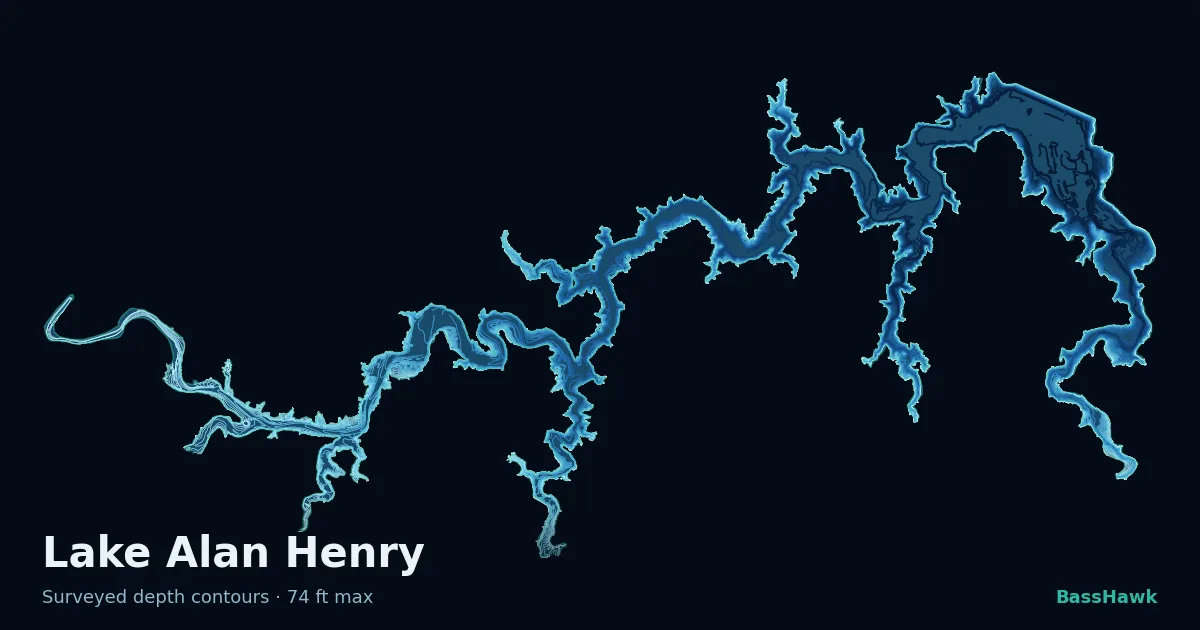
Brutal summer heat pushes fish deep and nocturnal. Hit ledges at first light and after dark, work them vertical on live sonar.
Water's sitting at 98 degrees, way too hot for shallow daytime feeding. Bass are locked onto deep ledges and timber lines where it's cooler and there's more oxygen. The lake's narrow, steep walls concentrate fish on vertical structure instead of broad flats. Pressure's dropping ahead of some weather rolling in, which should fire them up a bit before conditions change. If the cloud cover thickens and wind pushes in, the shallow bite can stretch longer, but don't count on it in this heat. Right now the bite is nocturnal and deep. Work your electronics hard and expect the fish to be suspended off the bottom, not hugging it.
The day's game plan
Where to fish
- Deep main lake ledges — 35-55 ft · Steep rock faces and drops, often with timber scattered along the edge or suspended above.
These are the summer survival zones where bass escape the heat and find cooler, more oxygenated water. Structure concentrates baitfish and gives bass an ambush point. The clear water and narrow lake geometry make ledges the primary deep-water highway. - Creek channel swings and timber lines — 25-50 ft · Inside bends of creek channels with standing flooded timber, bluff walls with timber margins, rock transitions.
Channels are natural highways for bass migration and baitfish movement. Timber on these swings creates shade and cover in summer. The narrow, steep nature of this lake means timber lines mark hard structure edges where bass stage. - Bluff ends and shallow creek timber — 8-20 ft (dusk and night) or 15-30 ft (early morning and late afternoon) · Flooded timber in creek arms, rock bluff walls at their base, steep-sided pocket banks with standing trees.
At night when water cools, bass move into creek timber from deep ledges. Timber is their ambush zone. Creek arms stay slightly cooler and have better oxygen. Bluff ends create transition zones where structure pinches and bass stage before moving shallow.
What to throw
- Minnow-style swimbait — 4-5 in · pearl or shad · 3/8 oz (Early morning and late afternoon when bass start to look up; also deep midday if suspended near structure.)
Drag along the ledge face or work vertically near suspended timber with sonar, slow and methodical. - Drop-shot rig with shad plastic — 3-4 in (plastic only) · natural shad or pearl · 1/4 oz (weight on drop-shot) (Midday deep bite and night bite when visibility is low; also works dusk to early evening.)
Fish it vertically or drag it slowly along the ledge. Keep it right on the cover. Pause and let it sit near suspended fish. - Lipless crankbait — 2.5-3 in · chrome or shad pattern · 1/2 oz (Evening bite when fish start to leave deep-water lockdown and move toward shallower structure.)
Steady retrieve with slight pauses, work around ledge edges and timber. Cover water to find active fish. - Dark finesse worm on shaky head — 4 in · black or junebug · 1/4 oz (head only) (Dusk and night bite when bass move into shallow timber and low light hides your line.)
Skip it under overhanging timber. Fish it on the bottom or suspended near cover. Shake it slightly and let it wobble. - Dark soft stickbait — 5 in · black or junebug · n/a (on drop-shot with 1/4 oz weight) (Dusk through night when bass feed shallow and dark colors shine.)
Rig on drop-shot and fish vertically near shallow timber and bluff walls. Work it with small twitches and pauses.
How to work it
- Forward-facing sonar targeting — All day, but especially midday and early morning when electronics are your only reliable tool to locate pressured, deep fish. · Main lake ledges, creek channels, bluff walls, deep timber lines in 25-55 feet.
Idle slowly along ledges and timber lines with live sonar active. Spot suspended fish among the trees or off the ledge. Mark the return and make a long, quiet cast to present a finesse bait directly above or to the side of the fish. Use natural colors and let the bait fall slowly into their strike zone. - Ledge dragging — Early morning and late afternoon when suspended fish are most active. Also works as a search pattern when sonar isn't available. · Steep ledges and rock transitions on main lake points, channel swings, and bluff walls.
Position the boat at the top of the ledge. Drop down and drag a minnow-style swimbait, small jig, or drop-shot rig along the face of the break. Keep the bait in contact with the structure and maintain a slow, deliberate pace. Let it tick and bump the edge. - Shallow timber skipping — Dusk through early morning when water cools and bass move into timber. After dark is prime time. · Flooded timber in creek arms, shallow bluff walls, and any standing trees in 4-15 feet of water at dusk and night.
Make tight casts under overhanging trees and dock overhangs. Skip a dark finesse worm or small compact plastic under the cover and work it slowly with the rod tip low. Twitch and pause. Let it sit in the thickest shade. - Night shallow feeding — Night after sunset, especially after midnight when water has cooled and pressure is dropping. · Shallow flooded timber in creek arms, 4-15 feet, and rock/bluff base in very shallow water.
Work dark-colored soft plastics slowly through shallow timber and rock. Texas rig a 5-6 inch worm or a small dark swimbait. Cast and retrieve with a crawl, letting them feel the cover. Focus on repetition and precision rather than distance. Fish dense structure only.
Pro tips
- Use your forward-facing sonar aggressively. At 98 degrees, sonar is not a luxury, it's your primary tool. Glass water and deep fish demand precision. Spot suspended fish and present directly. Wasted casts in this heat are wasted time.
- Work the pressure drop. Pressure is falling into the weather, and that usually fires bass up. Expect them to feed more aggressively in late afternoon and evening than they do at midday. This is your window to cover ground with reaction baits before conditions flatten out again.
- Respect the night bite and forget the midday. If you're fishing this lake in summer, plan your day around nocturnal and early-morning feeding. Midday is a waste unless you're running sonar and willing to sit on one suspended fish for 20 minutes and work it vertically. Spend midday resting, refueling, and scouting on sonar for the next evening and night push.
If conditions change
If the front rolls through and the wind picks up hard from the north, cold air will push down the bite and bass will bury in thickest timber. Switch to small dark worms on shaky heads and finesse drop-shots fished super slow, tight to cover. If clouds roll in and the wind lays down, the shallow bite can extend an extra 1-2 hours after dusk because the sun isn't heating the water as fast. If the lake muddies from wind churn or inflow, upsize your baits slightly and go with chartreuse or black for higher visibility. If it clears even more than today, downsize further and lengthen your leader to 8-10 feet, because these bass are already spooky and clear water makes them worse.
Find more fish. This is a real report from that day's conditions — open the app for today's · free account