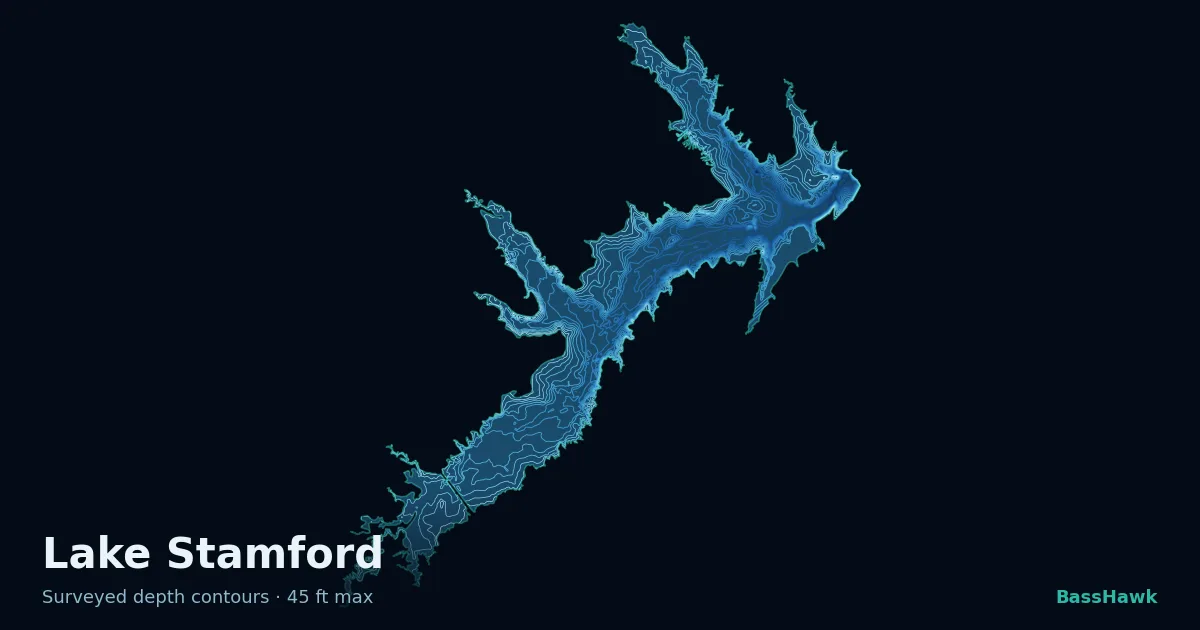
August heat has them scattered and deep, but a few quality fish are out there if you fish early and stick to rock and structure.
Water's 83 degrees and stained, which is typical August on Stamford. The heat keeps bass buried deep or tucked into the thickest cover, and they only feed seriously at first light and last light. During the day they pull into deeper rock and timber to stay comfortable, so numbers are down and fishing is scattered, but the fish that bite tend to be quality. Pool is down 3.2 feet, so the exposed rock, stumps, and bulrush points are more defined and easier to target. Pressure is steady and the light is bright all day, so those early and late windows are everything. If a breeze picks up or clouds roll in, the shallow bite can stretch a little longer, but don't count on it in August heat.
The day's game plan
Where to fish
- Bulrush and cattail points (shallow edges) — 2 to 7 feet · Dense bulrush and cattail stands with hard bottom or exposed rock underneath, tied to creek arms or main lake flats.
These are primary feeding and cover areas in early and late light. The low pool exposes the base of the cover, making it easier to work with jigs and worms. Bass use the cover for shade and hunt the edges during cooler hours. - Rock ledges and drop-offs (main lake) — 8 to 20 feet · Hard bottom shelves and channel edges with exposed rock, especially areas where depth transitions sharply from 10 to 18 feet.
During heat and daylight, bass pull deep to these structure-laden areas for comfort. Rock holds temperature gradients better and gives them escape routes. Spinnerbaits, drop shots, and slow drags all work here when the sun is high. - Creek channel bends and inside turns — 10 to 18 feet · The inside corners of channel bends where bottom composition changes and depth transitions. Often paired with submerged timber or rocky banks.
Channels funnel baitfish and offer quick access between shallow and deep water. Bass stage here during midday and become more active as light fades. Structure definition is high and the low pool makes the relief even more pronounced. - Exposed timber and stumps — 2 to 12 feet · Submerged trees, stump fields, and log piles throughout the main lake, more visible now due to the low pool level.
Timber provides instant shade and cover. In August heat, bass will hold tight to timber in shallower water during early and late light, and retreat to deeper timber during the day. The low water makes these features more defined and easier to target with flipping and dragging techniques.
What to throw
- 5-inch green pumpkin soft plastic worm — 5 in · green pumpkin · 3/16 oz (early/evening) or 1/4 oz (midday) (First light, evening, and early night when bass are shallow or transitioning.)
Texas rig and drag slowly along bottom structure, or pitch into cover and let it fall. Pause frequently. - 3/8 oz spinnerbait, single Colorado blade — n/a · chartreuse and white · 3/8 oz (Morning bite and late afternoon when bass move to mid-depth structure.)
Retrieve steady and slow 6 to 12 inches above bottom. Let the blade thump and create vibration in the murky water. Work the edges of drop-offs and ledges. - 5-inch finesse worm on drop shot — 5 in · white or ghost minnow · 1/2 oz weight, 12 to 18 inches above the worm (Midday when bass are deepest and least aggressive.)
Fish vertically or drag the weight along bottom with small shake movements of the rod tip. Let the worm hover and fall slowly. - 3/8 oz crankbait, square bill — 2 to 2.5 in · chartreuse, white, or sexy shad · 3/8 oz (Morning through mid-afternoon when bass are holding on ledges and points.)
Cast to structure and crank it steadily at a depth of 4 to 8 feet. Let it tick and deflect off rock and timber. Retrieve speed should be steady but not fast. - Topwater popper or stick bait — 2 to 3 in · black, dark green, or natural shad · n/a (Last 90 minutes of daylight and the first 2 hours of night.)
Work it slowly with small pops and walks, keeping contact with structure. Twitch and pause. Don't overdrive it; let the disturbance do the work.
How to work it
- Slow dragging on bottom — Early morning, evening, and anytime during midday when bass are deep and lethargic from heat. · Bulrush points, rock ledges, timber edges, channel bends, anywhere hard bottom is defined by the low pool.
Rig a soft plastic worm on 3/16 to 1/4 oz weight and drag it along structure, pausing for 2 to 5 seconds every couple of feet. Keep the rod tip low and feel for bites. - Vertical jigging or drop shotting — Midday when bass have pulled to deepest available water and won't chase horizontal baits. · Deep rock humps, channel bends, timber-laden points in 12 to 22 feet.
Lower the bait vertically to bottom, shake the rod tip with small movements, let it fall, and repeat. Work it tight to structure. - Topwater working — Last light of day, from 6:30 PM onward, and during night fishing hours. Most effective in the 45 minutes before dark. · Bulrush and cattail points, shallow rock, timber in 1 to 6 feet.
Cast to shallow cover and work the lure with small deliberate pops and twitches, holding contact with the cover edge. Walk the dog if using a stick bait. Pause between retrieves. - Spinnerbait run — Morning and late afternoon when bass are transitioning between deep and shallow water. · Rock ledges, channel drop-offs, points with structure, main lake areas in 8 to 18 feet.
Cast to the edge of deep structure and retrieve steady, letting the blade thump. Work it 6 to 12 inches above bottom on edges of ledges, drops, and humps.
Pro tips
- August is a quality-over-numbers month on Stamford. Don't expect to catch a bunch of fish, but the ones you do connect with in early light or on deep structure tend to be bigger. Fish early and late with intensity, grind the deep structure during the day, and don't waste energy during peak heat between 11 AM and 4 PM.
- The low pool is your advantage right now because it concentrates structure and makes rock, timber, and cover more defined. Bulrush bases are more exposed, which makes them easier to work with jigs and flips. Study where that exposed rock and stump wood is and you'll dial in faster.
- Pressure is steady today, which means no feeding surge from a weather change. The solunar major at 6:51 AM and 7:12 PM are minor boosts in an otherwise tough August day. Fish them if you're already out there, but the early and late light windows are what matter most. The 2:10 PM minor is essentially noise in midday heat.
If conditions change
If clouds roll in and the breeze picks up to 10-15 mph, the shallow bite can stretch 1 to 2 hours later into the morning and start earlier in the afternoon, especially on wind-blown banks. Shift a few baits to the shallower rock and bulrush then. If the water clears up (visibility past 3 feet), downsize your soft plastics to 4 inches, lighten the jig heads, and use natural colors like smoke and ghost minnow, and fish slower because they can see your gear better. If water gets muddier, upsize to 6-inch worms or 1/2 oz jig heads and stick with dark colors like black and junebug to maximize contrast. If you stay after dark, night-light fishing at bulrush and shallow cover is viable if you have a setup; bass will stay shallow and active longer once the sun is gone.
Find more fish. This is a real report from that day's conditions — open the app for today's · free account