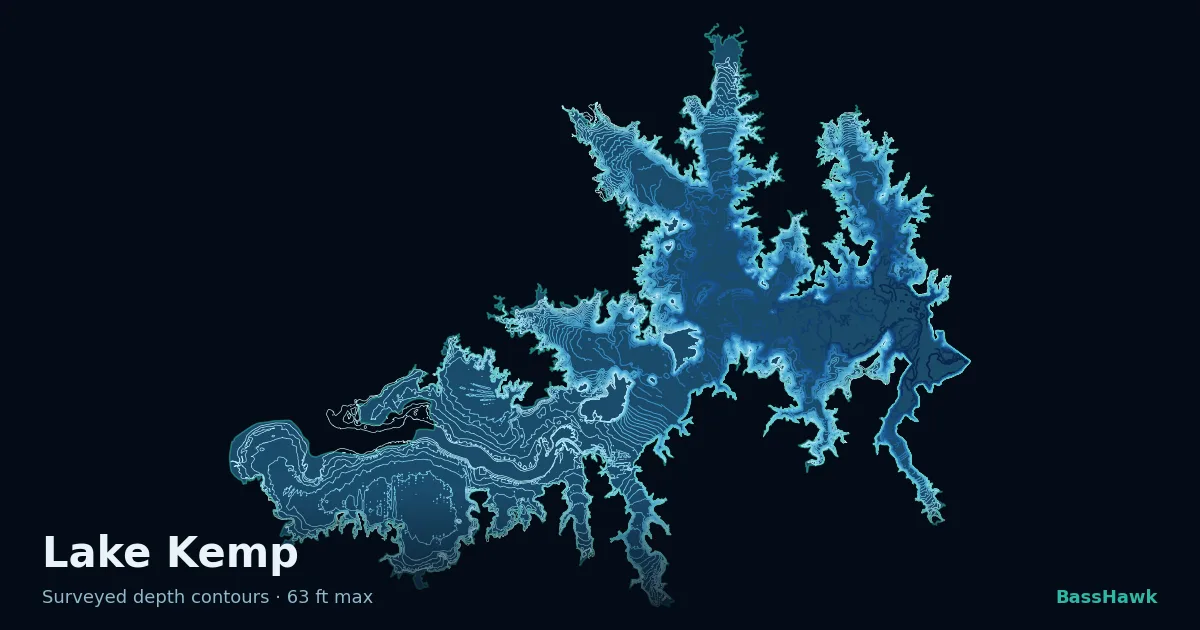
Hot water and falling pressure make early and late your only real bite, drag plastics tight to the brush and riprap.
Water's sitting at 84 degrees, well into summer comfort range for bass but pushing them to the hardest bite of the year. They're tucked deep in shade, under timber, and inside thick brush where the water's coolest and oxygen is best. Pressure's dropping ahead of some weather, which usually fires them up, but the heat and bluebird sun today override that edge. You've got maybe two hours at dawn and two hours at dusk when they'll look up shallow at the brush edges and rocky banks. Midday they go invisible. The flooded brush standing around the lake is holding the bulk of your bass right now, so patience and precision work better than covering water. Work slowly, skip baits into the thickest tangles, and don't overlook the riprap near the dam.
The day's game plan
Where to fish
- Flooded Brush Flats in Creek Arms — 4 to 8 feet, rising to shallower in back pockets · Standing terrestrial brush and vegetation, dense tangles with open gaps where baitfish ambush. Inside bends and dead-end pockets hold the best concentration.
Largemouth stack around flooded brush because it's their primary ambush cover for hunting shad. The brush also provides cooler, more oxygenated water in summer. Shade and structure concentrate prey. This is the most reliable largemouth holding area on the lake year-round. - Rocky Points and Riprap Near the Dam — 3 to 20 feet, depending on the point slope · Large broken rock, crevices, and hard bottom. Some areas have moss and algae growing on rocks. Rocky banks provide sudden depth changes.
Rock creates shade, holds cooler water, and concentrates baitfish. The riprap near the dam is a magnet for both forage and largemouth. Rocky points funnel bass movement between deep and shallow zones. Early and late light makes these areas extremely productive because bass don't mind the exposure when sun angle is low. - Main-Lake Channel Ledges and Points — 12 to 25 feet deep, with structure rising into 8 to 12 feet · Hard bottom transitions, clay or rock ledges, some timber standing on the bottom. Clear depth breaks where the bottom changes composition or angle sharply.
These are the summer sanctuary areas where bass retreat from heat and bright sun. Shad also stack on ledges hunting small forage. Bass position here to ambush prey moving between deep and shallow water. Late afternoon and early evening, these areas become migration highways as bass move toward shallow feeding flats. - Inside Bends of Creek Channels — 6 to 16 feet · Curved channel with inside bend having softer bottom and some brush or timber. Outside bend steeper and harder.
Inside bends create current breaks and sediment traps where forage concentrates. Bass set up on the inside bend edge to ambush. When water cools in fall, these areas become mega-productive because baitfish school here and bass know it. Even in summer, early morning and evening fishing the channel edges pays off.
What to throw
- Texas-Rigged Soft Plastic Worm — 5 to 6 in · Green pumpkin or watermelon red flake · 3/8 oz (Early morning and evening into brush. Dusk topwater if you want to mix in fast retrieves.)
Pitch and skip tight to brush stems and into gaps. Work short hops with pauses. Let it sit 3 to 5 seconds in each pocket before moving to the next. - Crankbait — 2.5 to 3.5 in · Natural shad or pearl · 1/2 oz (Morning transition and late afternoon when bass are between deep and shallow structure.)
Cast parallel to structure. Rip and pause, then steady wind through transition areas. Work edges more than open brush. - Spinnerbait — n/a · Chartreuse or white blade with dark trailer · 3/8 oz (Late afternoon into early evening when bass start moving shallow.)
Cast deep and retrieve steadily up the slope of structure. Cover water methodically. Let blade thump and flash draw strikes from the edges of brush and points. - Topwater Plug or Walking Bait — 3 to 4 in · Dark colors, black or shad · n/a (Dusk and night when light is low. Evening solunar peak at 6:23 PM.)
Walk it slowly across the surface with side-to-side twitches. Work edges of brush beds and riprap. Pause frequently to let the disturbance settle. - Drop Shot with Finesse Worm — 4 in · White, pearl, or watermelon · 1/8 oz (Midday when other presentations fail. Deep water, main-lake structure.)
Vertical presentation on midday deep structure. Drop to the bottom, then twitch upward 6 to 12 inches. Pause 30 to 60 seconds between twitches. Work it on the ledges and rocky points.
How to work it
- Pitch and Skip into Dense Brush — Early morning through mid-morning, and from late afternoon through dusk. Best when bass are positioned to ambush shad moving through brush. · Flooded brush flats and creek-arm timber, especially early and late when bass are shallow.
Use a pitching motion to land the bait quietly into gaps and under overhanging brush. Skip it like a stone to get deeper into pockets that hang above water. Keep the bait tight to wood, not in open water. - Work the Riprap Near the Dam — Morning transition and evening. Riprap holds shade and concentrates baitfish, plus it stays cooler than exposed water. · The dam riprap and any rocky shoreline edges where the bank drops steeply into deeper water.
Cast parallel to the rock wall. Rip your crankbait or plastic through the crevices with sharp upstrokes, then pause. Walk it methodically so you work every pocket. - Transition Depth Fishing on Main-Lake Points — Late afternoon and early evening when bass are migrating between deep sanctuary and shallow feeding flats. Fall is peak for this. · Main-lake rocky points and channel ledges between 8 and 16 feet.
Locate the outside edge of a rocky point where it drops from shallow to deep. Cast upslope and retrieve parallel to the break. Fish the middle depth where bass set up before committing deep or sliding shallow. - Dead-Stick Live Bait on Deep Structure — Midday when finesse plastics aren't working. When water is too hot for aggressive fishing. Live bait keeps bass from completely shutting down. · Deep open-water timber and brush, 18 to 25 feet, on main-lake rocky points.
Thread a live shiner on a light jig head or nosehook rig. Drop it 2 to 3 feet above deep brush or timber using a slip sinker. Let it hang with minimal movement. Twitch it every 30 to 60 seconds if bites slow.
Pro tips
- On a hot day with bluebird sun like today, don't waste time between dawn and dusk grinding open water. Scout your evening bite instead, locate the thickest brush patches and riprap stretches, and plan to execute during the feeding windows. Quality of presentation in 90 minutes of good light beats eight hours of mediocre fishing in heat.
- Falling pressure before a front is trying to turn on the bite, so don't bail just because it's hot. The early morning and late evening bites will be sharper than usual because of the pressure drop. Commit to those windows hard, use reaction baits in the afternoon transition, and you'll connect with more fish than you would on a stable high-pressure hot day.
- The flooded brush here is your confidence zone. Bass are always around it, season to season. Learn three or four thick brush beds intimately. Know their depth, their pocket layout, which direction they face. When the lake conditions shift, those spots adjust predictably, and you'll find bass faster than anglers throwing blind.
If conditions change
If a strong front rolls through and clears the sky after sunset, the bite will slow considerably. Shift immediately to the densest timber and brush on deep structure, downsize plastics to 4 inches or smaller, and drag a drop shot slowly on the bottom. Post-frontal fishing will be grind-it-out slow. If wind picks up out of the south and stays, shallow sunny banks can actually extend your window a bit because moving water stirs oxygen and pushes baitfish toward the riprap and exposed banks. Fish those banks aggressively during the otherwise dead midday hours. If water clears beyond 6 feet, lighten your terminal tackle and switch to more natural, translucent colors. If it stains (rain upstream), use darker colors and slightly faster retrieves to generate vibration and help bass track your bait. The brush pattern stays productive no matter what, so always anchor your day around it.
Find more fish. This is a real report from that day's conditions — open the app for today's · free account