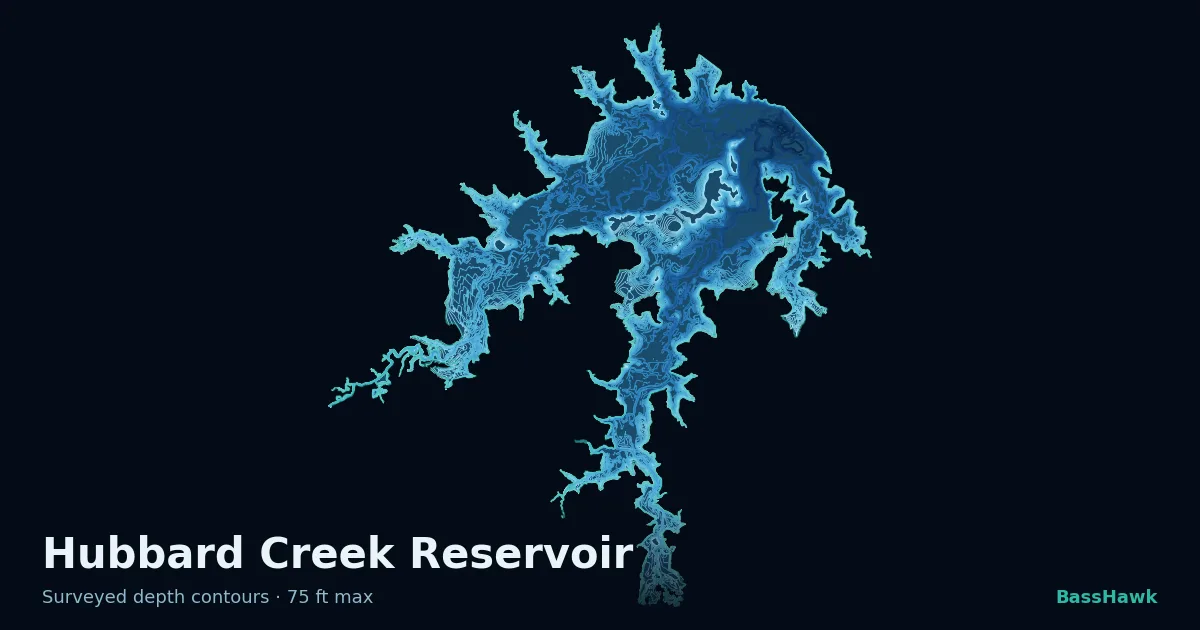
Extreme heat has bass buried, hunt deep shade and structure dawn to dusk or stay home.
Water is brutally hot at 102 degrees, well past where largemouth want to be. They are pulled deep into the creek channels and around the thickest timber and brush piles to find cooler water and escape the sun. This is pure survival mode. The lake is 16 feet below pool, concentrating everything into the remaining deep structure. Stained water and falling pressure before some weather rolls in might spark a brief window at dawn and dusk, but expect slow fishing and mostly smaller fish on soft plastics worked tight to cover. The vast majority of your day will be dead unless you find shade, depth, and timber. Pick apart brush piles on the deeper creek arms and skip soft plastics underneath any overhead cover you can reach.
The day's game plan
Where to fish
- Hubbard Creek main channel — 15-25 feet at drop-off, 8-12 feet on upper flats · Submerged timber, brush piles, defined channel banks where depth transitions are sharp.
Primary migratory highway. Bass stage and hold on the channel edges and deep bends because water is cooler and they have quick access to shade and escape routes into timber. - Sandy Creek arm deep zones — 18-28 feet at deepest, 12-18 feet on mid-channel ledges · Submerged brush, fallen timber, creek-bottom contours with hard substrate.
The second deepest creek arm. When water is this hot, the back of the creek arms offer the deepest available shade. Bass pull in here to stay comfortable. Less traffic than main lake. - Dam structure and overflow rocks — 20-30 feet immediately adjacent, shallower rocky zone 8-14 feet · Concrete structure, riprap, rocky ledges, defined depth zones with shade from spillway.
Coldest water in the lake due to inflow from bottom discharge. Shade from dam structure itself. A magnet for deep bass and occasional bigger fish seeking relief from surface heat. - Deeper brush piles on creek arms — 16-22 feet · Submerged timber and brush with open water nearby providing depth access.
Concentrated cover in cooler, deeper water. Reports consistently show bass feeding on soft plastics in brush piles year-round here, and in summer heat this pattern intensifies. Bass are stacked tighter around these piles when water is this hot.
What to throw
- Green pumpkin or watermelon soft plastic worm — 5 in · green pumpkin or watermelon red flake · 3/8 oz on Texas rig (Early morning, late afternoon, entire day when keyed to brush piles.)
Drag slowly along brush and timber on bottom, pause 2-3 seconds between pulls, work methodically through cover. - Dark craw soft plastic — 3-4 in · black or dark brown · 3/4 to 1 oz jig head (Midday deep water, all day on jigs near timber and channel ledges.)
Drag slowly on bottom or fish vertically near deep structure, let it fall naturally on semi-slack line. - Small paddle-tail swimbait — 3-4 in · natural silver, pearl, or dark patterns · 1/2 oz on Carolina rig or 3/8 oz on jig (Morning and late afternoon transitions, Carolina rig in morning and afternoon, jig-mounted at dusk.)
Drag on a Carolina rig along bottom contour with rhythmic pauses, or twitch a jig-mounted version with sharp movements. - Small topwater lure — 2.5-3.5 in · natural patterns or dark silhouette · n/a (Dusk only, last 45 minutes before dark.)
Work near structure at dusk and dawn with deliberate pauses, steady cadence, trigger strikes with sudden twitches near timber. - Deep-diving crankbait — 2.5-3.5 in · natural shad patterns or dark · 0.5-0.75 oz (Deep water midday on channel ledges, not a primary bait in this heat but viable as a search tool early morning.)
Cast and retrieve along deep channel edges and hump structure, work bottom contact, retrieve slowly with pauses.
How to work it
- Drag and pause on bottom — All day, primary technique for soft plastics and jigs in heat. · Brush piles, timber, channel ledges in 12-25 feet
Cast near structure, drag bait slowly along bottom with 6-12 inches of pull, stop for 2-3 seconds, repeat. Minimize slack and feel bottom contact constantly. - Vertical jigging near timber — Midday and any time bass are stacked vertically on cover, especially if depth is limited nearby. · Deep timber, brush piles, dam structure, 18-28 feet
Position boat tight to timber or brush, drop jig straight down, jig 12-18 inches with sharp upstrokes, lower on slack, repeat. Fish semi-slack line to detect subtle strikes. - Carolina rig drag on contour — Morning and late afternoon, primary search technique when bass are not tightly schooled. · Creek channels, channel bends, deeper flats with structure, 12-20 feet
Cast uptide or upstructure, reel slowly keeping slight tension, let sinker bounce bottom naturally, pause every 10-15 feet of retrieval, work the outer edges of structure. - Topwater trigger near dusk — Last 45 minutes before sunset only. · Shallow structure, rocky areas, timber near deeper water, 6-12 feet
Cast within 2-3 feet of timber, shaded banks, or structure. Walk or twitch lure with 1-2 second pauses between strokes. Create commotion near cover, trigger strikes with sudden movements.
Pro tips
- In 102-degree water, forget about efficiency and aesthetics. You are not working a pattern, you are hunting individual fish. Hit the deepest brush pile, the deepest timber on a ledge, the darkest shade you can reach. Spend 10-15 minutes picking it apart with drags and jig drops. If nothing bites, move to the next deep structure 50-75 yards away. Patience on one spot beats speed.
- Water this hot will stay near 102 for many hours after sunset. If you are fishing, stay on the water through dusk and into early night if you can stomach the heat. The brief cooling windows at dusk and at the very end of night are worth the effort. Otherwise, fish hard early morning only and call it a day.
- The lake is 16 feet below pool. Confirm your ramp is usable before you launch, and expect shallow water to be exposed. Use that to your advantage. Any exposed structure or rocky area where shade lands is a high-percentage spot. Pressure is falling, so if a front rolls through this afternoon or tonight, the bite may briefly improve tomorrow morning.
If conditions change
If a front blows through and the pressure rises sharply, bass will bury harder in the thickest cover available. Downsize to 4-inch finesse worms and fish even slower, right on timber and inside brush. If the wind picks up from the south, any south-facing banks may attract slightly more active fish due to warmer water and baitfish accumulation, but in 102-degree water this is a minor edge. If clouds roll in and the sun is blocked, shallow structure can improve briefly because direct sun is the main driver of the deep bite. Lengthen your midday period and spend more time on structure in 10-16 feet. If the water muddies from rain runoff, switch to dark colors and slightly larger baits to improve visibility. Never abandon the deep structure and brush piles, they are your only consistent bet in this heat.
Find more fish. This is a real report from that day's conditions — open the app for today's · free account