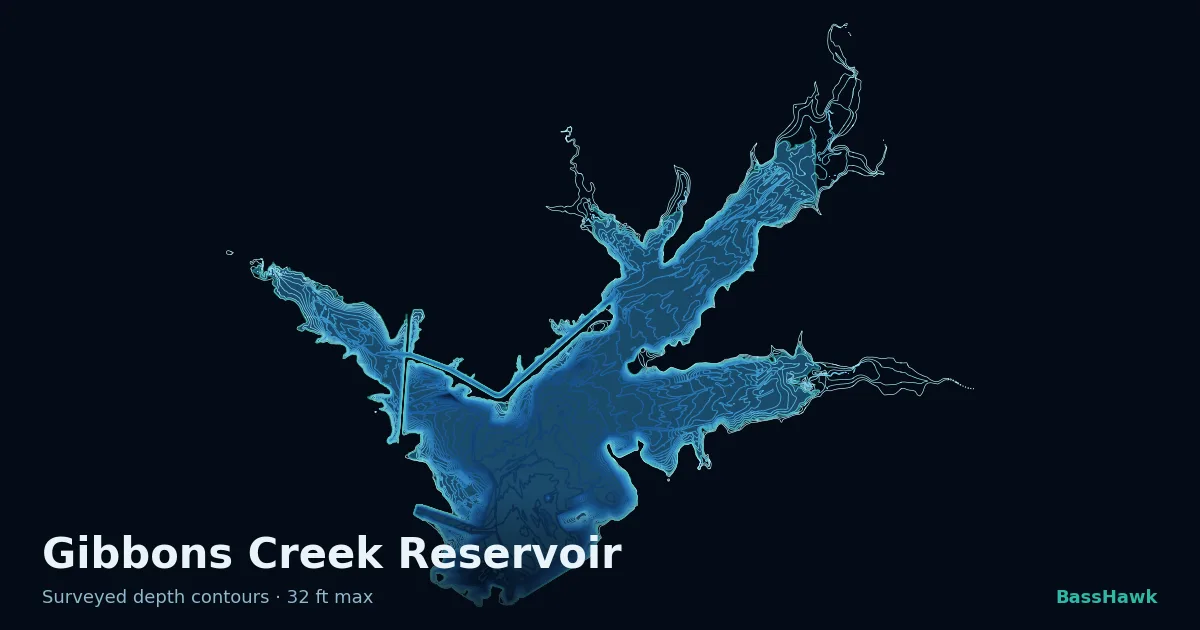
First light is your only window. Midday heat shuts it down completely. Work deep brush before sunrise, then go home or hunt the thickest cover you can find.
Water's pushing 95 degrees, so largemouth are in full summer survival mode. They're pulled deep into brush and timber during daylight to stay comfortable, and they only look up early and late when light is softer and water near the surface is cooler. The lake is stained, which helps keep things a shade cooler in the shallower stuff. Pressure's dropping ahead of some weather coming in, so they're a bit more willing than they would be otherwise, but heat overrides everything right now. You get a narrow window at first light and again at dusk, and the rest of the day you're fighting both the sun and their body telling them to sit still and wait. Your only chance midday is to fish the densest, darkest cover you can reach and move very slowly.
The day's game plan
Where to fish
- Main Lake Channel Edges and Drops — 18 to 28 feet on the drop, basin below 20 feet · Submerged timber, channel swings, hard-bottom edges where main lake drops to deep basin
Largemouth hold on these transitions because they offer quick access to deep cooler water while still being close to shallower hunting zones. In summer heat, they position on the edge where they can drop down fast if needed. - Secondary Points in Creek Arms — 12 to 22 feet · Brush, timber, hard bottom, points that jut into creek channels
Secondary points are the highways for largemouth moving between deep winter structure and shallow feeding zones. In summer they stack up on these waiting for cooler light periods. Proximity to deep water makes them security. - Submerged Timber and Brush Piles — 8 to 22 feet, deepest shade available · Fallen trees, standing timber, brush tangles, layered cover
Dense shade and shelter are largemouth's only refuge in extreme heat. They sit in the thickest wood where light penetration is minimal and water stays cooler. This is where finesse presentations pay off and where midday bass live.
What to throw
- Dark Jig and Trailer — 3/8 to 1/2 oz jig head · Black or junebug with dark purple or black trailer · 3/8 to 1/2 oz (Early morning, transition periods, and throughout the day when bass are deep and tight)
Drag along bottom and around timber, keep contact with structure, work slowly with short hops - Chartreuse and Black Spinnerbait — n/a · Chartreuse blade with black skirt · 3/8 to 1/2 oz (Early morning and evening when bass are positioning and willing to chase)
Slow roll along channel edges and drops, let it reach depth, steady retrieve - Dark Soft Plastic Worm — 6 to 7 inches · Black, dark green, or junebug · 1/2 oz texas rig (Morning into midday and whenever bass are deep and inactive)
Texas rigged, dragged slowly on bottom, light contact, pause often - Shaky Head with Small Soft Plastic — 3 to 4 inch plastic · Watermelon, watermelon seed, or dark green · 1/8 to 3/16 oz jig head (Midday when heat is highest and bass are locked into thick cover)
Light vibration on bottom, short hops, long pauses, minimal movement - Dark Topwater — n/a · Black or dark colors · Topwater (buoyant) (Dusk and evening as light fades and water cools)
Walking retrieve, jerking cadence, or popping, worked over shallow structure in low light
How to work it
- Slow Dragging Through Structure — Morning through midday, whenever water is hottest and bass are tight to cover · Deep brush, timber, channel edges, 15 to 25 feet
Keep bottom contact, crawl the bait through wood and brush with pauses, use minimal rod movement - Vertical Presentation in Thick Cover — Peak midday hours when largemouth won't chase and must be fished right on their nose · Dense timber and brush piles, 15 to 22 feet, layered cover
Drop directly into or alongside the densest wood, work small baits with slight jigging motion, stay vertical - Slow Roll Spinnerbait Along Drops — Transition periods in early morning and late afternoon when bass are beginning to move between zones · Channel edges, secondary points, drop-offs, 18 to 24 feet
Cast uptide or along the ledge, let it drop to near bottom, retrieve steadily with rod tip at 3 o'clock, maintain blade contact - Topwater and Reaction Over Shallow Structure — Dusk and evening as light fades and water cools, when largemouth are actively hunting baitfish · Shallow flats, timber in 4 to 10 feet, near structure
Cast to visible brush or timber in shallows, work with walking strokes or sharp pops, maintain cadence, fish close to cover
Pro tips
- The pressure drop ahead of weather is working in your favor right now. Bass are slightly more willing than they would be in stable high pressure, but don't mistake that for a lockdown bite. Heat still dominates. Use the pressure help to get bites in early morning and evening, but respect that midday is dead even with falling pressure.
- Work the deep side of your target structure first. Bass are pushed deep by heat. Shallow presentations and shallow structure will produce fewer fish in August than dropping to 20 feet and working timber systematically. Don't waste early morning light fishing 6 feet of water.
- If you see schooling activity or baitfish busting on the surface, that's usually white bass or other species, not largemouth. Largemouth in this heat are solo or paired up deep in cover. Don't get distracted chasing surface activity. Stay focused on structure and shade.
If conditions change
If the pressure front actually moves through and temperatures cool 5 to 10 degrees, largemouth will move shallower and bite longer throughout the day. Shallow brush will hold fish, and you can work transition periods with more standard presentations. If the pressure stabilizes at high, fishing gets even tougher midday, so shift even deeper into thickest cover and downsize baits further. If you get unexpected cloud cover and cooler air, the shallow bite can extend into midday slightly. Wind out of the south will warm surface water more, pushing bass deeper, so lean harder on deep timber. North wind would cool things slightly and give you a longer window, but don't expect dramatic change in August heat. Stay flexible on bait color. If clarity improves after a rain, go darker and more subtle. If it muddies, jump to chartreuse and add vibration with bladed baits.
Find more fish. This is a real report from that day's conditions — open the app for today's · free account