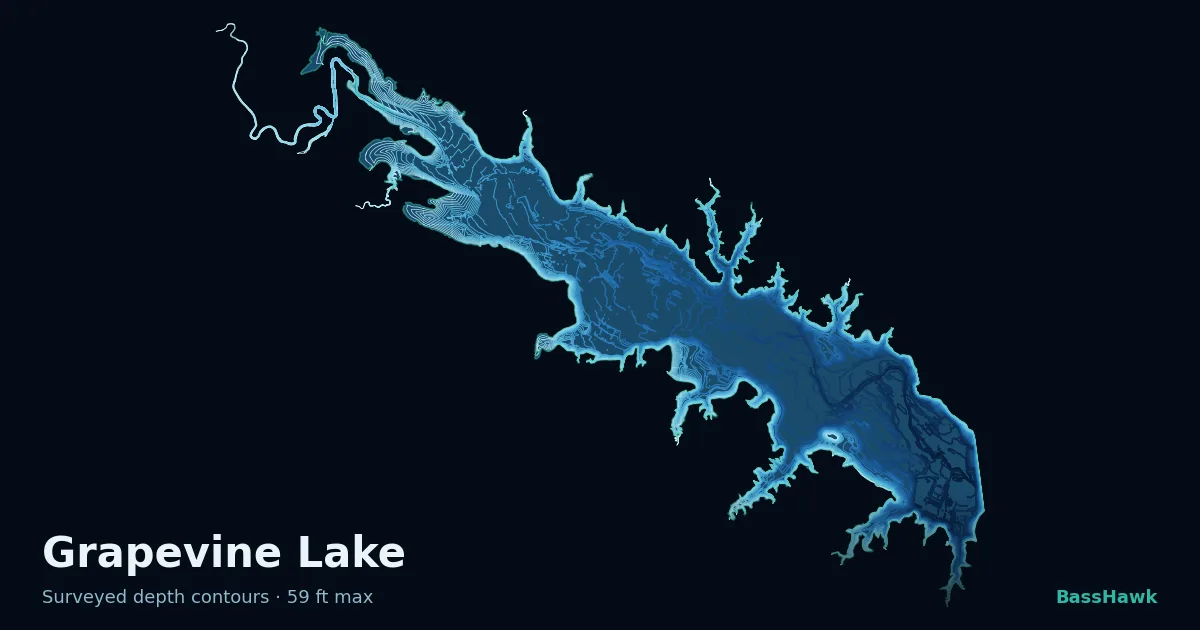
Summer heat at 92 degrees keeps largemouth tight to shade and structure, bite early and deep before sun spikes
Water's in that uncomfortable heat zone, well above what they like, so the bass are pulled deep into timber and on rocky breaks where there's shade and cooler water. This time of year they feed mostly at dawn and dusk, and you won't find many willing to eat in full sun unless they're locked on shade. The pressure is dropping ahead of some weather, which will juice the bite a little, but the real edge today is getting in front of them before the sun gets high. Clear water means they can see you coming, so finesse and accuracy matter more than noise. Pool is down about a foot, which tightens the pattern a bit, so focus on structure with deep water access. If you can get them to commit during the early window when it's still cool, that's your day.
The day's game plan
Where to fish
- Twin Coves Timber — 2 to 15 feet, transition to 20+ foot channels nearby · Flooded timber and submerged wood throughout, with open water above for shad movement, proximity to deep water channels
Flooded timber holds shade and breaks up the water column, attracting largemouth in heat. Early and evening light filters through timber creating depth transitions that bass hunt. Access to deep water channels allows fish to retreat and recover during the hottest part of the day. - Rocky Main-Lake Banks and Points — 2 to 28 feet with hard-bottom drop-offs and ledges · Submerged boulders, rock formations, and rocky shoreline creating natural shade and feeding edges
Rock absorbs and radiates heat, but undercut banks and deep boulder piles offer shade and cooler water. Bass use rocky structures as ambush points along migration routes. The hard bottom concentrates baitfish, and the depth variation allows fish to adjust based on heat and light. - Mid-Lake Humps and Ledges — 18 to 28 feet, hard bottom, sides steeper than tops · Rocky and hard-bottom humps with adjacent deeper channels, often with scattered timber or rock
When surface water is hot, largemouth retreat to humps and ledges where deeper cooler water is accessible and structure holds shade. The sides of humps (not the tops) provide feeding edges where baitfish and ambush predators meet. Depth and structure proximity allow quick adjustment between shallow and deep as temperature cycles through the day. - McPherson Slough Docks — 2 to 12 feet near docks, channels 15+ feet nearby · Boathouses, docks, pilings, and undercut banks with night lighting and timber backdrop
Docks provide overhead shade during the day and attract baitfish at night via lights. The structures concentrate largemouth for predictable positioning. After dark, lights draw small forage, triggering feeding. Early morning shadows cast by docks create cool refuges before the sun is high.
What to throw
- 4-inch Finesse Worm — 4 in · Watermelon or Green Pumpkin · 1/8 to 3/16 oz (Early morning, evening, and transition periods when light is lower and fish are shallow)
Shaky head rig, dragged slowly on bottom or shallows, paused for 5-10 seconds between movements - 5-inch Shad Swimbait — 5 in · Shad or Pearl · 1/4 oz (Morning when fish are sliding from shallow to deep, and dusk when they return to shallows to feed)
Steady retrieve along structure transitions, covering ground from shallow to deep. Let the lure follow the contour of the bottom and rock/timber. - Jigging Spoon with Trailer — 3/8 to 1/2 oz · White or Chrome with White or Pearl Trailer · 3/8 to 1/2 oz (Midday and early afternoon when fish are locked on deep structure in 18-28 feet)
Vertical jigging on humps and ledges, ping the bottom and rock structure, short hops and pauses. Maintain bottom contact and let vibration attract fish. - Drop Shot Rig — 3 in · Watermelon or Smoke · 1/8 oz (Late afternoon when sun is highest and fish are most lethargic and buried in structure)
Vertical or slight horizontal movement, shake and pause, worked very slowly on the bottom near structure. Keep the weight on the bottom and let the worm hang and flutter above it. - Dark Topwater or Crankbait — 2 to 3 in · Black or Natural · n/a (Dusk and early night when light drops and bass move shallow to feed, especially near dock lights or shallow timber)
Cast near docks and timber at dusk and night, work with short twitches and pauses if topwater, steady slow retrieve if crankbait. Keep noise moderate and work shallow edges.
How to work it
- Vertical Jigging on Humps — Midday and early afternoon when fish are deepest and most inactive, temperature is hottest · Main-lake humps and rocky breaks, especially where structure has a hard bottom and adjacent deeper water
Position directly over a hump or ledge in 18-28 feet, drop spoon to bottom, jig with short 1-2 foot hops while maintaining bottom contact. Pause for 2-3 seconds between hops. Feel for hits as the spoon falls. - Shallow Timber and Rock Picking — Early morning and evening when light is low and bass are shallow hunting or resting in shade · Twin Coves timber, rocky banks on main lake, secondary points near creeks, anywhere with overhead shade or structure
Cast to within 12 inches of timber, rocks, and banks. Work the lure slowly along and through the structure, pausing frequently. Stay tight to cover and move progressively along the break. - Transition Zone Hunting — Mid-morning into early afternoon as fish slide from shallow structure toward deeper holding areas · Creek channels, point shoulders, main-lake structure with adjacent deep water access
Identify depth changes from 6 feet to 15 feet, especially on creek channel bends and point shoulders. Work a crankbait or swimbait that reaches the depth zone, covering the drop-off and the deeper flat below it. Move deliberately. - Slow Shake and Pause — Early morning and evening, anytime water is cool enough for shallow feeding, especially during transition windows · Any shallow structure, rocky banks, timber edges, points in 2-12 feet
Cast finesse worm or small swimbait to structure, work with a tight line, use small vertical shakes of the rod tip while pausing for 5-10 seconds. Imitate an injured or resting forage item. Repeat along the structure. - Night Dock and Light Fishing — After full dark when lights draw baitfish and bass feed openly, especially in the 8:30 PM to 11:30 PM window · McPherson Slough docks, other accessible dock systems, shallow timber edges near lights, undercut banks
Position near dock lights or pilings in water 2-8 feet deep, cast toward the light and undercut banks. Work dark-colored baits slowly, letting them soak near the light and structure where small baitfish gather. Search multiple docks methodically.
Pro tips
- In extreme heat like this, the difference between early morning and mid-morning is huge. Getting on the water by 6:50 AM gives you the best window of the entire day. Water is coolest, fish are most willing, and the shade is deepest. Waste the midday grind on depth and structure jigging rather than chasing shallow water.
- Pressure is dropping today ahead of weather moving in. This should add aggression to the bite, especially during transition periods like early morning and dusk. Fish may be willing to move and chase a little more than typical for this heat. Take advantage of it early and late.
- Clear water means fluorocarbon leader is critical. Largemouth can see braid and monofilament, especially in shallow zones and around structure. 8 to 10-pound fluoro on a spinning setup will reduce refusals and missed opportunities in the shallows.
If conditions change
If a cold front moves through and the pressure rises sharply, dial way back. Fish will bury in the densest timber and deepest cover, and the bite will shut down for 24 to 36 hours. Downsize to a 3-inch worm on a drop shot, fish 20 to 28-foot humps and deep timber, and slow everything down even more. If the wind picks up from the south or southwest, it will warm the water slightly and keep baitfish pushed toward those banks. Focus on wind-blown rocky banks and timber early and late. If clouds roll in and cool the sun, the shallow bite will stretch longer into the day and dusk will fire earlier. Increase retrieve speed and work more structure in 6 to 15 feet rather than running deep baits all day. If the lake gets stained from any creek flow or run-off, switch from watermelon and green pumpkin to dark colors (junebug, black) or bright contrast (white, chartreuse) and increase vibration by adding a spoon or blade.
Find more fish. This is a real report from that day's conditions — open the app for today's · free account