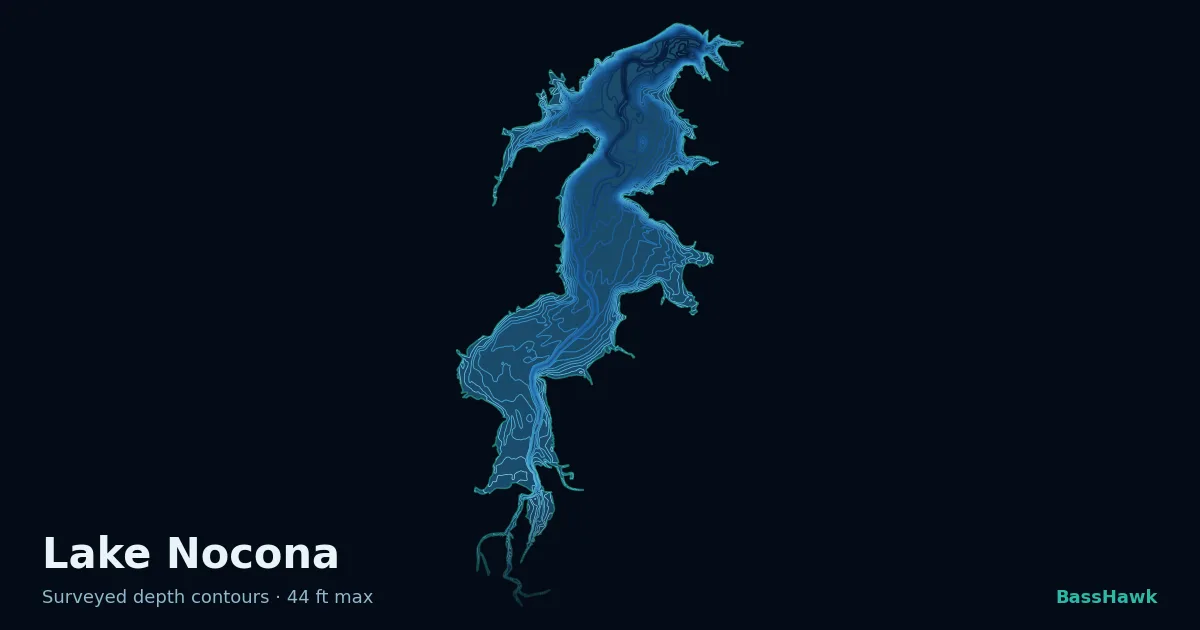
Hot summer water and bluebird sun mean tight windows. Early and late only, work the deep shade and vegetation edges hard.
At 89 degrees the water is way too warm for active feeding during the day. This is survive-mode water. Bass are locked in the thickest shade they can find, deep docks, heavy timber, thick vegetation, or down on ledges where it's cooler. The pressure is steady and the sun is brutal with no clouds, so there's no help coming from light or weather swings. Your real bite is pinched into early morning before the sun climbs and late evening after it starts dropping. In those windows, fish will look up shallow and feed. Between sunrise and roughly 9 AM and then again from about 5 PM on, you can catch them. The rest of the day is a grind unless you're working deep and tight to cover where the water stays tolerable.
The day's game plan
Where to fish
- Farmers Creek Arm Vegetation and Docks — 2 to 8 feet · Cattails, water willow, laydowns, boat docks, standing timber. Shallow flats transitioning to deeper timber.
Best early-morning and evening shallow water on the lake. Holds the bulk of forage and attracts bass when they feed shallow. Cattails provide shade and ambush points. - Main-Lake Points and Secondary Points — 8 to 20 feet · Hard bottom transitions, timber, baitfish migration routes from shallow flats to deep channels.
Funnel bass movement. Points give fish quick access to deep water when midday heat forces them down. Fish the inside of secondary points early and late, outside main-lake points midday. - Rocky Ledges and Channel Bends Near the Dam — 18 to 30 feet · Rip-rap, hard bottom, steep drop-offs, channel ledges with texture.
Deepest, coolest water on the lake. Holds bass when surface water is 89 degrees. Water quality and oxygen are better at depth. Vertical presentations dominate here. - Deep Boat Docks and Pilings — 6 to 15 feet · Wooden docks with shade, pilings, cover underneath. Docks positioned over deeper water.
Best all-day refuge. Shade and cooler water directly underneath. Bass hold tight. Slow wacky worms and drop shots work. Skip baits under docks if current is low.
What to throw
- Soft Jerkbait — 4 to 5 in · Pearl or Shad · n/a (Early morning, evening, and dusk. Especially good when bass are not aggressive.)
Cast and twitch with 2 to 3 second pauses. Let it sink slightly between twitches. Work it both shallow (early and late) and suspending at depth (midday). - Wacky Worm — 5 in · Green Pumpkin or Watermelon · n/a (Midday, midmorning, and late afternoon. Any time fish are inactive and deep.)
Rig on a shaky head, 1/4 oz, or drop shot, 1/8 oz. Drag slowly along bottom or suspend under heavy cover. Barely move it; let the tail vibration do the work. - Topwater Popper — 2 to 3 in · Black or Bone · n/a (Dusk and early evening, 5 PM onward. Last light and early dark.)
Cast to specific cover, pause 3 to 5 seconds, pop once or twice, pause again. Work it very slowly. Do not chug it fast. - Drop Shot with Finesse Worm — 4 in · Pearl or White · 1/8 oz (weight only) (Midday and midmorning when bass are deep and inactive.)
Rig worm on small drop shot hook 12 to 18 inches above the weight. Work it vertically or in small horizontal sweeps just off bottom. Shake the rod tip while holding position. - Crankbait — 2 to 2.5 in · Shad or Natural · n/a (Late afternoon into early evening, when fish are transitioning shallow.)
Cast and retrieve at a steady slow roll. Keep it in the 12 to 18 foot diving range. Bump it off timber and bottom without aggressive hunting.
How to work it
- Early-and-Late Feeding Windows — Summer with high water temps. This pattern is locked in from mid-June through August. · Shallow structure, vegetation, and docks during dawn and dusk; deep timber and ledges during midday.
Fish hard and aggressively during the first 2 to 3 hours after sunrise and the 2 to 3 hours before sunset. Use faster retrieves, cover water, and hit topwater. Between these windows, slow down and go deep. - Tight-to-Cover Fishing — All day, but especially midday when bass refuse to leave shade. Skip baits under docks if safe. · Anywhere heavy shade is present: docks, overhanging timber, dense vegetation.
Cast directly to boat docks, under limbs, into thick timber, and along weed edges. Work the bait slowly and deliberately. Make multiple casts to the same piece of cover from different angles. - Vertical Drop Shot in Deep Water — Midday when bass are locked on bottom in cooler layers. Patience over speed. · Deep ledges near the dam, channel swings, deep timber in 18 to 30 feet.
Position over structure (ledges, channel bends, deep timber), drop the rig and work it up and down with slight rod shakes. Hold depth and let the bait do minimal horizontal movement. - Shade Layering — Clear bluebird days when shade is the only escape from sun. Overcast days compress this pattern. · Any structure with overhead cover that changes position throughout the day.
Fish shallow shade first (docks, timber), then mid-depth shade (boat houses in 8 to 12 feet), then deep shade (ledges in 20 to 30 feet). Follow the sun shadow as it moves. Early and late, shallow; midday, deep.
Pro tips
- At 89 degrees, oxygen and shade are everything. Skip docks with direct sun exposure no matter what. Hunt for docks positioned under trees or facing north. The angle of shade matters more than the dock itself.
- Threadfin shad are abundant this year. Stay on baits that match a 2-inch to 2.5-inch profile. Oversize baits will catch fewer fish in summer heat when bass are conservative. Small and slow beats big and fast.
- The 1:43 PM solunar major falls right at the worst part of the day. Ignore it. Your real window is the gap between dusk minor (8:36 PM) and dawn. If you can stay until after dark, the evening into night bite often outlasts the eclipse of midday.
If conditions change
If a front rolls in and pressure drops before tomorrow, disregard this entire plan. Pre-frontal feeding is aggressive and all-day. Fish everything shallow and fast. If clouds roll in and cool the air significantly, shallow vegetation can fish all morning, not just until 9 AM. If wind picks up and clouds build, the midday bite extends and the early bite may not fire until clouds thicken. If water stains from rain or runoff, shift to chartreuse or white-tipped trailers and widen your blade for more thump on the spinnerbait if you choose to use one. If the pool drops further (already at minus 4), expect bass to stack tighter on deep structure because shallow flats become isolated. If wind direction shifts to come from the north and cools things by even 2 to 3 degrees, early bite extends and evening bite stretches longer. At 89 degrees, every degree cooler is a 15 minute window gain.
Find more fish. This is a real report from that day's conditions — open the app for today's · free account