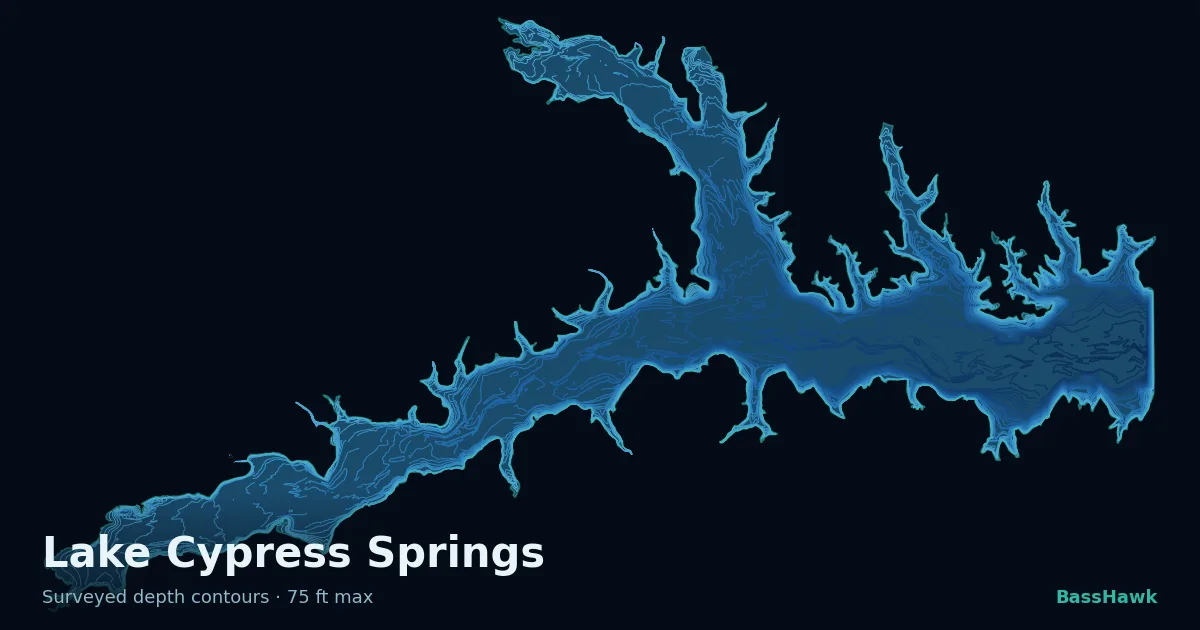
Peak summer heat shuts down daytime bass. Fish deep structure at dawn, dusk, and night.
Water's at 95 degrees and screaming hot. This is survival mode for bass. They're pulled deep to cooler water around 18-20 feet on main lake points and timber lines where they can hold tight until first light or after dark. The lake's clear and stained normal, so sight plays a role, but the heat is the story. A falling pressure ahead of weather coming in can fire them up for a window or two, but don't expect much during the blaze. Pressure's dropping, which should help, but it won't override 95-degree water. Bass feed hard at dawn before the sun punches, again at dusk when the surface starts cooling, and stay most active after dark. Daytime is a waste of energy unless you're working very deep or fishing docks and shaded timber with finesse presentations. Night fishing under lights is your best shot for consistent action.
The day's game plan
Where to fish
- Main lake points (18-22 feet) — 15-25 feet · Hard bottom, transitions from point flat to channel, scattered timber and brush.
Bass stage and hold on points year-round. In summer heat, they use the deep edge of points as daytime refuges and feed along them at dawn, dusk, and night. Points funnel fish movement and hold bait. - Channel swings and bends (20-25 feet) — 18-28 feet · Inside bends of creek channels, drop-offs, timber lines along the channel edge.
Channels are migration highways. Inside bends create current breaks and shade. Fish use them to move between deep water and feeding flats. Deep channel bends are security for heat-stressed bass. - Docks with underwater lights — 10-15 feet (light zone) to 20+ feet nearby · Pilings, riprap under docks, adjacent timber.
Lights concentrate bait and attract bass hunting at night. Docks provide shade during the day and structure for ambush. Night fishing docks is the most consistent summer pattern. - Deep timber and brush piles (20-25 feet) — 20-28 feet · Standing dead trees, submerged brush, laydowns in the deepest part of the lake.
Densest shade and coolest available water. Bass bury here during midday heat. Vertical jigging works best. This is survival habitat in extreme heat.
What to throw
- Jig with craw trailer — 3/8 oz · black, dark blue, or junebug · 3/8 oz (Early morning, late afternoon, night fishing. All depths 15-25 feet.)
Drag on bottom, short hops, work timber and point transitions. Keep contact and shake gently. - Texas rig worm — 4 in · green pumpkin, smoke, junebug · 1/4 oz (pegged) (Early morning around timber, dusk on dock pilings, night anywhere.)
Pitch to timber, let fall naturally, work with slow drags on bottom. Pause often. - Drop shot rig — 2 in · smoke, green pumpkin, pearl · 1/4 oz (sinker) (Morning bite on timber, midday vertical work on deep brush, any time you're holding tight to deep structure.)
Suspend vertical near timber, shake the rod tip subtly, let the weight tick bottom occasionally. Small shakes, long pauses. - Topwater (Zara Spook-style walk-the-dog) — 2.5-3 in · bone, pearl, dark patterns · n/a (Evening window 5:45 to 7:30 PM when bass are rising and water is cooling.)
Work with subtle side-to-side walks, let it rest 2-3 seconds between pops. Low-energy retrieves. - Small dark crankbait — 3 in · black, dark blue, junebug · n/a (Morning to midday on deeper timber, evening dusk on shaded banks.)
Crank down to 15-20 feet and hold depth, work slowly near timber. Tick wood and let it deflect naturally.
How to work it
- Vertical jigging on deep structure — Midday when fish are absolutely locked down to shade. Also effective at night if you locate deep structure on electronics. · Main lake points with standing timber, deep brush piles, channel bends with thick wood.
Hold the boat tight over timber or brush in 20-25 feet. Drop the jig straight down, work short strokes, let it fall on semi-slack line. Read your electronics to hold depth on the densest cover. - Pitching and flipping to shallow timber — Dusk through early morning when bass move shallow. Also at night around lighted docks. · Dock pilings, timber on shallow points, brush lines in 8-15 feet during early morning and dusk.
Use your casting rod to pitch or flip a worm or jig to timber and dock structure within 20 feet of the boat. Let it fall naturally, keep slight tension. Set if you feel weight or see the line twitch. - Drag-and-hop bottom technique — Early morning, late afternoon, and night when bass are staged on structure but not committed to feeding hard. · Point edges 15-22 feet, channel breaks, transitions between flats and deeper water.
Cast to a depth transition or point edge. Drag the jig or worm along bottom with steady tension, then hop it 1-2 feet and let it settle. Drag 5-10 feet, hop, pause. Keep it methodical. - Night fishing under lights — After dark through pre-dawn. Peak periods around solunar windows (5:22 AM minor, before that), but the entire night bite is strong. · Any docks with underwater lights, preferably on main lake points and creek inflows.
Position 20-30 feet back from docks with underwater lights. Flip or pitch dark worms and jigs to the light perimeter. Work them slow and let bait sit longer. Use a quiet approach.
Pro tips
- Use your electronics hard. In this heat, bass are locked to specific structure and you won't find them by sight. Mark timber, brush, and bottom transitions. North-facing banks and the shadiest structure hold more fish during the day.
- Fish at night if you want consistent action. The data shows night fishing under lights and on deep structure is the bet in August heat. You'll work fewer hours and catch more fish. A headlamp and dark lures make a huge difference.
If conditions change
If a front moves in and pressure rises after the current falling trend, the bite will get tougher. Expect a slowdown in the next 2-3 days. Stick to the densest cover, downsize your presentations to 2-inch worms and tiny jigs, and fish slower. If the water clouds up from algae bloom or run-off, shift to darker lures (black, junebug) and slightly wider-thumping jigs with more vibration to help bass find the bait. If clouds roll in and the sun stays off the water, the shallow bite can extend longer. Work timber in 12-18 feet mid-morning instead of pulling completely deep. Wind won't change much at 8 mph from the south, but if it drops and the lake goes glassy, expect the daytime bite to shut down faster and the night bite to become even more critical. Stay flexible and fish the lights hard.
Find more fish. This is a real report from that day's conditions — open the app for today's · free account