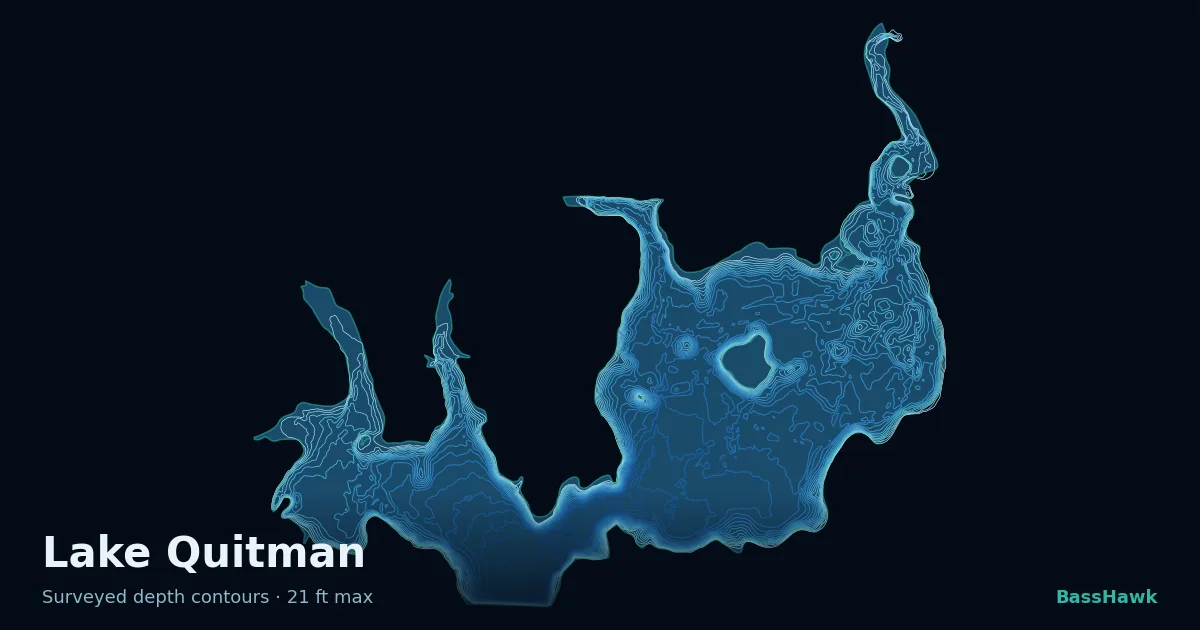
Hot water, bluebird sun. Early and late only, deep structure all day.
Summer heat at 84 degrees has the bass tucked into the deepest available comfort. Water's clear and the sky is wide open, so they've pulled out to channel swings and ledges where it's cooler and darker. They'll look up at first light and again after the sun drops, but midday is a dead zone unless you're working vertical presentations right on the structure itself. Pressure is steady, which keeps them predictable. Work the creek channel and the hard structure around the north island early, then switch to deeper ledges and channel bends when the sun climbs. Come back shallow if clouds roll in and drop that light.
The day's game plan
Where to fish
- Creek Channel Swing — 6 to 25 feet depending on zone · inside bend with hard bottom, outside bend with steeper drop-off, transition zone where channel widens into staging area
main highway for bass movement between shallow and deep. Early and evening, they stage on the swings before moving in or out. Midday, the deeper portions hold the cooler refuge. - Primary Points and Ledges — 12 to 25 feet · hard bottom with defined drop-off, often clay or gravel, adjacent to channel access
fish stack on these high-relief breaks because they're close to deep water but can quickly move shallow. Summer holds them on the deeper ledges; they use the point structure as a highway. - North Island Timber and Structure — 4 to 20 feet · submerged timber, brush piles, hard bottom shelf around the island perimeter
consistent cover through all seasons and a reliable focal point. Early and evening, the shallower timber zones light up. Midday, bass hold on the drop-offs around the island base where it transitions to deeper water.
What to throw
- Squarebill Crankbait — 2.5 in · white or chartreuse · 1/2 oz (early morning and evening when bass are shallow or moving between shallow and deep)
cast and steady wind with occasional pause, let it deflect off timber and structure - Shaky Head Worm — 3 to 5 in · watermelon red or green pumpkin · 1/4 oz (morning drop, midday deep holds, and late afternoon ledge transitions)
drag slowly on bottom or work with a light shaking vertical motion - Lipless Crankbait — 2.5 in · white or black · 1/2 oz (morning window when they're moving to deep structure but still responsive to reaction strikes)
cast and slow lift-and-fall retrieve, allowing flutter on the drop - Drop-Shot Rig — 3 to 4 in · pearl or watermelon finesse worm · 1/16 oz split shot (midday deep structure and any time you need a finesse approach on concentrated fish)
vertically jigged on bottom or soaked with minimal movement, dead-stick allowed - Topwater — 2 to 2.5 in · white, black, or chartreuse prop or chugger · n/a (evening and dusk when light is low and bass are shallow and hunting)
pop-and-pause, slow chug with pauses, or fast strip depending on light conditions
How to work it
- Vertical Jigging — when bass are stacked tight and won't move away from the structure · channel bends and ledges in 20 to 30 feet during midday
drop a small jig or shaky head straight down on deep structure, work it with short lifts or let it sit and shake - Slow Dragging — morning through late afternoon when they're locked to structure and feeding passively · channel walls, ledge transitions, and hard bottom areas
cast and drag a finesse bait across the bottom, maintain light contact, feel every bump and change in bottom composition - Shallow Timber Picking — evening and dusk when they're aggressive and fully shallow · north island timber, boathouses in 4 to 8 feet, shallow channel pockets
cast close to timber and boathouse pilings, work the bait through the cover with controlled twitches and pauses, extract straight out without snagging
Pro tips
- Work the solunar major at 11:34 AM vertically on the deep ledges. Most days it's a minor bump, but in summer heat it can trigger a brief spike when nothing else is working.
- Fish the tideline where the channel swing meets open water. That hard-soft bottom transition is a relief point where bass position between hunting shallow and hiding deep.
- If you find one quality fish on a ledge or point, don't leave immediately. Flip a drop-shot or shaky head within 2 feet of where it was and work it methodically. Summer concentrates them tighter, and there are usually two or three within an arm's length of the first strike.
If conditions change
If a front moves through and pressure rises, expect a feeding shutdown midday. Tighten to the thickest timber and drop to 1/8 oz finesse presentations dragged right on the cover. If clouds roll in and light cuts, the entire bite moves shallower and stretches longer, especially into midday. Move off the deepest ledges and fish the 12 to 18-foot transition zone with crankbaits and swimbait. If wind picks up SSW harder, the southern banks warm and the shallower bite can extend. Fish the early morning window on the south-facing channel swings longer. Clear water stays reliable, but if rain or run-off stains the water, switch to chartreuse or darker silhouettes and rely more on vibration. A lipless crankbait becomes your primary tool instead of small finesse baits.
Find more fish. This is a real report from that day's conditions — open the app for today's · free account