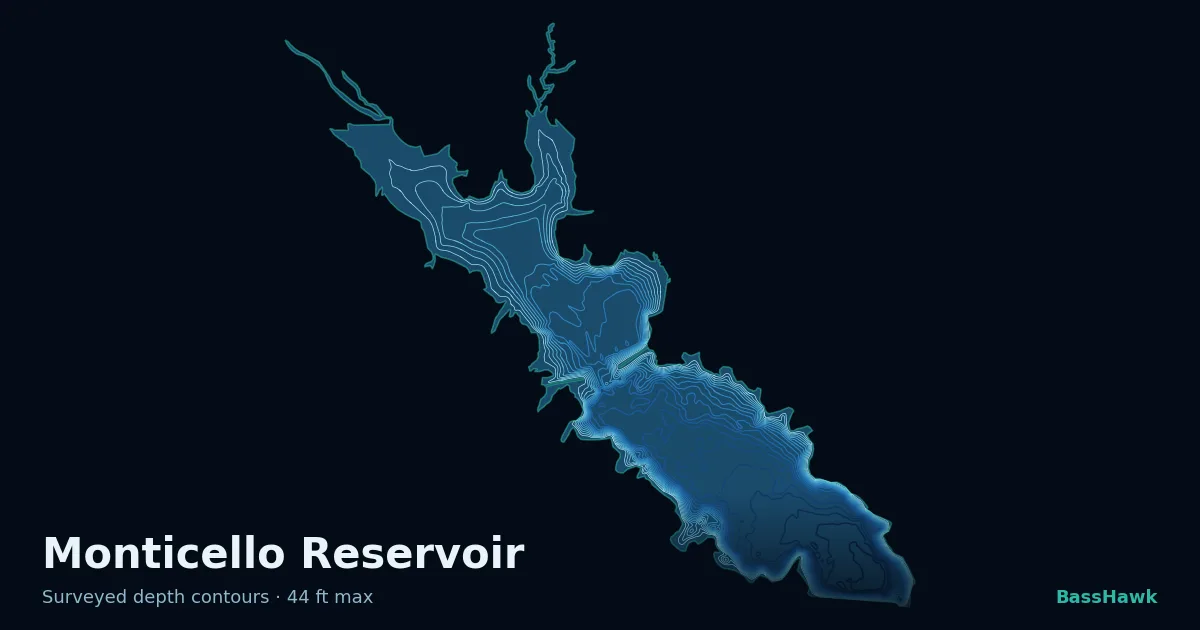
Brutal midday heat forces a dawn-dusk grind on deep structure and shade, with a pressure drop adding some spice to the bite.
Water's sitting in the low 90s, which puts the bass in survival mode. They're pulling deep to find cooler water and oxygen during the day, and they'll only look up shallow in the first hour after sunrise and the last couple hours before dark. The pressure is dropping ahead of some weather moving in, which should fire them up some if you can get on them during those narrow windows. Clarity is typical for summer, so darker colors and defined presentations will cut through the water and show the fish what you've got without giving them time to look too close. The pool is down a bit, so those creek channel breaks and main-lake ledges that normally hold summer bass are going to be even more concentrated. This is a heat-of-summer bite where timing and depth are everything.
The day's game plan
Where to fish
- Main-lake points with channel access — 12 to 24 feet on the break, shallow water on the flat · Hard bottom transition, timber on the edge, or rock if available
Summer bass stage on points that connect shallow flats to deep channels. The break is where they stage during heat, and the flat is where they hunt early and late. Points hold fish all day if you work the right depth. - Creek channel bends and swing areas — 8 to 20 feet in the channel, 2 to 8 feet on inside bends · Hard bottom channel edge, timber on inside bends, transitions from sandy to hard bottom
Channels act as migration highways and feeding zones. The inside of a bend concentrates bass and baitfish. In heat, fish hold on the bend edge but feed on the shallow inside in low-light windows. - Main-lake humps and mid-lake ledges — 20 to 28 feet peak, 14 to 20 feet shoulders · Hard bottom hump with any timber or rock, steep shoulders for quick depth access
When water is 93 degrees, bass burrow into the deepest available structure during the day. Humps and ledges in open water hold tight schools of bass and allow fast vertical jigging when they're unresponsive to horizontal presentations. - Shallow flats with timber or brush near channel entrances — 2 to 8 feet · Remnant timber, brush piles, rocky areas, or hard sandy bottom
These are feeding zones in early morning and dusk. The proximity to deep water (within 30 to 50 yards) lets bass hunt shallow and escape to cool water quickly if needed. Low-light feeding happens here first and last each day.
What to throw
- Texas-rigged soft worm — 5 in · green pumpkin or junebug · 3/16 oz for shallow, 1/2 oz for deep (early morning, dusk, and night when water cools slightly. Also during the falling pressure window.)
Crawl it slowly along bottom with frequent pauses, feeling for weight. Keep contact with the bottom. Let the bait sit on any change in depth or cover. - Blade bait or lipless crank — 2.5 in to 3.5 in · black, junebug, or dark shad · 1/2 oz for channels and breaks, 3/4 to 1 oz for open humps (midday on deep ledges and main-lake humps. Morning and late afternoon on transition breaks. Falling pressure amplifies the bite.)
Drag it slowly along bottom with steady contact, or work it vertically on humps with short 6 to 12 inch lifts. Let it fall on slack line. Keep the thump steady and deliberate. - Shaky head with small creature bait — 2 in to 2.5 in creature · green pumpkin, junebug, or dark green · 3/8 oz to 1/2 oz (early morning on shallow structure, midday when fish are deep and tight, and evening as they start to move shallow.)
Hold it 2 to 3 feet off bottom and shake the rod tip steadily in short 6 to 8 inch vibrations. Move it very slowly across structure. Work cover hard and methodically. - Spinnerbait with Colorado blade — 3/8 oz to 1/2 oz · white or chartreuse body, matching blade · 3/8 oz to 1/2 oz (early morning before the sun heats the shallows, dusk as light fades, and night when bass hunt by feel. Can work late afternoon if the pressure drop has them aggressive.)
Work it steadily through the shallows with a moderate retrieve speed. Bump cover and work figure-eights around timber. Let it bulge the surface slightly on calm water. - Squarebill crankbait — 2.5 in · junebug, black, or dark shad · n/a (morning as bass move from deep to shallow, late afternoon and early evening on transition zones, and dusk as light fades.)
Work it with steady moderate speed and occasional sharp jerks. Hit cover and bounce it off structure. Keep it in the 6 to 12 foot strike zone.
How to work it
- Vertical jigging on deep humps and ledges — Midday heat. When bass are stacked tight and you need precision. When pressure is rising after the front passes. · Main lake humps and channel ledges in 20 to 28 feet during midday hours.
Drop a 3/4 to 1 oz finesse jig straight down on the deepest part of a structure, feel the bottom, then hop it 6 to 12 inches at a time with long pauses between hops. Keep your line nearly vertical. - Slow dragging blade baits along bottom transitions — Mid-morning through late afternoon. Falling pressure and dusk periods. Any time fish are at a depth break but not actively moving. · Channel breaks, first and second main-lake points, and hump shoulders, 12 to 24 feet.
Cast to a depth zone, let the blade bait sink to bottom, then drag it slowly with a steady 1 to 2 inch per second retrieve. Feel for subtle weight increases and watch your line for any movement. - Shallow cover picking in low-light windows — Early morning (first 90 minutes after sunrise), dusk (last 90 minutes before sunset), and night. When the falling pressure has bass more willing to chase shallow. · Shallow flats, inside creeks, and secondary points near deep water, 2 to 8 feet.
Work a Texas-rigged worm or shaky head around timber, docks, and shallow brush with short casts and precise placement. Fish every piece of cover before moving. Work slowly and methodically. - Reaction jigging with spinnerbaits and crankbaits — Early morning, evening, and dusk when light is changing. When the pressure drop has kick-started the bite and fish are more responsive. · Secondary points, creek channels, and transition breaks, 8 to 16 feet.
Cast to structure and work with steady speed, adding sharp snaps or jerks to trigger instinctive strikes. Cover water and let the speed and flash do the talking. Stay moving.
Pro tips
- In 93 degree water the falling pressure is your biggest advantage today. The bite window is narrow, so plan to be on the water from 30 minutes before sunrise through 8:30 AM, then grind the deep stuff until 4 PM, then finish hard from 4:30 PM to full dark. Miss the early window or the dusk window and you've given up your best chances.
- Watch the wind direction. If it shifts from south-southeast to north-northwest as the front approaches, expect the bite to shut down hard in the afternoon even though you have falling pressure. A north wind pushes cooler air and can stall the pressure drop effect. Bank on early morning and dusk, forget midday if that shift happens.
- Keep your boat positioned to work structure vertically or parallel to depth breaks rather than perpendicular. In this heat, bass hold tight to specific depth zones. A jig dropped straight down on a hump at 24 feet will outfish horizontal casting 5 to 1 because the fish aren't roaming. Precision matters more than speed.
If conditions change
If the front rolls in faster and pressure rises sharply, expect a shutdown by mid-morning. Drop to 4-inch green pumpkin finesse worms, skip them under docks and overhanging cover, and fish the densest timber you can find. Forget the points and humps; go vertical in the thickest stuff on shallow structure. If clouds build and the wind picks up from the south, the shallow bite can stretch an extra hour into midday because light penetration decreases and water stays slightly cooler. Push harder into the creek flats and work secondary points more aggressively. If the water clears more than typical summer stain, shift to natural shad colors and downsize everything by a half size; switch from 5-inch worms to 4-inch, from 1/2 oz blade baits to 3/8 oz. If the pool drops further and flats thin out, concentrate on the channel edges and points closer to deep water because the transition zones tighten up and fish group tighter.
Find more fish. This is a real report from that day's conditions — open the app for today's · free account