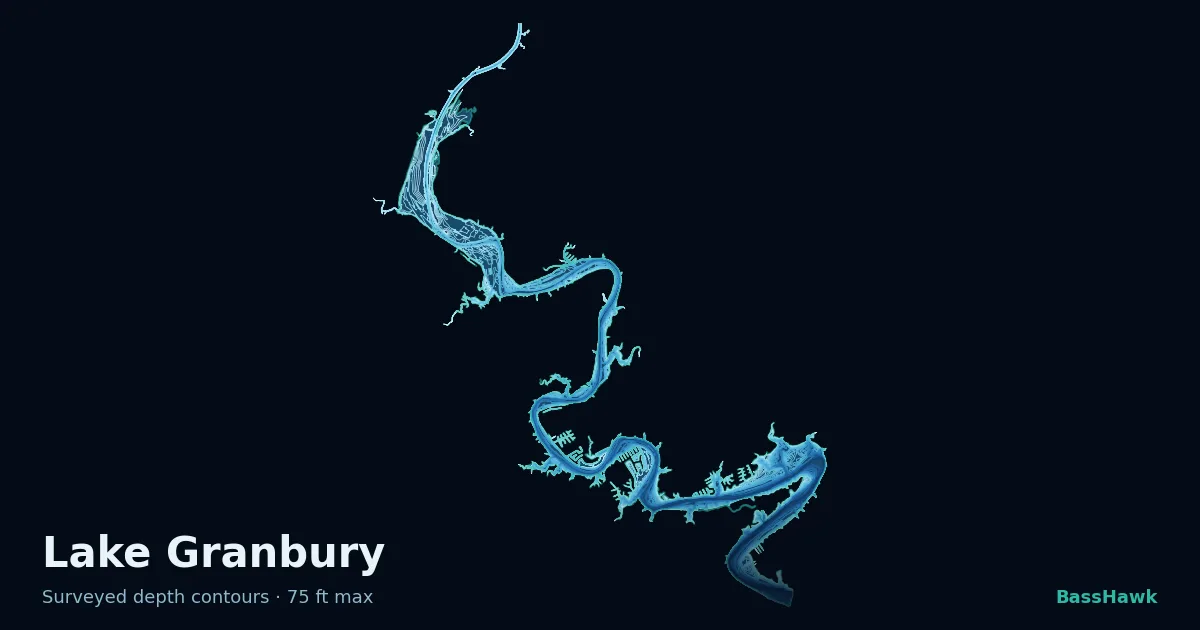
Hit the docks and creek mouths hard early, then dig deep on the ledges when the sun turns the screws.
Summer water is locked at 90 degrees and crueler by the hour. Clear skies, zero clouds, and brutal noon sun push bass down to find relief. Thermocline sits around 20 feet in most areas. Bass are feeding early and late near shallow cover and creek mouths where baitfish stage, but once the sun climbs they retreat to deeper water and tighter shade. Low pressure keeps them willing to bite if you find them, but the window is tight and the depths shift hard as the day heats.
The day's game plan
Where to fish
- Creek Entrances and Mouths — 4 to 10 feet at mouth, drops to 15-20 feet in creek channel · Hard sand and clay bottom, baitfish concentrated, secondary points inside creeks, grass or timber edges where present
Baitfish stage here to feed on the flats and then retreat to deep channel. Bass position at the mouth and just inside to intercept shad moving up and down. Early and late, bass feed shallow here. It is a primary feeding area. - Main Lake Points with Channel Connection — 8 to 20 feet depending on position on point · Hard bottom, rock and clay, drop-offs to deeper channels nearby, some sparse timber or grass
These are migration highways. Bass use them to move between shallow and deep water. The proximity to deep refuge is critical. Even when fish are pulled deep, they stage on these points, making them reliable all day. - Deeper Ledges and Humps, 18-25 feet — 18 to 25 feet on top, drops farther on edges · Hard bottom, sometimes rocky, channel-connected, thermocline water in this zone
Summer retreat zone. Bass hold here all day when heat is brutal. It is cooler, lower light penetration, and bass can hang in a tighter area. Slow presentations are the only way to get bites here. - Shaded Docks and Timber — 6 to 15 feet, variable · Man-made docks, submerged timber, brush piles, pilings
Docks and timber provide instant shade that bass need in summer. They hold fish all day if the shade is dense enough. Granbury is dock-rich, so these are year-round targets but especially critical in heat.
What to throw
- Lipless Crankbait — 2.5 to 3 in · Chartreuse, black, white · 1/2 oz (Early morning first 2 hours, evening as sun drops, dusk topwater window)
Fast retrieve with snaps and pauses near shallow structure and creek mouths early. Work parallel to banks and docks. - Soft Plastic Worm, Texas-rigged — 4 to 5 in · Green pumpkin, watermelon, dark grape, natural shad · 1/4 to 1/2 oz (All day, but especially midday deep work and late afternoon transitions. Dusk in shallow water.)
Pitch to shade under docks and into brush. Drag slowly on bottom, especially on deep structure. Work with slow hops or let it sit. - Jig with Soft Trailer — n/a · Black, brown, junebug · 3/8 to 1/2 oz (Midday and late afternoon on deep structure)
Drag on bottom slowly around deep ledges and channel drops. Work vertically on humps. Minimize movement, maximize precision. - Shaky Head with Soft Plastic — 3.5 to 4 in · Natural shad, green pumpkin, watermelon · 1/4 oz (Midday and afternoon on deep structure when bass are not feeding hard)
Work with tiny vibrations, minimal movement. Drag slowly or set and wait. Let the vibration do the work. - Spinnerbait — n/a · White, chartreuse blade and skirt · 1/4 oz (Early morning and dusk)
Fast retrieve near shallow cover and docks early morning. Slow roll along transitions in evening. Work parallel to structure.
How to work it
- Pick Apart the Docks — Early morning first 2 hours and dusk. Bass tuck tight under docks to escape sun and find cooler water. · Shaded docks throughout the main lake and creeks, especially creek mouths and channel edges
Skip soft plastics and jigs under dock platforms and around pilings. Keep the boat at distance and pitch with precision. Work the shade lines, transitions between full shade and open water. - Work the Ledge Drop — Morning transition from 8:30 AM onward. As bass leave the shallows, they pause on ledges before dropping to deep refuge. Work it from the top down. · All main lake points, creek channel bends, secondary points off creeks. Typical drop from 8-10 feet to 20+ feet.
Position on the edge where shallow structure falls to deeper water. Use crankbaits to search the transition, then switch to soft plastics and jigs to work the drop vertically or slowly along the lip. - Drag the Bottom — Midday and late afternoon when bass are lethargic and locked on bottom. This is a patience game, not a speed game. · Deep ledges, channel drops, humps in 18-25 feet of water
Use slow, deliberate drags of soft plastics on a Carolina rig or weighted jig. Crawl the bait along the substrate, pause frequently, let pressure build. Do not rush. - Target Shade Lines — All day, but most important midday when direct sun is brutal. Shade can hold fish all day if it is dense enough. · Any tree canopy, docks, deeper timber, channel bends with bank shade
Fish the hard transition between full sun and shadow. Work baits along the edge of the light line, especially under overhanging branches or dock shadows.
Pro tips
- The thermocline at 20 feet is real and bass respect it. Once you locate it, fish above it in the morning and transition periods, and right on it midday. Do not waste time below it unless you mark fish on the graph.
- Pressure is steady today, which is actually good news. Bass acclimate to stable conditions fast. Focus on time of day and water temperature, not pressure changes. Dusk and early morning will be your best shots regardless.
- If you get a bite on a deep ledge in the afternoon, mark that spot and fish it slowly for the next 30 minutes. Summer bass do feed midday on deep structure, but they are concentrated and the window is small. Once you dial in the depth and cover type, you can get multiple fish from one area.
If conditions change
If a front rolls in and pressure starts dropping, expect a feeding burst, especially in the late afternoon and early evening. Bass will move shallower and more aggressive. Burn faster baits and cover more water. If the front passes and pressure rises, the opposite happens: fish pull tighter, go slower, and bury in the deepest, thickest cover. If clouds build and kill the direct sun, the shallow bite extends all day and dusk comes earlier. Fish creek mouths and points longer than normal. If the wind picks up from the south or southwest, it warms the water further and pushes it around. Fish deeper and slower. Wind from north or northwest brings cooler air but does not help much in August heat. If water clarity drops from stain to muddy, shift to dark colors (black, junebug) and wider-thumping blades for more vibration. If it clears further toward tea, downsize everything and fish with natural colors and longer leaders.
Find more fish. This is a real report from that day's conditions — open the app for today's · free account