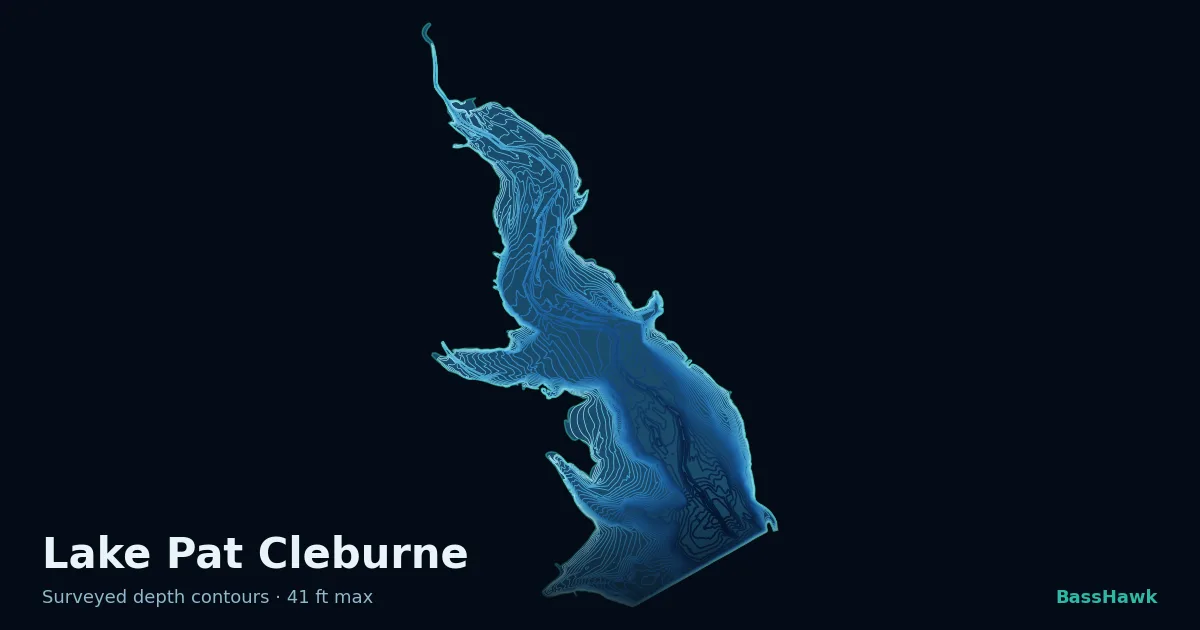
Hot summer water and bluebird skies push bass deep and tight to cover. Fish the shade, work the riprap early, then chase the vegetation edges.
Water's sitting at 80 degrees and the sky is clear and bright, which means largemouth are going to be uncomfortable in the shallows during midday. They pull out to deeper shade and structure to find cooler water and stay comfortable. The lake runs stained like it always does, which works in your favor because it keeps the sun from burning down quite as hard as it would in clearer water. With steady pressure and no front moving in, the bass are in their normal summer pattern. Early and late light is your friend today because they'll move shallow to hunt when the sun isn't beating down so hard. All day long, riprap, vegetation edges, and any hard cover will hold them. Fish tight to cover and work it thoroughly.
The day's game plan
Where to fish
- Riprap Banks — One to four feet, with structure extending to six to eight feet offshore · Hard concrete or rock riprap armoring the shoreline, often with sand and gravel at the base, provides shade and cooler water than open banks.
Riprap is the most consistent producing area on Pat Cleburne. It holds bass morning and evening because of shade and hard bottom. Early and late light, it's a go-to starting point. The dark color of the rocks and the hard substrate make it the highest-percentage hard-cover option on the lake. - Shallow Vegetation Edges — One to four feet, with some vegetation extending into six feet in summer · Water willow, lotus, cattail, bulrush, and buttonbush form dense mats along the shoreline and in shallower bays, creating shade and cover.
Vegetation is the dominant shallow-water cover on Pat Cleburne and holds the most bass. It provides shade from midday heat, cover for hunting, and ambush points. Morning and evening bites in vegetation are consistent. Midday, the thickest mats are where you'll find bass hiding from the heat. - Vegetation and Riprap Transitions — One to four feet · Where hard riprap meets soft vegetation, or where different vegetation types border each other, creating zone changes and structure breaks.
Bass use transitions between cover types as highways and feeding zones. These areas concentrate fish and make it easier to pattern them. If you find one fish, you can replicate the pattern elsewhere on the lake. - Laydowns and Submerged Wood — One to four feet, with root systems often extending toward slightly deeper water · Fallen trees and heavy limbs along the shoreline, providing overhead cover and shade.
Any wood holding shade is a magnet in summer. Laydowns give bass the deepest shade available in shallow water. Early morning, these spots hold aggressive fish. All day, they hold at least a few bass tucked underneath. They're a secondary option to riprap and vegetation but worth working if you're near them.
What to throw
- Spinnerbait — 3/8 to 1/2 oz · Black, dark purple, or black and blue · matched to size (Early morning, late afternoon, evening when light is lower and water is cooler)
Cast to riprap and vegetation edges, retrieve at varying speeds from slow creeping to medium steady pace, pause occasionally to let the bait flutter, work right on the cover. - Buzzbait — 1/2 oz typical · Black, dark colors · matched to size (Early morning, evening and dusk, anytime light is low)
Cast over shallow vegetation and riprap, keep the blade cracking the surface, retrieve slow to medium with frequent pauses, let the vibration and sound do the work. - Plastic Worm, Texas-rigged — 5 to 6 inches · Green pumpkin, dark green, or black · 3/8 oz bullet sinker for normal cover, 1/4 oz for dense vegetation or light weight for weightless (Morning through midday when you need precision and cover density, all day when you're picking apart vegetation)
Pitch or cast tight to cover, work with short hops or slow drags, keep contact with the bottom or work through the vegetation one small section at a time, use pauses to let the worm fall. - Shallow-diving Crankbait — 2.5 to 3.5 inch length · Shad patterns or natural colors · no weight, lure design dependent (Morning and late afternoon when fish are slightly higher in the water column and riprap holds fish)
Cast along riprap and hard-cover banks, retrieve with steady twitches and occasional pauses, keep the bait just bumping the structure or running one to three feet deep. - Black Jig with Crawfish Trailer — 4 to 6 inch trailer, 3/16 to 3/8 oz jig head · Black or black and blue · jig head only (Midday and transition periods when fish are tight to cover and less aggressive)
Pitch to wood, riprap, and vegetation edges, work with short hops and pauses along the bottom, keep tension on the line and feel for strikes, let the jig sit briefly between hops.
How to work it
- Flipping and Pitching Vegetation — Morning through late afternoon, anytime you need precision and vertical presentations in thick cover. · Dense water willow, lotus, and cattail edges in one to four feet of water, anywhere you see a pocket or opening in the vegetation.
Hold the rod at nine o'clock, feel the tension on the line, make short underhand or sidearm casts to specific targets within a few feet, drop the bait to the bottom or let it sink into the mat, retrieve slowly and set the hook with a sharp upward stroke. - Tight-line Riprap Work — Early morning, late afternoon, evening. Riprap bites best when light is lower and water is cooler. · Riprap banks in one to four feet of water, especially north or west-facing sections where shade lingers.
Cast parallel to the riprap, keep the line tight and feel the bottom, retrieve slowly with small twitches and pauses, bump the rocks and listen for strikes, work the same stretch multiple times from different angles. - Slow Blade Retrieve in Structure — All day, but most effective during morning and evening windows and whenever water temperature favors shallow feeding. · Laydowns, wood, and riprap in one to four feet, transitions between shallow vegetation and slightly deeper water.
Cast to cover and begin the retrieve immediately, keep the spinnerbait or crankbait in contact with the structure, use a steady slow to medium pace, pause occasionally and let the bait flutter or sink slightly, twitch the rod to trigger strikes. - Pause and Twitch Finesse — Midday heat when bass are lethargic and tight to shade, or anytime you need to slow down and trigger strikes from reluctant fish. · Dense vegetation mats and tight cover in one to three feet.
Cast weightless or lightly rigged worms or soft plastics, let them fall on slack line or with a slow twitch, pause three to five seconds, twitch the rod tip subtly, repeat. Keep retrieves small and deliberate.
Pro tips
- Start your day at riprap on a north or west-facing bank to maximize early shade and morning light. Make multiple passes from different angles because one bass often means more are stacked in the same exact cover.
- In murky summer water, dark colors and vibration matter more than perfect shape matching. Black and dark colors stand out, and a thumping blade or buzzbait travels farther through stained water than sight alone.
- If the pressure is stable all day, focus on the time-based pattern rather than weather shifts. Early and late light are your two feeding windows. Use midday to scout new areas and set up for the evening bite, which is often better than morning.
If conditions change
If a front rolls in and the pressure rises and the sky clears even more, expect the bite to get tougher during midday. Tighten up on finesse baits, go weightless or use a jig, and fish the absolute thickest cover you can reach. If the wind picks up from the southwest, the wind-blown banks will have more bait and oxygen, so shift to those banks and fish faster. If clouds develop and humidity rises, the shallow bite can stretch longer into midday. If heavy rain muddies the water even more than normal, go with pure black plastics and widen your blade selections for maximum vibration.
Find more fish. This is a real report from that day's conditions — open the app for today's · free account