Summer heat shutdown, get dark and deep early or fish first light aggressively.
Water's at 90 degrees and the sun's flat out, so the bite compresses hard into dawn and dusk. Bass have pulled out to deeper edge cover and timber to stay comfortable, and they're not looking up much during the day. The stained water helps you but it also means they're tight to structure and won't chase far. Pressure's dropping before some weather rolls in, so there's a window before the front hits where they'll feed more freely, but don't count on much once the sun climbs. This is a low-light fishing day. Hit the timber edges and creek channel ledges from sunup until about 9 AM, then shift deep or hunt shade until the evening bite kicks back in after 6 PM.
The day's game plan
Where to fish
- Hackberry Creek timber edges — 4 to 18 feet · Submerged standing trees, old fencerows, and timber lines along the creek channel.
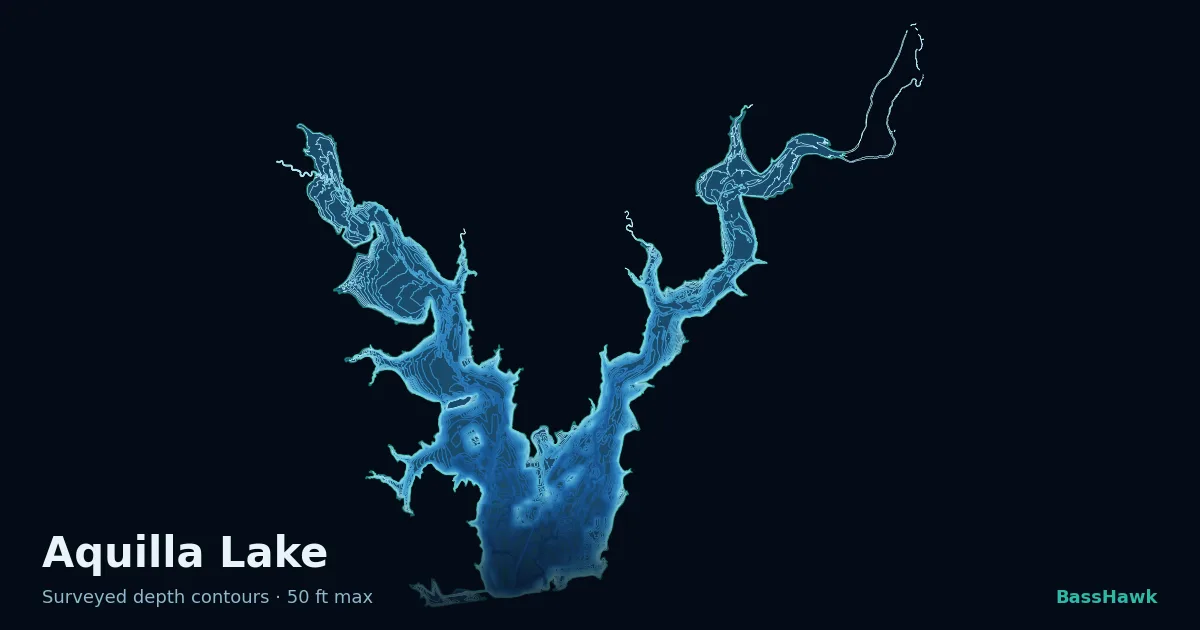
This is the primary staging area for largemouth in the stained water. Bass use the timber as ambush points and the deeper edges as escape routes. Early and late light concentrates fish here, and the variety of depths lets you follow the daily movement pattern from shallow to deep and back. - Aquilla Creek main channel and swings — 12 to 25 feet · Inside and outside bends of the creek channel, ledge transitions, and secondary point breaks along the channel route.
Creek channels funnel bass between deep and shallow water and concentrate forage. The inside bends create current breaks and shadowed pockets where bass hold. The depth range mirrors the daily shift from shallow early and late light to deep midday, making this a productive area for most of the day. - Deep main lake timber and humps — 18 to 30 feet · Isolated standing timber, submerged brush piles, and main lake humps with hard bottom.
This is where bass retreat in peak heat. The deeper water and isolated cover provide thermal refuge. Published fish-attractor coordinates are valuable here because structure is scattered. This is a sonar-dependent area but holds bass throughout the midday period when other shallow patterns shut down. - Secondary point flats in creek mouths — 3 to 10 feet · Shallow flats with scattered timber and hard bottom leading into deeper creek channels.
These flats are staging areas where bass rest between hunting runs. In early morning and dusk they become feeding grounds. The proximity to deeper channel access gives bass an escape route while still allowing shallow feeding in low light. This area produces throughout the early morning and dusk windows.
What to throw
- Spinnerbait — n/a · Black or dark green · 3/8 oz (Early morning (first two hours of light) and evening (last two hours of light) when bass are aggressive and looking for something moving.)
Slow roll tight to timber edges, work the blade to push water and create vibration in stained conditions. Cast to the deeper side of standing trees and let it track the contour rather than burning it fast. - Jig and Pork — jig head 3/8 oz · Dark brown or black jig, dark pork trailer · included in jig head (Mid-morning through midday, especially around deeper timber edges and the transitions where bass are starting to pull from shallow cover.)
Pitch to shadowed pockets around timber and ledges. Let it fall on controlled slack, shake slightly on the drop, then crawl it across the bottom with short hops. Work slower than you think you should. - Finesse Worm on Drop Shot — 4 inch · Green pumpkin or black · 1/16 to 1/8 oz sinker 12-18 inches above hook (Midday when fish are deep and lethargic, and late afternoon as they begin waking in deeper structure.)
Hold the rod tip at 10 o'clock and work the rig vertically or with minimal horizontal movement. Shake the worm with small twitches and pause frequently. Let it sit on bottom between movements. - Chatterbait — n/a · Black or dark green with dark craw trailer · 3/8 oz (Evening and early dusk when bass are moving shallow and aggressive, and water temp has backed off from peak heat.)
Slow roll along timber edges and creek channel bottoms. Work it steadily with slight rod movements to maintain blade clatter. Keep contact with the bottom and let the vibration do the work. - Soft Plastic Worm Texas Rigged — 5 to 6 inch · Black, junebug, or dark green pumpkin · 1/8 oz bullet weight (Dusk and early evening when light is low and bass are hunting on shallow flats and timber.)
Pitch tight to submerged wood, downed trees, and fencerows. Work it with short hops along the bottom, pausing between movements. Let it drag and settle into gaps in timber. Fish it slow and methodical.
How to work it
- Tight-cover timber cranking — Early morning when bass are aggressive, and evening when they're moving back shallow. Avoid this in midday heat when fish are deeper. · Hackberry and Aquilla Creek arms where standing timber is abundant, depth 4 to 18 feet.
Work spinnerbaits and jigs in and around submerged trees and old fencerows by casting tight to the wood and working the bait down the contour. Keep the rod tip moderately high to work the bait at the target depth and make quick, short pitches rather than distance casts. - Creek channel ledge fishing — Throughout the day as a fallback pattern, especially midday and late afternoon when timber-only patterns are slow. Channel edges hold bass that are transitioning between shallow and deep. · Main creek channel swings in Hackberry and Aquilla Creek arms, depths 12 to 25 feet.
Follow the inside and outside bends of creek channels and work the transitions where depth changes from 10 to 20 feet. Cast parallel to the ledge edge and use a jig or drop shot to work the harder bottom where bass position between deep and shallow water. - Deep isolated structure hunting with sonar — Midday when fish are deep and concentrated. This technique shortens water search time and lets you target fewer, higher-percentage spots. · Main lake humps and deep isolated timber locations away from creek arms, 18 to 30 feet.
Use a quality sonar unit to locate fish-attractor coordinates and submerged humps and isolated timber stands in 18 to 30 feet. Mark waypoints and work the breaks with drop shots or vertical jigging. This is precision work that requires boat control and patience. - Shallow-water low-light presentation — Dusk, early evening, and night when light is low and bass feed aggressively on shallow structure. · Shallow timber, downed trees, and secondary point flats adjacent to creek arms, 2 to 8 feet.
Fish dark soft plastics and topwater frogs to shallow wood in 2 to 8 feet during dusk and night. Work topwater frogs with slow pops and long pauses. Drag soft plastics across the bottom with minimal speed, pitching to individual pieces of wood rather than casting into open water.
Pro tips
- When pressure drops before weather moves in, the bite window expands earlier in the morning and later into the evening. Don't leave at your normal time. Fish 30 minutes longer than you normally would at dusk because dropping pressure energizes the bite.
- The stained water at Aquilla is an advantage in summer heat. It keeps bass confident in shallower water longer than they would in clearer lakes. Use dark colors and vibration-based presentations to your advantage. Topwater and loud presentations work better here than on clearer lakes because bass rely more on sound and lateral line than vision.
If conditions change
If clouds roll in and the sun disappears, the heat effect lessens immediately and the bite expands into midday. Shift from drop shots and deep structure to lighter spinnerbaits and jigs in 10 to 15 feet and work them more aggressively. If the pressure continues to fall and a front approaches, the bite will intensify in the hours before it hits. Fish faster, cover more water, and use reaction baits like spinnerbaits and crankbaits rather than dragging slow presentations. If the wind picks up from the south, wind-blown banks oxygenate the water and attract baitfish, making shallow flats and timber edges more productive even during midday heat. If the front moves through and pressure rises sharply with clearing skies and cooling temps, expect a severe shutdown for 24 to 36 hours. Downsize to 4-inch finesse worms on drop shots, fish the thickest timber cover available, and slow your retrieve to a crawl. Focus on shaded areas on the northern banks where water stays slightly cooler. This is grind-it-out territory.
Find more fish. This is a real report from that day's conditions — open the app for today's · free account