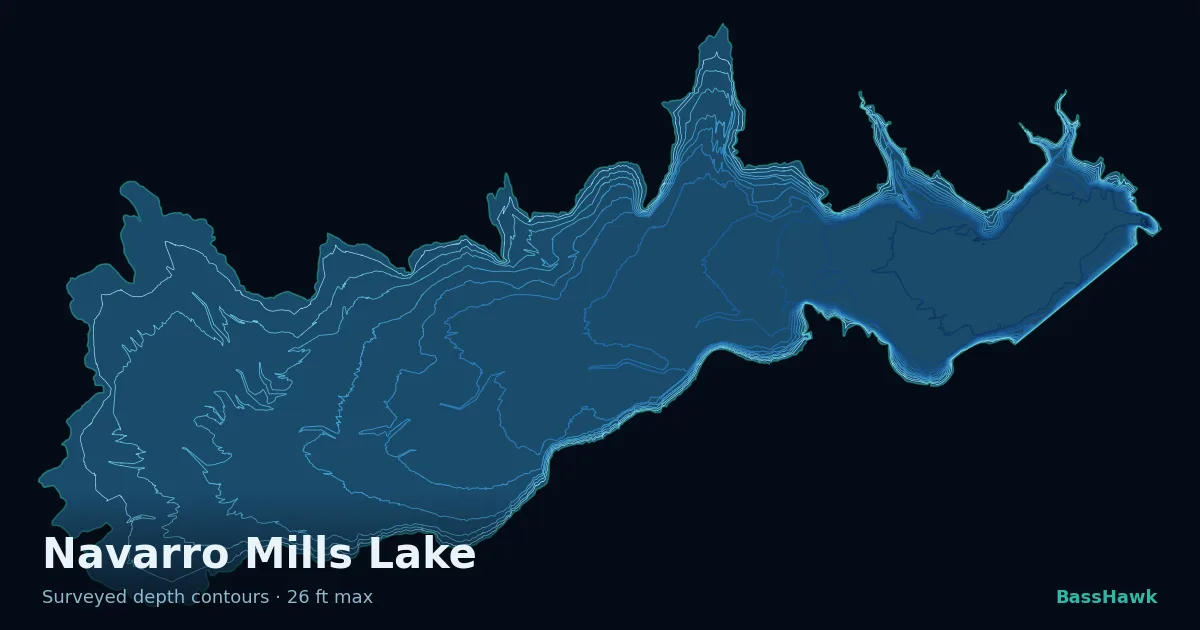
Hot-water early bite on deep timber, then hunt the docks and shallows when the sun climbs.
Summer at full throttle and water's pushing 90 degrees, so largemouth are going deep and tight to cover during the day to stay comfortable. You'll find them pulling away from light and heat into brush, timber, and shade. The pressure is dropping into rough weather, which will fire up a bite before the front hits, so early morning and late evening will be your best windows. Water's clear enough to see what you're doing, so pick apart the structure carefully. Dawn and dusk are when they'll slide shallow looking for food, but midday they hunker down in the timber and deeper brush where it's cooler and dimmer.
The day's game plan
Where to fish
- Deep timber near the dam — 15 to 25 feet · Standing timber, dense brush piles, wood laydowns
Core midday holding area in hot water. Bass retreat here to escape light and heat during the day. The wood provides cooler, shaded ambush points and concentrates forage. This is where the biggest fish hole up when the sun is high. - Dock and bank structure — 2 to 8 feet · Dock pilings, overhanging trees, shallow brush, cut banks, grass edges
Early morning and evening bass move into shade and shallow water to hunt. Docks and overhangs provide immediate relief from sunlight and heat. This is the most productive shallow-water zone during the morning bite and evening window. - Creek channel bends and transitions — 8 to 18 feet · Inside and outside channel bends, drop-offs, hard-bottom transitions to softer bottom, gravel
Channels act as migration highways and stage fish between deep and shallow water. Inside bends create current breaks and concentrate baitfish. These transitions hold fish feeding during early morning, late afternoon, and evening when they're not locked deep in timber. - Underwater humps and main-lake structure — 18 to 25 feet · Hard-bottom humps, main-lake brush piles, channel bends near deep water
Summer home for largemouth that want proximity to deep water for escape while still able to feed. These structures hold cooler water and concentrated baitfish. Good for the pressure-is-dropping early bite before the front rolls in.
What to throw
- Soft plastic worm, 4 to 5 inch — 4 to 5 in · Dark purple, watermelon red flake, green pumpkin · 1/8 to 1/4 oz Texas rig or drop-shot (Early morning shallow, midday deep in timber, evening on flats and transitions)
Texas-rigged on bullet sinker or drop-shot rig, dragged slowly on the bottom, worked tight to cover with pauses and short hops - Crawfish jig — 1/4 in to 1/2 in · Brown, dark green, or black · 3/8 to 1/2 oz (Midday and deep water, anytime the sun is high and heat is intense)
Dragged on bottom with short lifts and controlled falls, worked tight to structure and timber, fished slowly with long pauses in dense cover - Shaky head jig — 2 to 3 in · Green pumpkin, watermelon red flake, natural shad · 1/8 oz (Morning dock fishing, shallow evening water, anytime bass are in shade and tight to cover)
Fished on a drop-shot rig or light shaky head, worked with subtle vibrations and small hops, kept tight to docks and shallow brush, long pauses between movements - Drop-shot rig — 3 to 4 in · Watermelon, green pumpkin, natural shad · 1/8 to 1/4 oz weight on drop, 2 to 3 feet above (Morning docks, deep timber midday, suspended fish in deeper structure)
Suspended above cover or on the bottom, worked with vertical hops and small twitches, pauses held steady to let the bait hover
How to work it
- Slow dragging on the bottom — Midday when bass are deep and locked to cover, early morning in timber, anytime the sun is high and water is hot · Deep timber, channel bends, brush piles, bottom structure
Keep the jig or worm tight to the bottom, drag it steady with occasional pauses, lift and reset when you hit cover. Work the bait slowly without rushing. Short hops trigger strikes without moving the bait out of the strike zone. - Skip casting under docks and overhangs — Morning when bass move into shade, evening and dusk when they slide shallow, anytime you find overhead cover · Dock pilings, overhanging trees, shallow brush, cut banks
Cast the bait low and hard, skip it under the dock like a rock across water, work it with short twitches and pauses in the shade. Keep tension on the line so you feel strikes immediately. - Sight fishing timber and brush piles — Early morning, midday deep-water hunt, late afternoon transitions · Standing timber in 15 to 25 feet, dense brush piles, laydowns along banks, deep creek bends
Cast to the edge of the structure and work the bait down it slowly. Pick apart the cover piece by piece, do not rush. Let the bait sit in open pockets and then drag to the next piece. Work around all sides of the cover.
Pro tips
- Pressure is falling before weather rolls in, which fires up a pre-bite window in the early morning. Fish that first hour hard and cover the deep stuff with purpose. This is premium time and the bite will be more aggressive than normal summer fishing.
- The water is clear and bright. Skip the heavy, flashy stuff. Dark, natural colors and slow presentations will outfish anything bright or fast. Bass can see everything, so give them something they recognize and that doesn't spook them.
- When you find a dock or shaded area holding fish in the morning, work it thoroughly. A single dock can hold multiple keepers in this heat. Do not just cast once and move on. Skip it multiple times from different angles and let the bait sit in the shade.
If conditions change
If a strong front blows through and the sky clears with north wind after the pressure rises, the bite shuts down hard. Fish tighter to cover, go smaller and slower, and focus on the thickest timber and brush at depth. Work methodically through dense cover and spend 10 minutes on a single spot instead of moving around. If clouds roll in and the wind stays light, the shallow bite extends all day and you can work docks and banks much later than normal. If rain arrives before the front fully passes, the water muddies slightly, which actually helps. Go with darker colors and work with more vibration. A larger crawfish jig with a thick trailer will produce when visibility drops.
Find more fish. This is a real report from that day's conditions — open the app for today's · free account