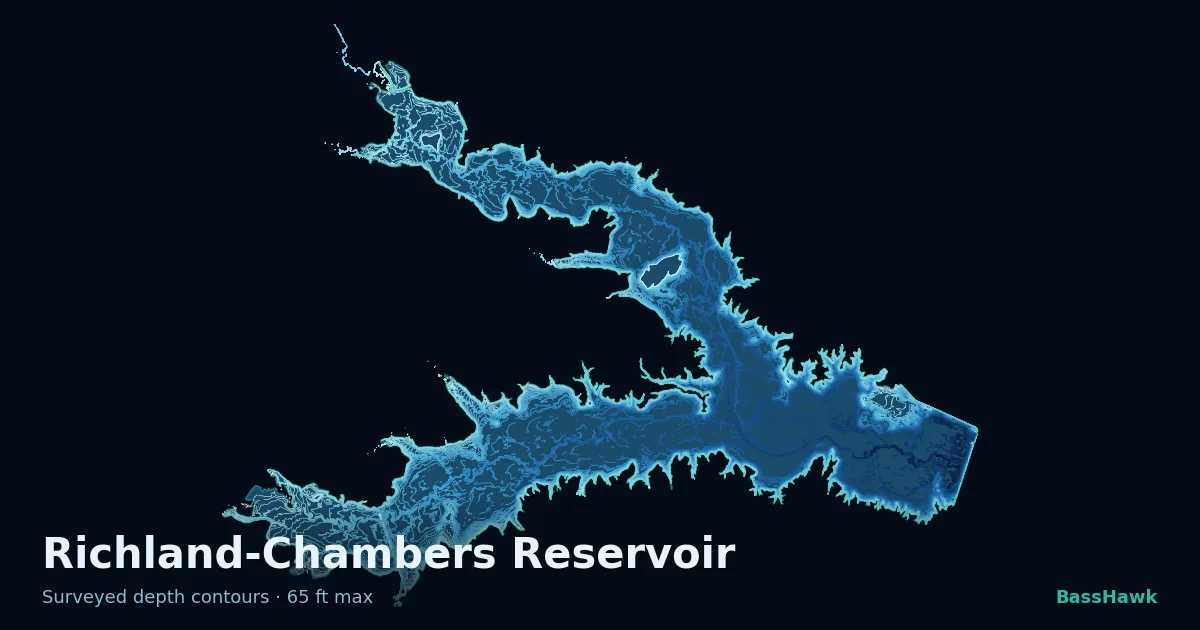
A complete, real report for Richland-Chambers Reservoir — nothing held back, from a few weeks back. It ran on that day's conditions, and conditions have moved since. Today's is in the app.
SAMPLE GUIDE REPORT · FRIDAY, AUGUST 21, 2026
Summer dead-zone heat means pre-dawn and dock hunting in shade.
WATER 89°FAIR 85°FWIND 13 MPH SWSEASON SUMMERPOOL -1.7 FT
At 89 degrees the water is too warm for consistent comfort. Bass get lethargic and pull into shaded cover during the day. The pressure is rising and the sun is bright and clear, which pushes fish deeper and tighter to structure. Early and late light become your prime windows. The dock bite is your bread-and-butter right now because it offers shade and the submerged lights that draw baitfish. Water is stained, so dark lures cut through it better than light ones. Fish shallow in the cool of dawn, then retreat to deeper structure, docks, and brush piles as the heat builds. By midday they're holed up. Evening brings another brief window before the full heat settles in again at night.
The day's game plan
EARLY MORNING · 6:53 AM to 8:30 AM
Shallow main-lake docks and secondary creek-arm docks in 3 to 6 feet of water with brush piles nearby.
Dark-colored ChatterBait Elite in green pumpkin or black, 3/8 oz, cast tight to dock pilings and brush. Work it with a steady medium retrieve, pausing when you feel contact.
The cool dawn water gives bass a brief window to hunt shallow. Docks provide shade and attract baitfish. The electrical lights under some docks bring in shad overnight, and bass stack around them at first light.
MORNING · 8:30 AM to 11:00 AM
Main-lake channel ledges and hump edges in 20 to 35 feet, particularly near structure transitions.
Green pumpkin or black Keitech Swing Impact FAT swimbait, 4 inch, 1/2 oz Texas rig. Slow-roll it just above the bottom or suspend it in the water column if you mark fish.
As sunlight strengthens and the surface warms, bass pull deeper to find cooler water and oxygen. Channel swings and humps give them highway routes and the depth they need. A swimbait profile matches the shad forage and a slow swim keeps it working in the sluggish heat.
MIDDAY · 11:00 AM to 3:00 PM
Deep brush piles and standing timber in 25 to 40 feet of water, or return to the thickest dock structure in shade.
Small Keitech or similar 3-inch finesse swimbait on a 1/4 oz drop-shot, fished vertically or with a slow lift-and-drop. Alternatively, work dark crankbaits like a Norman DD22 or DT-10 tight to deep wood on a slow crank.
This is the toughest window because the sun is high and the heat has pushed most bass into the deepest, darkest cover they can find. Brush piles and timber offer thick shade. A drop-shot lets you fish precise depths where electronics show the fish. If conditions allow, thick docks with shade remain productive.
LATE AFTERNOON · 3:00 PM to 5:30 PM
Secondary creek-arm docks and shallow points with rock or hardpan in 6 to 12 feet.
White or dark-colored squarebill crankbait like a Rapala DT-10, 1/2 oz. Crank it steadily just off the bottom and around dock structure. Skip baits under dock overhangs when you stop to work them.
As afternoon light begins to ease and surface water cools slightly, bass inch shallower to hunt. Docks remain shaded havens, and secondary points hold bass staging between deep water and shallow flats. The squarebill mimics a small baitfish and the deflection off structure triggers reaction strikes.
EVENING · 5:30 PM to 7:30 PM
Shallow flats and points near creek channels in 2 to 8 feet of water, especially areas with submerged brush or rock.
Green pumpkin or black ChatterBait Elite, 3/8 oz, with steady retrieve and occasional pause. Or work a dark-colored glide bait with a twitch-and-glide pattern.
As the sun drops the water cools enough for bass to hunt the shallows again. Flats and points are travel routes where bass intercept baitfish. Brush and rock hold prey and give bass ambush spots. The cooler evening brings a second feeding window.
DUSK · 7:30 PM to 8:30 PM
Main-lake docks and shallow channel entries in 4 to 10 feet.
Dark ChatterBait Elite or All-Terrain swing jig, 3/8 oz, fished with confidence. Keep retrieving through low light. Do not slow down yet.
The final hour before dark is an active window. Bass feed aggressively as light fades and comfort returns. Docks and channel mouths are travel corridors where fish converge to feed. The low light removes visibility pressure and bass commit to strikes.
NIGHT · 8:30 PM to 6:53 AM next morning
Deep main-lake structure: channel bends, humps, and ledges in 25 to 50 feet, or docks with lights if accessible.
Slow-moving baits only: small dark swimbaits on drop-shot, or soaking a live shad near bottom if permitted. If working docks with lights, dark ChatterBait or jig fished around the light cord.
Once full dark arrives the water cools further but the summer pattern keeps bass content in deep, structured sanctuaries. Lights under docks continue to draw baitfish and bass all night if you have access. Otherwise, bass remain staged deep and inactive unless a baitfish disturbance wakes them.
Where to fish
Main-lake docks on secondary points — 3 to 6 feet · Dock pilings, floating platforms, submerged lights, and brush piles beneath or around them. Docks provide shade and attract baitfish via lights. They are reliably productive all day during summer heat, especially early, late, and at night.
Creek-channel entries and swings — 15 to 35 feet · Hard bottom transitions, inside bends with reduced current breaks, and channel ledge drops. Channels funnel bass movement and offer cooler water zones with stable structure. Baitfish move through channels, and bass stage along the edges waiting to ambush.
Deep brush piles and standing timber — 25 to 40 feet · Submerged wood, brush piles, and timber with thick vertical cover. In summer heat bass retreat to the thickest, deepest, darkest cover available. Brush and timber provide shade and hiding spots for both bass and prey.
Shallow flats with rock and hardpan — 2 to 8 feet · Rock outcrops, hardpan transitions, and points with submerged boulders or gravel. In early morning and evening bass hunt these flats to feed on baitfish. Rock and hard bottom hold crawfish and other forage. They are a transitional zone between deep and shallow water.
What to throw
ChatterBait Elite — 3 to 4 in · Green pumpkin or black · 3/8 oz (Early morning, late evening, dusk around docks and shallow cover.) Steady medium retrieve around docks, brush, and structure. Pause and let it drop when you feel resistance.
Keitech Swing Impact FAT swimbait — 4 in · Green pumpkin or black · 1/2 oz (Texas rig) (Morning and early afternoon when bass pull deeper.) Slow-roll just above bottom structure or suspend in the water column. Use a steady retrieve with occasional pauses.
Rapala DT-10 or Norman DD22 crankbait — n/a · Natural shad or dark patterns · 1/2 oz (Late afternoon and evening when bass move shallower.) Steady crank down to the bottom on shallow structure and docks. Deflect off hard cover to trigger strikes.
Drop-shot finesse rig — 3 in · Dark colors: black, junebug, green pumpkin · 1/4 oz sinker, 12 in above the bait (Midday heat when bass are deep and inactive.) Vertical presentations with a lift-and-drop cadence, or slow drags along bottom. Fish directly over marked structure.
Biffle Bug or dark glide bait — 3 to 4 in · Black or dark green · varies by model (Evening and dusk as light fades.) Twitch and pause with a glide pattern. Work it along shallow flats and points with sporadic pauses.
How to work it
Dock fishing — Early morning, late afternoon, dusk, and all night if lights are present. · Main-lake docks and creek-arm docks in shallow water (3 to 6 feet). Cast tight to pilings and under overhangs. Skip baits under dock platforms and work the shade lines. Work both the sunny and shaded sides because baitfish move between light and shadow.
Channel ledge slow-rolling — Morning and early afternoon when bass have pulled into deeper structure. · Main-lake channel transitions and hump edges in 20 to 40 feet. Locate a drop from 15 feet to 25+ feet with electronics. Slow-roll a swimbait just above the bottom or suspend it at the depth where you see fish. Minimize slack and feel for subtle hits.
Brush pile vertical drop-shot — Midday when bass are locked to thick cover and inactive. · Deep brush piles and standing timber in 25 to 40 feet. Mark brush or timber with your graph. Position directly over it and work a small soft plastic with a lift-and-drop motion. Hold the rod at 10 o'clock and raise 1 to 2 feet, then let it fall back. Repeat.
Shallow point coverage — Late afternoon and early evening as bass move shallow again. · Secondary creek-arm points and shallow main-lake structure in 6 to 12 feet. Crank or move a bait across the flat and point transition. Cover water methodically from shallow to deeper structure. Pause the lure when you feel bottom or suspect a holding area.
Pro tips
Use your graph constantly in summer to find suspended fish at mid-column depths. Bass don't always hug bottom; in 89-degree water they suspend just above the thermocline where oxygen and temperature are balanced. Mark those zones and work them with swimbaits or drop-shots.
Focus on docks with underwater lights if you can identify them. Lights draw shad and baitfish all night and day, concentrating bass around the light cord. Early morning and dusk are peak times, but the lights remain a reliable pattern even during midday heat.
Work secondary points and creek-arm docks before main-lake open water. In summer, bass prefer enclosed shade and structure over vast open basins. Secondary areas warm faster at dawn, cool faster in afternoon, and hold bass more reliably than big-water points.
If conditions change
If a breeze picks up from the south or southwest and the pressure continues to rise, the shallow bite can stretch longer into late morning because wind-blown banks oxygenate water and bring comfort. Stay shallow and cover docks and points aggressively. If clouds roll in suddenly the entire bite shifts shallower and more aggressive all day. If the pressure drops sharply ahead of a front moving in, bass feed hard for 12 to 24 hours before it arrives, so move fast and cover water with reaction baits like ChatterBaits and crankbaits. If the water begins to stain further from an upstream dump or runoff, go darker and slower: black jigs and dark swimbaits on drop-shot in the thickest cover. If the water clears unexpected, downsize to finesse presentations and use natural shad colors on deeper channel ledges and humps.