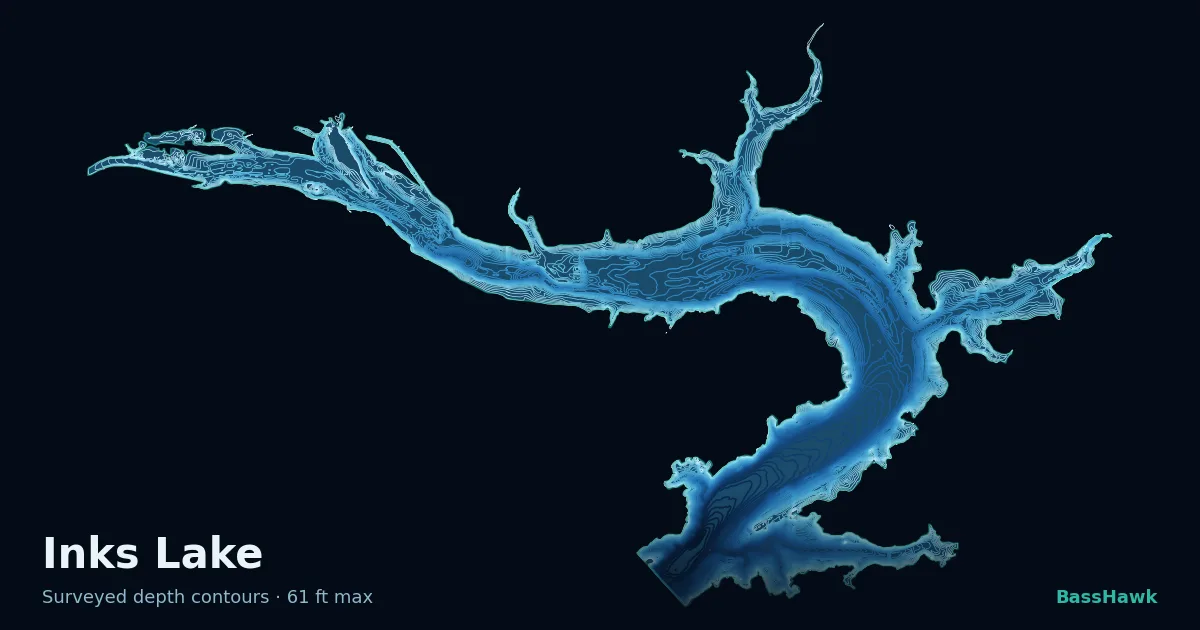
Brutal midday heat pushes bass deep and tight. Win early and late with topwater around docks, then grind the rock piles 10-20 feet on dragged plastics.
Water's scorching at 95 degrees, well above the comfortable range, so bass are locked down in shade and deeper structure where it's cooler. The pressure is dropping ahead of some weather rolling in, which normally fires them up, but this heat is the real boss today. They'll feed early and late when it's not a furnace, especially around deeper docks and rock piles. The water's got a normal stain so you can see your lures but bass won't chase far. Clear skies and zero cloud cover mean shallow water gets brutal by midmorning, so don't waste time up shallow once the sun gets high. The key is starting before sunrise when it's still cool, milking the docks hard, then transitioning deep by 9 a.m. and staying there until the sun softens late afternoon.
The day's game plan
Where to fish
- Private docks along western shore — 4-8 feet · Dock pilings, shaded undersides, transitions to deeper water beyond the dock structure
The western shore is noted for packed boat docks that hold bass year-round. Docks provide shade and ambush points. The fish stacked under them early morning and evening when shallow feeding is on. Many docks have deep water immediately offshore, letting bass feed shallow then retreat. - Rock piles and ledges main lake — 10-22 feet · Chunk-rock banks, exposed ledges, bottom transitions from soft to hard bottom, boulder piles marked by sonar
Rock piles are the primary structure on this lake. They concentrate bass in summer because rocks hold cooler water and provide shade. They're scattered throughout but main-lake points have the larger groups. Bottom drag and dropshot rigging work here all day. - Brush piles and submerged timber near structure edges — 8-20 feet · Standing dead timber, brush piles (some added by TPWD), laydowns, transitions where timber meets open water
Timber and brush provide shade and ambush cover. Inks has abundant brush relative to its size. Deep brush in 15-20 feet holds bass in the afternoon and midday heat. Brush piles near ledges are choice because they offer both shade and structure. - Creek channel swings and deeper transitions — 12-25 feet · Inside bends of creek channels, depth transitions from 8 to 15+ feet, channel drop-offs and ledges
Creek channels serve as migration routes and concentration points. Inside bends have current breaks and concentrate forage. The deeper water access means bass can feed shallow and escape deep quickly. Important for afternoon and midday patterns when bass are roaming between shallow and deep spots.
What to throw
- Walking topwater (6th Sense Catwalk or similar) — 4-5 in · bone, white · n/a (Early morning 7-9 a.m. and dusk 7-8:30 p.m. when light is soft and bass are feeding up)
Walk it side-to-side with steady twitches of the rod tip, keep cadence even and controlled, not frantic. Work it 10-15 feet per pass around dock pilings and structure edges. - Texas-rigged craw or creature bait — 4-5 in · green pumpkin, junebug, brown · 1/4 to 3/8 oz (Morning through late afternoon, 9 a.m. to 5:30 p.m. on deep rock piles and ledges)
Drag it slowly across bottom structure, pause 5-10 seconds on rocks and ledges, then inch it along with short 12-inch hops. Stay in contact with the bottom. - Dropshot rig with finesse worm — 4 in · watermelon, smoke, natural shad · 1/16 to 1/8 oz on weight, 12-18 inches above (Midday 11:30 a.m. to 2:30 p.m. when heat is worst and bass are in deepest water)
Work it vertical with small hops or slight twitches, barely moving the worm. Let it hover and flutter. Adjust depth to the bottom structure, 15-22 feet on rocks and deep brush. - Football jig with craw trailer — craw trailer 3-4 in · brown, green pumpkin, black · 1/2 oz jig (Midday on deep rock piles 15-22 feet, also effective morning 9-11:30 a.m.)
Drag it across rocky bottom, let it contact the rocks, short hops of 12-18 inches, pause between hops. Keep it bouncing and clawing across structure. - Shallow crankbait or small swimbait — 2-3 in · shad, perch, natural forage match · 1/4 to 3/8 oz (Evening and early morning 5:30-8:30 p.m. and 7-9 a.m., shallow structure adjacent to deep water)
Steady retrieve at moderate speed, 4-6 feet of water around docks and shallow edges. Twitch and pause if needed, or fish a weedless swimbait with 3-4 inch profile on steady retrieve.
How to work it
- Dock skipping — Early morning and evening, especially first and last light. Bass hide under docks to escape the brutal midday heat and hunt baitfish from that cover. · Western shore where docks are densest, 4-8 feet of water, focus on docks adjacent to deeper drop-offs
Cast under and around dock structure, aim for pilings, shaded undersides, and the spaces between docks. Let the lure settle and pause, then twitch it or drag it out. Skip baits like jigs and worms underneath to reach fish hiding in shade. - Bottom dragging — All day, but critical midday 11:30 a.m. to 2:30 p.m. when bass won't chase. Slow presentation keeps baits on the bottom where heat-stressed bass are. · Rock piles and ledges 10-22 feet, main lake points, structure breaks
Keep your bait in contact with the bottom, dragging 12-18 inches, pausing 5-10 seconds, then dragging again. Stay tight and feel the rocks and structure. This is vertical and methodical, not fast. - Sonar hunting — Midday and afternoon. Sonar helps you find and stay on structure in deep water where you can't see it visually. · Main lake structure, deep water 15-22 feet, transitions between flat bottom and ledges
Use your sonar to mark rock piles, brush piles, and depth transitions. Fish these marked spots with dropshots, jigs, or dragged plastics. Mark the GPS coordinates of productive areas and return to them. - Topwater walking in low light — Early morning 6:58 to 9 a.m. and dusk 7:30 to 8:30 p.m. when light is soft and bass are feeding up · Docks and shallow structure 4-8 feet, edges of deeper drops, anywhere with cover and adjacent deep water
Cast a walking topwater bait near dock structure, around pilings, and along ledges. Walk it side-to-side with steady rod twitches. Keep the cadence even and deliberate so bass can track the lure in fading or early light.
Pro tips
- The pressure is dropping ahead of some weather, which usually fires bass up, but don't count on it today. The 95-degree heat is the dominant factor. Bass will respond to the pressure drop at first light tomorrow morning much more than they will today. Focus on the early and late windows today and don't waste energy grinding deep structure in the brutal heat unless you're already there from the morning push.
- This lake is clear and lightly pressured, so natural colors and downsized baits pay off. Bone and white topwaters work because they match natural forage, not because they're flashy. Green pumpkin and brown dragged plastics are always solid here. Avoid neon colors unless the water gets stained, and match the size of the forage you see. Smaller bait = more bites when it's this hot.
- The waning moon is on day 29, which means darker nights and a shortened topwater window in dusk light. The solunar major at 1:47 p.m. is late afternoon, which could help the bite slightly then, but don't plan a trip around it. The minor at 8:34 p.m. is after dark. Focus on the proven windows: first light and dusk dock fishing, deep structure midday.
If conditions change
If the front rolls in ahead of forecast and the pressure drops faster or the temperature cools, the bite will improve throughout the day, especially on shallow and medium-depth structure. Switch to reaction baits like small spinnerbaits and moving swimbaits if the water cools. If clouds roll in and block the brutal sun, the shallow bite extends 1-2 hours later into morning and starts 1-2 hours earlier in afternoon. If the wind picks up from the south or southwest, that warms and energizes the water slightly, which can help the morning and evening bites. If the wind swings to the north or northwest, the shallow bite shuts down harder and you'll want to stay deep and on the thickest cover available. If clarity decreases from run-off, shift to darker plastics (junebug, black) and wider-blade spinnerbaits to increase vibration. If the water somehow clears further, downsize everything 25% and fish deeper, slower, and more stealthy.
Find more fish. This is a real report from that day's conditions — open the app for today's · free account