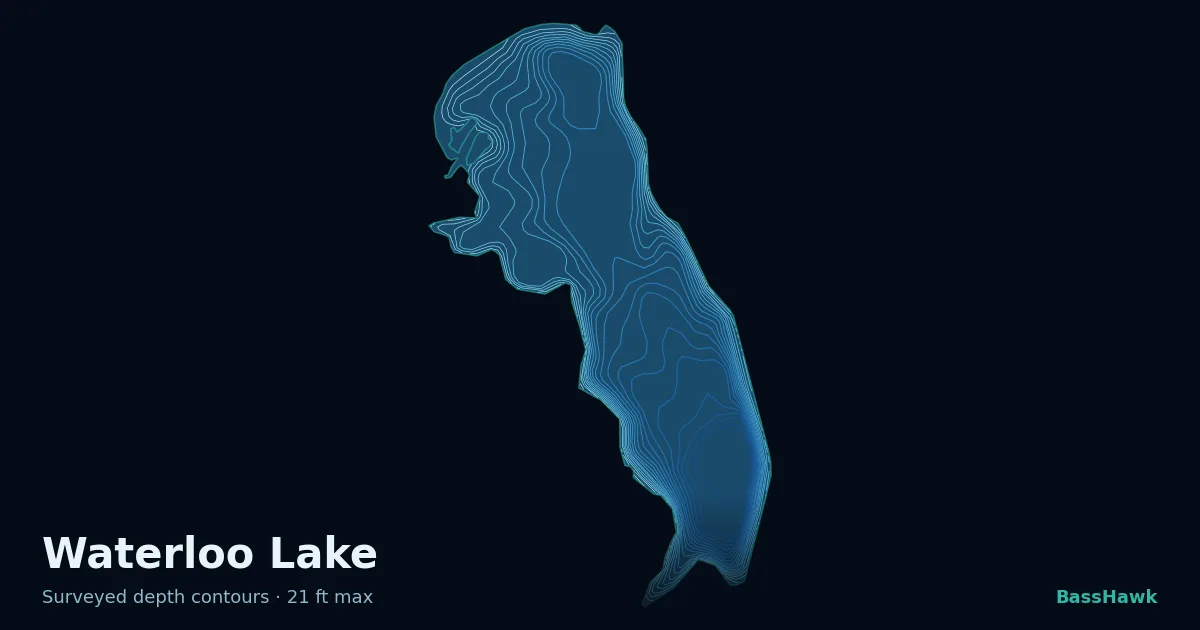
Early and late light saves the day in summer heat. Bass are deep and lazy, hunt the first hour and last two hours.
Summer on Waterloo Lake means bass are tucked deep to stay comfortable in 83-degree water. The lake is stained, which works in your favor because it lets you fish shallower and more aggressively than clear water would allow. The fish won't chase far, so you need to put the bait right in their face on structure where they're holding tight. Pressure is steady, which means patterns are predictable and repeatable. The real bite window is locked into dawn and dusk when the water feels less intense and the light is low. During the brutal midday bluebird sun, bass shut down hard. Plan to fish hard early, take a midday break or work deeper structure, then get back on it hard when the sun starts dropping.
The day's game plan
Where to fish
- Main Lake Points (north and south facing) — 6-18 feet shallow zone, 20-35 feet deep access · Hard bottom transitions, rock outcroppings, any timber, bait concentrations on flats just off the point
Points funnel bass movement between deep and shallow water. In summer, bass stage on the deep side of points or use the shallow flats at dawn and dusk. Main lake points always have deep water nearby, so bass can escape heat stress quickly. Hard bottom concentrates forage and gives bass a defined territory to hunt. - Creek Channel Bends and Swings — Inside bends 10-20 feet, outside bends dropping to 25-40 feet · Channel edges, inside bends create slack water and current breaks, outside bends have steepest drop-offs
Creek channels are highways. Bass use them to move between deep and shallow water. Inside bends slow the current and create ambush points. Outside bends provide quick access to deep sanctuary. In summer when bass are temperature-sensitive, proximity to deep water is everything, and channel bends offer both. - Shallow Timber and Rocky Structure (6-12 feet) — 6-12 feet, tight to cover · Fallen timber, standing dead trees, rock pile outcroppings, boulder fields, riprap banks
In low light at dawn and dusk, bass hunt shallow timber because shade and cover make them feel safe. Rocky banks warm slightly in afternoon sun and cool as evening approaches, creating micro-temperature changes that trigger feeding. Timber and rock provide ambush points where bass can hide and strike at prey moving past. This is the prime area for early and late light fishing.
What to throw
- Green Pumpkin Shakey Head — 4 in · Green pumpkin · 1/4 oz (Early morning and dusk, 6-15 feet of water on shallow structure)
Cast on or near structure, work slowly with small 2-3 inch hops on the bottom, pause between hops - 3-inch White Swimbaits — 3 in · White or pearl · 3/8 oz (Morning and late afternoon, 12-25 feet of water on channel edges and swings)
Swim steady 2 feet off the bottom, let it flutter on drops occasionally, methodical pace through transition zones - Chartreuse or White Blade Bait (Spinnerbait or Chatterbait) — n/a · Chartreuse with white blade, or solid white · 1/2 oz to 3/4 oz (Midday in deep water, 20-35 feet, over ledges and humps)
Drag steady along bottom and ledges, maintain bottom contact, work with sweeps of the rod, keep retrieve slow and methodical - Small Topwater (3-4 inch pencil popper or walking bait) — 3-4 in · White or chartreuse · n/a (Evening and dusk, 6-12 feet of water on main lake points and creek mouths in low light)
Cast and twitch with steady short movements, create small ripple and popping sound, measured retrieve speed not fast - Dark Soft Plastics (Black, Junebug, Dark Purple) — 5 in · Black or junebug · 1/4 oz (Dusk and night, 6-12 feet of water on shallow structure and timber)
Work slow on bottom with pauses, drag with occasional lifts, keep in contact with structure, rely on silhouette
How to work it
- Slow-Drag on the Bottom — Early morning through morning, and late afternoon through dusk. Works all day in deep water during heat of day. · Main lake points, channel edges, creek channel bends, anywhere bass are holding tight to cover in 8-25 feet of water
Cast near structure, reel just fast enough to maintain bottom contact, let the weight of the jig or blade bait do the work, pause occasionally and let the bait fall naturally - Topwater Twitching — Low light only: early morning from sunrise to 2 hours after, and from 2 hours before sunset through dark. Do not throw topwater in full sun. · Shallow structure within 10 feet of shoreline, main lake points, timber, docks, creek mouths in 6-12 feet of water
Cast beyond the target, let it settle, then work it with short sharp twitches of the rod tip at 6-inch intervals, keep the pace steady and measured, don't overspin it - Vertical Presentation or Light Jigging — Midday during intense heat when bass are stacked tight on structure and won't chase. Most effective in the hottest hours of the day. · Deep main lake humps, channel ledges, steep drop-offs in 20-35 feet of water
Position the boat over structure using electronics, drop the jig or blade bait straight down to the bottom, work it with short lifts and drops, stay vertical to maintain bottom contact and feel strikes
Pro tips
- Pressure is steady today, which means patterns repeat and fish location is consistent. If you catch one on a main lake point in 10 feet of water early on a shakey head, run your entire morning hitting similar setups on other points. Don't waste time searching, replicate the pattern.
- The solunar majors today hit at 6:39 AM and 6:59 PM. The 6:39 AM window overlaps your early bite almost exactly, so the first 30 minutes are peak. The 6:59 PM major happens right at the start of your evening topwater window, so expect a feeding flurry when the sun is low. These windows are your tiebreakers when deciding where to fish during transition periods.
- Summer forage is small and abundant, so downsize everything compared to spring. Bass won't chase a big bait, and they'll ignore oversized presentations when smaller naturals are everywhere. Stay with 3-5 inch baits, not the 6-8 inch range. This is finesse season.
If conditions change
If a breeze picks up from the south or southwest and clouds roll in, the shallow bite can extend deeper into the day. Cooler, windier conditions push comfort window later. Keep throwing topwater even into midday if it's overcast and breezy. If the pressure drops sharply and you sense a front moving in before nightfall, expect an aggressive pre-front bite for 6-8 hours as bass sense the change. Go aggressive with faster blade baits and topwater. Skip the finesse and cover water. If the water clouds up from wind or runoff, shift to chartreuse and white blade baits; darker colors work less well if visibility drops below 2 feet. If it clears unexpectedly and you get bluebird skies, bass will move even deeper than predicted. Push your deep-water fishing to 30-40 feet and fish the steepest structure available, even during early and late light.
Find more fish. This is a real report from that day's conditions — open the app for today's · free account