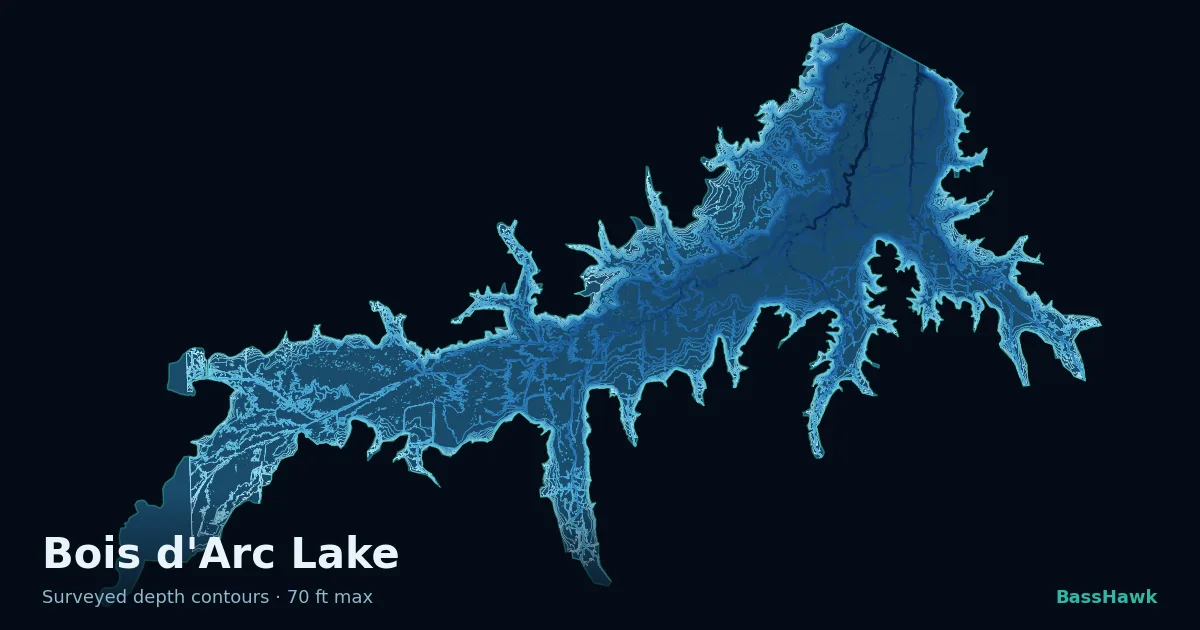
Hot summer grind. Early pondweed and timber, then pull offshore to brush piles and points after the sun climbs.
Water's sitting at 89 degrees in full summer mode, which means the bite is split hard between early shallow and deep midday. The bass have pulled into two camps: shallow pondweed and timber in the first couple hours, then they scatter offshore to deeper brush piles, pond dams, and points in 15-23 feet to find cooler water and stay comfortable. Pressure is dropping ahead of some weather, so they should be chewing more aggressively than they have been in the dog days. Water's got normal stain, so natural to bright colors both work. Light is brutal all day on clear skies, so shade and depth are the two things bass are hunting. The lake's running low, which keeps structure more defined and easier to pattern. Work fast early, then slow down and soak it once the sun gets overhead.
The day's game plan
Where to fish
- Pondweed flats and edges — 2-5 feet (edges), up to 8 feet in deeper pockets · American pondweed colonies with open water pockets; natural forage-rich shallow flats
Bass hunt baitfish in pondweed early and late in the day when light is low. The grass provides oxygen, shade, and cover. Early morning frogs and topwater dominate here. The edges are where bass position to intercept baitfish moving in and out. - Flooded timber west of FM 897 bridge and secondary timber areas — 3-15 feet (dense timber extends into deeper water) · Standing trees with creek channels and old road beds running through; creek channel swings nearby for deep water access
This is the densest cover on the lake and holds the most aggressive bass. Texas rigs and shaky heads work all day here. Bass use timber as ambush points and escape routes. Creek channels running through timber funnel movement and provide deep water refuges. - Main lake brush piles, pond dams, and points — 15-23 feet, structures rise toward the surface (top of pile may be 12-16 feet) · Engineered and natural brush piles, old pond dam remnants, secondary and primary points with rock or hard bottom transitions; creek channel bends with drop-offs
Deep water is where bass retreat during midday heat. Brush piles and pond dams concentrate bass because they're predictable structure in a young lake. Points funnel movement between shallow and deep water. Side-imaging helps locate individual piles and drop-offs. - Windy points and secondary points with bushes — 6-10 feet, with drop-off to 15+ feet nearby · Points with scattered bushes, shallow hard-bottom drops, baitfish-pushing wind-blown banks
If afternoon wind picks up, these areas oxygenate and push baitfish, drawing bass to hunt more aggressively than they would in flat-calm conditions. Chatterbaits and spinnerbaits work well on the edges. The proximity to deeper water provides bass an escape route, making them more willing to hunt shallow.
What to throw
- Texas-rigged creature bait — 4-5 in · Green pumpkin or black/blue · 1/4 oz to 1/2 oz depending on depth and cover density (All day around timber and structure, especially early morning and evening in shallower water (3-10 feet), and offshore in 15-20 feet at midday)
Pitch and flip into timber and bushes, drag on bottom with pauses, work edges of creeks and channels. Let it sit 3-5 seconds in pockets before dragging again. - Popping frog — n/a · White/chartreuse or natural black · n/a (Early morning (before 8:30 AM) and dusk (after 7:00 PM), whenever water is cooler and light is low)
Cast over pondweed, work with a cupped-prop cadence, creating splashes and commotion. Skip under docks or overhanging brush. Work the edge where grass meets open water. - Carolina rig with large worm — 10.5 in · Watermelon red or watermelon/red flake · 1 oz sinker, standard Carolina rig setup (Midday and afternoon, offshore in 15-23 feet over brush piles and deep points)
Drag slowly on bottom over brush piles, humps, and pond dams. Keep the line semi-slack and feel for bottom contact. Work systematically, covering the entire structure from edge to center. - Flukes or soft plastic sticks — 4-5 in · Natural shad, white, or chartreuse · Wacky rigged (no weight) or shaky head 1/8-1/4 oz (Early morning and evening around pondweed, also effective on shaky head all day on transition edges (2-6 feet early, 8-12 feet midday))
Wacky-rig near pondweed edges and let it flutter on the fall. On a shaky head, drag it slowly on bottom near timber and bushes. Work the edge of structure where grass meets open water. - Spinnerbait or chatterbait — n/a · White/chartreuse or black/blue blade combo · 3/8 oz to 1/2 oz (Early morning (8-9 AM) around pondweed edges and on windy points if afternoon wind picks up, also evening as light fades)
Work on or around pondweed edges, points with bushes, and shallow flats. Cast and retrieve steadily, pumping the rod occasionally. In wind, burn it faster to trigger reaction strikes.
How to work it
- Pitch and flip — Early morning through midday when bass are tight to cover; most effective in 3-8 feet but works in 12-15 feet if you can reach it · Shallow timber and bushes in 3-10 feet, especially around the dense standing timber west of the FM 897 bridge and secondary points
Underhand or sidearm cast to specific timber, bushes, or dock posts. Drop the bait into pockets with minimal splash, let it settle, then drag or shake it gently. Use 15-20 lb fluorocarbon and be ready for a hard strike. - Dragging Carolina rigs — Midday through late afternoon when deep water is the primary pattern; also effective in early morning and evening if bass are holding deep structure close to shallow · Offshore brush piles, pond dams, humps, and points in 15-23 feet
Cast beyond the structure, drag slowly on bottom, keeping tight to the contour. Feel for the weight ticking bottom. Pause occasionally over the highest points of brush piles. Move methodically, covering the entire area. - Edge targeting — All day, especially during light transitions when bass shift depth. Most productive when conditions are changing (falling pressure, sun angle shifting, wind picking up) · Pondweed edges, timber line transitions, outside bends of creeks, breaklines from flats to channels (2-8 feet early/late, 10-18 feet midday)
Identify the transition between different depths or cover types (grass to open water, timber edge to channel, point to flat). Fish the exact edge with slow presentations, shaky heads, or wacky-rigged plastics. Bass position on edges to intercept forage moving between areas. - Topwater popping in low light — Early morning (before 8:30 AM) and dusk (after 7:00 PM) when light is low and bass are willing to chase aggressively · Pondweed flats and shallow timber in 2-4 feet, focus on open pockets or edges where bass can approach
Cast a popping frog or propeller bait over or near grass and timber. Work it with short, deliberate pops to create splashes and commotion. Pause 3-5 seconds between pops. Keep the rod tip at 10 o'clock and let the lure do the work.
Pro tips
- Pressure is dropping ahead of weather, which usually fires up the bite slightly. Bass should be a touch more aggressive than they have been in the recent dog days. Use this window to cover water and load the boat on the offshore bite 10 AM to 2 PM before the bite tapers.
- The lake is low (running around 0.8 feet below pool), which actually helps you. Structure is more defined, brush piles are easier to locate with side-imaging, and points have sharper break angles. Spend time identifying and marking individual piles early in the season so you can return to them consistently.
- Switch to fluorocarbon leaders in the shallow pondweed bite, especially early morning. Water clarity is normal stain but in bright sunlight on shallow flats, bass can see braid. A 12-15 lb fluoro leader tied to your main line helps with both visibility and abrasion on sharp grass and wood edges.
If conditions change
If clouds roll in and the sun gets blocked for an hour or more, the shallow bite will extend later into the morning. Stay on pondweed and timber in 3-8 feet and work topwater and faster presentations longer than usual. If the wind really picks up (15+ mph), target the wind-blown points and work spinnerbaits, chatterbaits, and lipless crankbaits to trigger schooling bass. Windy banks hold active baitfish and aggressive bass. If the lake muddies from afternoon rain or run-off, move to darker colors (black, junebug, black/blue) and upsize to 6-inch creature baits. Max out the vibration with bladed baits (spinnerbaits with Colorado blades) and fish the shallowest, shadiest timber you can find. If the pressure stays low or continues to drop through the afternoon, the offshore bite can stay hot longer than typical. Don't abandon deep structure early if you're catching. If the sky stays brutally clear and hot all day, abandon any evening shallow plans and stay deep on brush piles and points through sunset. Shade and cool water will be the only thing bass care about.
Find more fish. This is a real report from that day's conditions — open the app for today's · free account