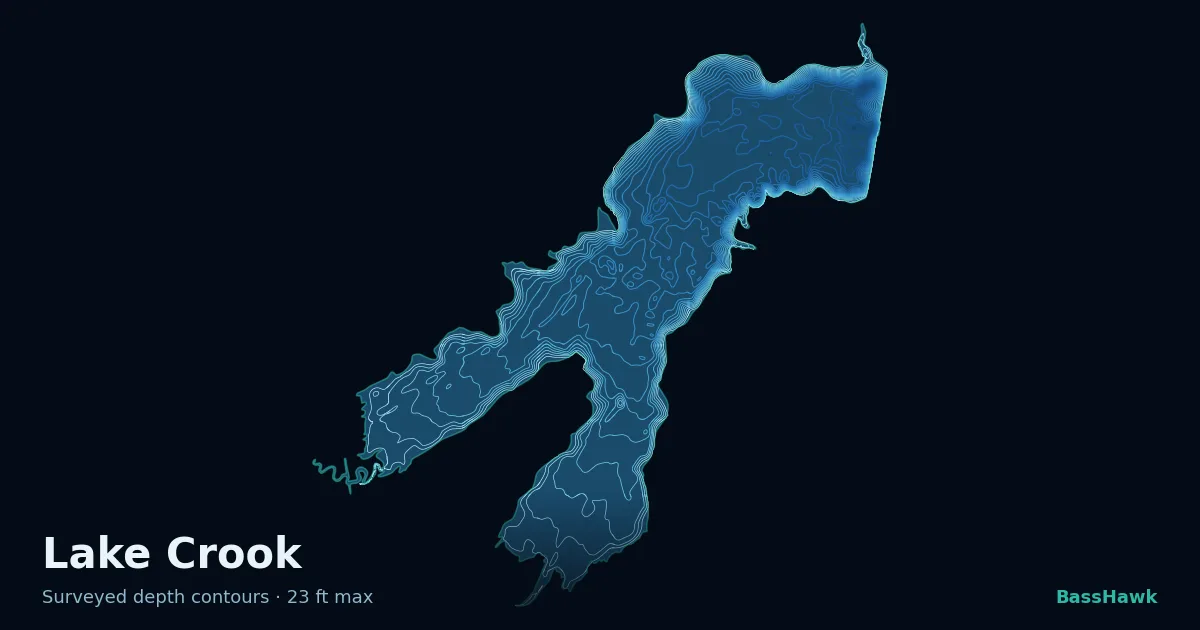
Brutal heat bite—work the deep channel edge early, then hunt shaded timber from mid-morning through dusk.
Water's sitting at 95 degrees, well into the uncomfortable zone where bass shut down in open water and pile into the deepest shade they can find. This time of year on Crook, that means the channel and the timber edge on the main lake. The lake stays turbid year-round, which actually works in your favor today because it cuts light penetration and keeps bass willing to move shallow during low-light windows. Pressure's dropping ahead of some weather, so if you time the early bite right you'll catch a few fired-up fish before the heat locks them down. After sunrise, it's a grinding game on deep structure and thick cover. The shallow shoreline grass won't hold anything today except maybe a catfish.
The day's game plan
Where to fish
- Main lake channel edge — 18 to 24 feet · Outside bends and ridge breaks where the bottom drops into the deepest basin
In 95-degree water, the deepest, most stable zone is where bass hold. The channel is the migration route and the edge is where they position to intercept shallow-moving baitfish without leaving their comfort zone. - Deep timber flats on main lake — 16 to 22 feet · Submerged timber, root systems, and hard brush near the channel
Timber provides both depth and shade. Bass use it as a refuge from the heat and as an ambush point. Working timber methodically is the most reliable way to find bass that are holding tight all day. - Secondary points with timber — 12 to 18 feet · Point structure with submerged or partially submerged timber and nearby deep water access
These areas hold transition fish in late afternoon and evening. Bass use points as navigational markers between deep holding areas and shallow feeding zones. Timber on the point gives them secure cover while they hunt. - Shallow shoreline timber and bulrush — 3 to 8 feet · Bank-side timber, root systems, and emergent bulrush line near deep water
After dark, bass move into shallow water to hunt. The bulrush and timber provide cover and the nearby deep water gives them an escape route. This is your second-best zone outside the early-morning window.
What to throw
- Finesse worm on shaky head — 4 in · Green pumpkin, junebug, watermelon red flake, or natural shad · 3/16 oz to 3/8 oz (Early morning and all day on deep structure; transitions and evening in shallower timber.)
Dead-stick or shake it gently on bottom in deep water; drag it tight to timber in mid-depth zones. - Texas-rigged finesse worm — 5 in · Green pumpkin or watermelon red flake · 3/8 oz (Mid-morning through early afternoon on deep timber.)
Drag it tight through submerged timber, pause 2 to 3 seconds between lifts. Keep tension light so it falls naturally. - Jig with chunk trailer — Jig 3/8 to 1/2 in head, trailer 3 in total · Black or junebug jig; black, blue, or dark chunk trailer · 1/2 oz (Midday and tight-to-cover afternoon periods.)
Drag it through timber, bump it off structure, pause 3 to 4 seconds. Work it vertically through deep brush. - Chatterbait or small spinnerbait — 1/4 oz · Black or dark purple chatterbait; Colorado blade in silver or gold · 1/4 oz (Evening when water starts cooling and bass are willing to move faster.)
Burn it steady over points and structure, then slow it as it drops off the edge. Keep blade speed consistent. - Black topwater popper or crawler — 2.5 to 3 in · Black · n/a (Dusk and night when bass are shallow and hunting in the dark.)
Walk it gently with soft twitches if it's a crawler; pop it deliberately if it's a popper. Keep the cadence slow and methodical.
How to work it
- Deep channel edge work — Early morning and again in late afternoon as bass transition to and from shallow water. · Main lake channel edges and outside bends of creek channels
Position your boat on the channel edge where the main lake ridge breaks into deep water. Cast shaky heads, drop shots, and jigs along the contour. Work the breaks where the bottom transitions from 18 feet to 22 feet. - Timber picking — Mid-morning through early afternoon when bass are locked in tight to shade. · Deep timber stands on main lake structure, 16 to 24 feet
Identify submerged timber on sonar, then cast tight to each stick. Pitch Texas-rigged worms or jigs right into the branches and work them slowly through the wood. Don't rush between casts. - Drop shot precision — Late afternoon when the bite is turning on again. · Channel edges and ridge transitions in 16 to 20 feet
Mark the contour with sonar, then work a drop shot rig vertically or with slight horizontal drags. Shake it gently on bottom, lift it 12 inches, and let it fall back on slack. Cover one contour line thoroughly before moving. - Evening shallow transition — Evening as the sun lowers and bass move up from deep sanctuary. · Secondary points with timber and brush, 12 to 18 feet
Focus on points and secondary structures that have shallow water nearby and deep water access. Work chatterbaits or small spinnerbaits at moderate speed over the shallower portions, then slow them as they fall into deeper water.
Pro tips
- Pressure is dropping, which gives you a small edge on the morning bite. Even in this heat, dropping pressure makes bass slightly more willing to feed. Hit that early-morning channel edge hard for the first 45 minutes, then transition to the timber grind. Don't waste time on shallow water during the day.
- In water this turbid and this warm, color matters less than vibration and feel. A shaky head with a slight twitch will outfish a finesse worm that sits dead on bottom. The lateral line is doing all the work for these bass, so make sure your presentation creates disturbance without being too aggressive.
If conditions change
If a line of thunderstorms rolls through and pressure drops further, the bite could fire up briefly across all depths, especially on the channel edge and timber. Fish faster presentations (chatterbaits, spinnerbaits) and cover water more aggressively. If the wind picks up from the south and clouds roll in, the shallow bite could extend longer into the morning, and dusk could stay productive later into the night. If the water level drops more than another half foot, tighten your focus on the channel edge where deep water access is most pronounced. If a north wind arrives and clears skies, the shallow bite evaporates and you're purely a deep-structure grind from sunrise to dusk. If water clarity improves or a heavy algae bloom arrives, adjust colors toward natural shad and downsize everything by half.
Find more fish. This is a real report from that day's conditions — open the app for today's · free account