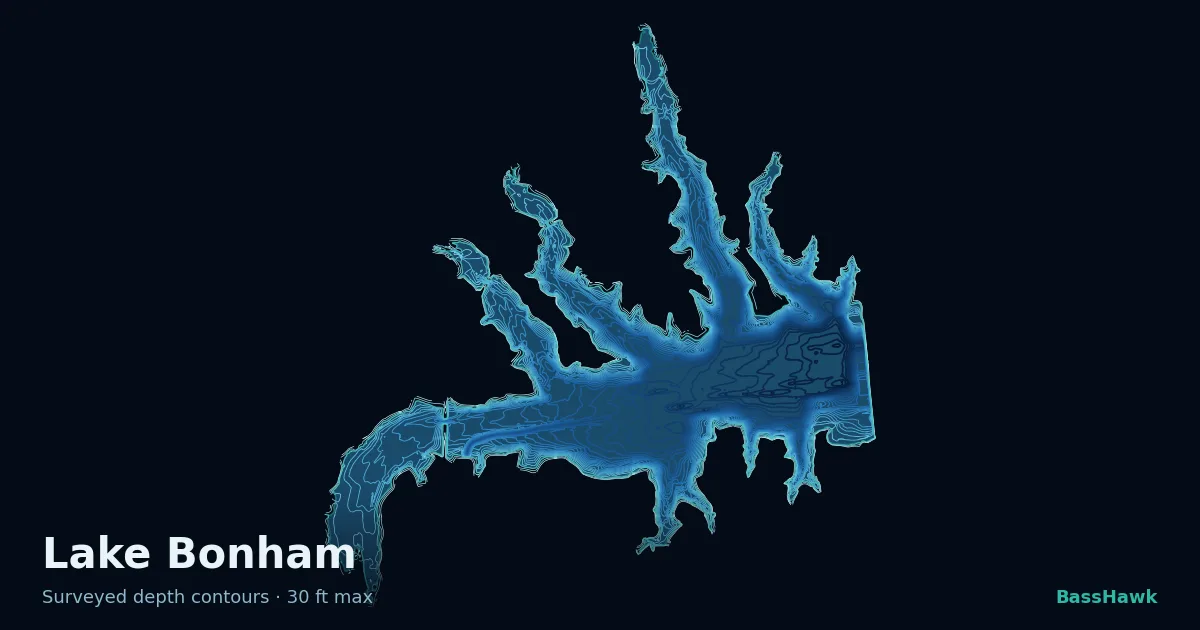
Fire up the dam and the cattails at dawn, then hunt the wood and weeds deep when the sun pins everything down.
Water's hovering at 103 degrees. That's uncomfortably warm for largemouth and they're going to be lethargic, hiding in the thickest shade and deepest available structure all day. The pressure's dropping before weather moves in, so there's a bite window right now at dawn and again at dusk when they'll look up shallow, but between sunrise and sunset they'll be locked down tight in timber, around the dam rip-rap, and in submerged vegetation in 15 to 25 feet. The lake's down 1.4 feet, which concentrates bass tighter to cover and makes them less aggressive. Light is intense with no clouds, so every bass is heading deep or hunting shade. Early morning and evening are your real windows before heat shuts them down.
The day's game plan
Where to fish
- Dam Rip-Rap — 3 to 12 feet along face and adjacent shallow water · Large rock and concrete breaks, current breaks behind rocks, shallow flats feeding into drop-offs
Primary holding area, concentrated bass, reliable depth gradient, shade from noon sun, rip-rap creates ambush points - Cattail-Lined Coves — 2 to 10 feet · Emergent cattail and water willow, vegetation edges, shallow flats with weed transitions
Shallow cover and shade, concentrated baitfish, natural spawning and feeding habitat, accessible at dawn and dusk, bass set up on edges - Standing Timber and Submerged Vegetation — 12 to 25 feet in main basin and creek channels · Submerged wood, pondweed, coontail beds, channel bends near timber
Deep shade and cooler water during heat stress, bass retreat here midday, fish attractors placed here hold quality fish, vegetation provides forage cover - Fish Attractors near T-Pier — 18 to 25 feet · Placed structure, deep timber concentration, channel adjacency
Documented bass concentration point, holds bigger fish per survey data, deep refuge during heat, tight cover focus when bass aren't roaming
What to throw
- Spinnerbait — n/a · white or chartreuse blade with white or chartreuse skirt · 3/8 to 1/2 oz (Early morning at the dam and cattails, first light before heat)
Steady retrieve bumping structure, rip the blade through shallow cover, keep it thump-thumping to trigger strikes - Texas-Rigged Worm — 6 to 7 in · green pumpkin, watermelon-red flake, natural · 1/4 oz pegged (Morning and midday on timber and weeds)
Drag it slow along wood and through vegetation, feel the bottom, let it sit in heavy cover for 3 to 5 seconds at a time - Drop-Shot Rig — 3 in finesse worm · natural shad, ghost minnow, pearl · 1/4 oz weight below the hook, 6 in apart (Midday heat window when bass are deepest and least active)
Vertical shake over structure, small lifts and pauses, hold the boat tight, let gravity do the work - Compact Crankbait — 2 to 2.5 in · charcoal shad or natural forage · n/a (Late afternoon as heat eases and pressure drops)
Steady mid-depth retrieve parallel to structure, keep a slight contact with weeds but don't dig deep, work at a pace that vibrates the bill - Finesse Worm on Shaky Head — 5 to 6 in · green pumpkin, watermelon, black, junebug · 3/16 to 1/4 oz jighead (Evening and dusk when bass move shallow to feed)
Cast near cover, small hops with a pause between each, let it settle near cattails and docks, work slowly with just the rod tip
How to work it
- Slow Dragging — Morning through midday when water is hot and bass are lazy · Timber, vegetation, rip-rap edges
Keep the rod at 10 o'clock, reel steady and feel the bottom, let the worm bulge through cover, pause for 3 to 5 seconds when you feel weight or resistance - Vertical Shaking — Midday heat when bass won't chase, requires pinpoint accuracy and patience · Deep timber, fish attractors, channel drops
Drop the rig straight down over structure, keep the weight on or just off bottom, shake the rod tip vertically 12 to 18 inches of rod motion, pause and settle - Reactive Retrieve — Early morning and evening when pressure and light favor aggression · Shallow rip-rap, cattail edges, shallow docks and pilings
Cast to cover and rip the bait with sharp rod jerks followed by controlled fall on semi-slack line, trigger a strike reflex with movement rather than natural forage appeal - Slow Crank — Late afternoon transition as sun angle drops and bass begin moving shallow · Shallow flats, weed edges, adjacent to channel drop-offs
Steady handle turn at a pace that lets the bill tick bottom or kiss vegetation, maintain constant depth and vibration, don't pause or vary the speed
Pro tips
- Water at 103 degrees means every fish is either in shade or deep. Don't waste time on open water or shallow flats between 10 AM and 4 PM. Fish the thickest cover and deepest available structure, and when you find a bass on wood or in a weed mat midday, immediately look nearby for identical structure. The pattern is Cover equals depth equals rest.
- Pressure is dropping before weather, which should spike the bite at dawn and dusk. Don't cut your morning short. That first hour from sunrise to 8:30 is your best chance at numbers and quality. If you skip early morning because the launch is slow, you're leaving the biggest window of the day on the table.
- At this water temperature, slow is not optional, it's the only play that works. A worm dragged at a crawl through timber will out-fish any crankbait or fast presentation all day. Bass in warm water are lethargic. Make them commit to eating, not just chasing. Put the bait in their face and let gravity and patience do the work.
If conditions change
If the front rolls through hard and pressure climbs, bass will tighten up even more into the thickest wood and the dam. Downsize everything to 3 to 4 inch worms, go to darker colors (black, junebug), and fish the tightest cover available. Forget open-water presentations entirely. If the wind swings to the north after the front passes, water will feel slightly cooler; lengthen your evening and dusk windows and work the shallow flats more aggressively, but midday heat is still the enemy. If clearing algae bloom muddies the water from summer bloom breakdown, go to a wider-blade spinnerbait with a darker skirt (black or dark blue) and increase vibration to help bass find it via lateral line. Stay on structure and don't burn energy covering clear water. If unexpected afternoon clouds roll in and the sun is blocked, the shallow bite can extend later into the afternoon and the deep-structure lockdown eases earlier. Work more of the transition zone between shallow cover and the channel drops. The pattern stays the same, just compressed into tighter time windows.
Find more fish. This is a real report from that day's conditions — open the app for today's · free account