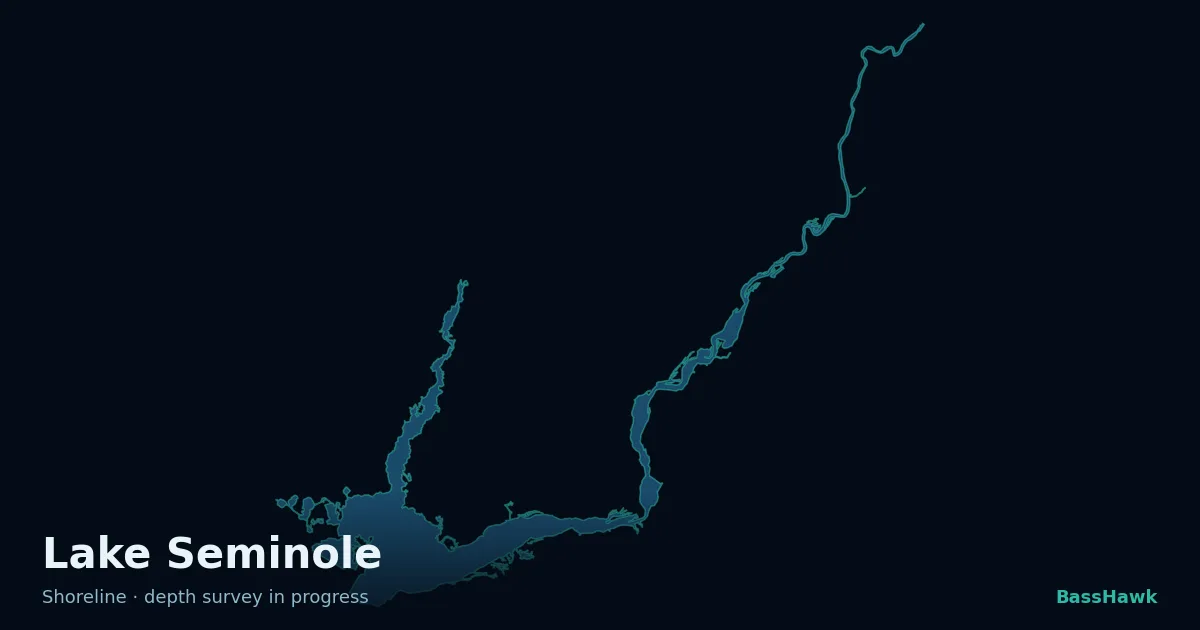
Summer doldrums bite, but shallow wood and channel ledges fire when the heat backs off early and late.
Water's at 75 degrees and we're deep in summer mode on Seminole. Bass pull away from the shallows midday to find cooler water and shade, but the new moon and light pressure sitting stable means they're not locked down tight. Early morning and evening you get a real window to pick apart the shallow wood and riprap before they tuck into the deeper channel ledges where the real comfort zone is. If the sun stays bright and clean all day like it looks to be, don't waste much time grinding the shallows past mid-morning. Work into dusk and you'll catch them again as they slide back up.
The day's game plan
Where to fish
- Shallow riprap banks on creek points — 3 to 8 feet · rock banks with wood and current breaks, feeding zones off deeper channels
Early morning staging spot where fish move to hunt before sun climbs. Riprap holds bait and gives them current shelter. Close proximity to deep creek channel means they drop to shade quickly when heated. - Secondary creek channel ledges and inside bends — 15 to 22 feet · hard bottom transitions, timber on ledge edges, current breaks at inside bends
Transition zone where morning fish stack before committing deep, and where evening fish stage before moving shallow. Depth and structure give them options to move up or down without abandoning the creek. - Main lake deep channel structure — 20 to 28 feet · hard bottom ledges, channel bends, timber on edges, old river channel
Summer refuge when heat builds. Deepest available structure with adequate shade. Channel bends concentrate scattered fish. Hard bottom holds cooler water than soft mud. - Shallow creek bays and flats — 1 to 8 feet · scattered laydowns, reed edges, riprap points, dock cover near deeper water
Evening and night hunting grounds when new moon and low light give them confidence. Forage congregates in shallow bays at dusk. Adjacent deeper water gives them escape route.
What to throw
- Green pumpkin finesse worm — 5 in · green pumpkin · 1/8 oz (early morning on riprap and shallow wood, also evening and night)
shaky head, steady drag with small pauses along structure - White blade spinnerbait — n/a · white blade, dark skirt · 1/2 oz (morning and transition hours when bass move between deep and shallow)
steady retrieve with lift and drop cadence, cover water fast - Black or junebug lipless crankbait — n/a · black or junebug · depends on model, typically 1/2 to 3/4 oz (midday deep water, also night)
cast, pause on bottom, dead stick, minimal movement, pause retrieves over deep structure - Dark craw jig — 5 in total with trailer · black or junebug · 3/8 oz (evening and dusk on shallow structure with cover)
pitch to wood, let it fall, work it slow on bottom with minimal hops - Natural shad swimsuit — 6 in · natural shad, pearl, or chrome · 1/4 oz (evening transitions and early night)
steady retrieve along the deep side of shallow structure, 6 to 12 inches off bottom
How to work it
- Shaky head — early morning, evening, low light when fish are active but not chasing · riprap, wood edges, shallow channel transitions 3 to 15 feet
Small finesse worm on 1/8-ounce weighted jig head, cast and drag along bottom with small vibrations and pauses, minimal rod movement - Vertical drop shot — midday when fish are deep and stationary, also transition hours when they're holding specific depths · channel ledges, deep main lake structure 15 to 28 feet
Worm rigged 12 to 18 inches above a 1/16-ounce weight, cast over ledges and deep structure, work it vertically with small pops and long pauses - Pitch and flip — dusk and night when bass hunt cover aggressively, also morning early before shade breaks · dense wood, laydown cover, docks, shallow creek structure 2 to 10 feet
Cast or flip a jig and craw to cover within 15 feet, let it fall on controlled line, work bottom with hops and pauses
Pro tips
- New moon and stable pressure work together this time of year, so the early and evening windows will stay active longer than usual summer days. Don't leave the shallows until midday sun really bears down, and get back to shallow wood at least an hour before dusk.
- Lipless cranks and shaky heads are your foundation baits in summer because they work reaction and don't require the fish to chase. When heat maxes at midday, switch to dark baits and vertical presentations over the deepest structure available. Make every cast count instead of covering water.
- Watch the transition hours closest. Fish move between shallow and deep over a quick window, and secondary points and channel bends are where they pause. Hitting those edges at 9 AM and 5 PM often beats straight deep or straight shallow fishing.
If conditions change
If a front rolls in overnight and pressure drops, expect them to fire harder early and later into morning before retreating deep. Stay on the shallow wood longer than the game plan says. If a northerly front blows through and water cools, they'll compress tighter to the deepest channel and wood, so downsize everything and fish slower and closer to cover. If the wind picks up from the south after a calm morning, shallow riprap banks activate longer because wind oxygenates and pushes bait. If water clarity drops from summer algae bloom, switch to wider-thumping blades like Colorado spinners and darker solid colors, and slow your retrieves so they can track the bait by vibration alone.
Find more fish. This is a real report from that day's conditions — open the app for today's · free account