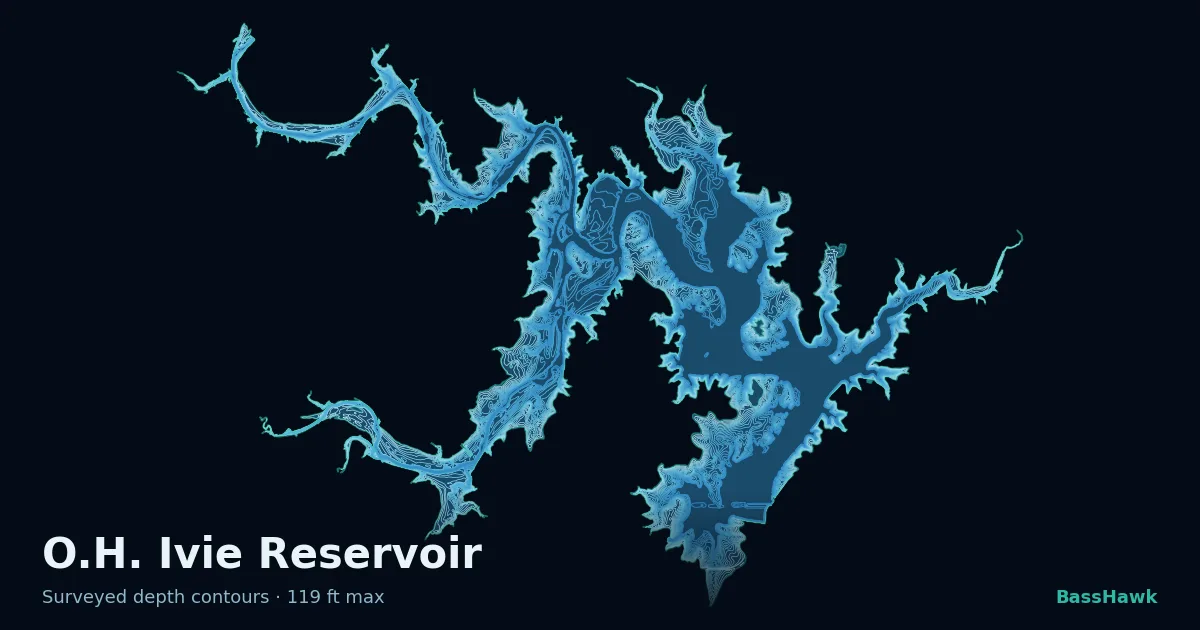
Heat's crushing the bite, but early topwater and deep shaky-head work will connect you before the sun locks them down.
Water's sitting at 94 degrees, which is about as uncomfortable as it gets for largemouth. Fish are lazier than usual, and they're not looking far for meals. You're past prime topwater season but the shallows will still hold some early, then everything slides deep into cooler water and shade by mid-morning. The pressure is falling ahead of some weather, which normally fires them up, but the heat is the real governor here. Stained water gives you some color options. Most of your day-in, day-out fish will be holding on deeper ledges, channel bends, and in thick timber where they can sit tight and conserve energy. The ones willing to feed are doing it at first light, then again at dusk when the sun backs off.
The day's game plan
Where to fish
- Turkey Bend — 2-25 feet depending on zone · Main lake point with shallow flats running into deeper channel, hard bottom, some timber.
Consistent producer year-round. Shallow flats hold early morning and dusk bass. The channel break at 12-18 feet is transition zone morning and evening. Deep ledges hold midday fish. Versatile spot for covering all daylight periods. - North Island and South Island — 3-20 feet · Main lake islands with shallow grass and brush flats, rocky banks, deeper bends and channel swings.
Midlake islands concentrate bass year-round. Shallow brush fires early in the day. Channel swings and deeper structure around the islands hold them as sun climbs. Reports confirm consistent depth-to-structure variety that matches today's pattern. - Creek Channel Swings — 8-18 feet (inside bends) · Inside bends of Concho River and Colorado River channels where bass stage and feed. Hard bottom, occasional timber, depth transitions.
Channel breaks funnel bass movement and concentrate them during migration and daily feeding. Inside bends create current breaks and hard-to-soft transitions that bass use as highways. Early morning and evening bite strong here. Transition zone all day. - Rocky Points and Riprap — 2-15 feet · Hard-bottom main lake points, rocky banks, exposed riprap near dam area, gravel and clay flats.
Bass stage on hard bottom for feeding. Early topwater works rocky shallow points. As heat builds, deeper hard-bottom points 12-18 feet hold transition fish. Rock creates structure for holding and ambush. Consistent depth producers throughout the day.
What to throw
- Topwater Frog — 2.5 to 3.5 in · Okeechobee Craw, black · n/a (First light (7:02-9:00 AM) and last light (7:30-8:25 PM) in shallow brush and salt cedar.)
Cast tight to vegetation and shallow cover. Work with slow, steady twitches 2-3 inches apart. Pause 3-5 seconds between moves. Let the frog do the talking, don't overwork it. - Soft Plastic Worm (Ribbon Tail) — 10 in · Plum, Plum Apple, Red Bug · 3/8 to 1/2 oz on shakey head (Midday 11:30 AM to 3:30 PM in deep water 18-25 feet, also productive all day on deeper structure.)
Rig on a shakey head (jig head with thin wire keeper). Fish vertically or with short 6-inch drags just off the bottom. Let it sit and shake in place, keep tension on the line. Work rocky bottom, hard flats, and channel ledges. - Soft Plastic (Swimbait or Creature Bait) — 6.5 in · Plum Apple, Red Bug, Okeechobee Craw, Green Pumpkin · 1/2 oz jig head (Morning 9:00-11:30 AM on transition ledges 12-18 feet, evening 5:30-7:30 PM on shallow to medium flats.)
Pitch and drag along bottom, rock piles, and wood. Work the lure with short 6-8 inch drags, let it settle, then drag again. Keep it tight to cover. - Whopper Plopper — 5 to 7 in · White belly, grey belly · n/a (Early morning 7:02-9:00 AM and dusk 7:30-8:25 PM in shallow flats and rocky points 2-8 feet.)
Cast and retrieve with steady, rhythmic twitches. Work it along flats and points, not too fast. The tail blade does the work; keep tension and let the lure walk. - Small Swimbait — 3 to 4 in · Natural shad, bluegill pattern, light colors · 1/8 to 1/4 oz jig head or unweighted (Night fishing under lights in shallow water 2-8 feet, or deep structure in heat of day.)
Fish near lights at night or retrieve slowly on bottom in deep structure. Cast and drag, let it flutter down. Mimic injured shad or small baitfish.
How to work it
- Shakey Head Finesse — Midday grind and any time bass retreat to deep cool water in heat. Primary technique from 11:30 AM to 3:30 PM, but effective all day on deeper structure. · Deep main lake ledges, channel bends, rocky humps, and off-shore structure 18-25 feet.
Rig a 10-inch worm on a 3/8 to 1/2 oz jig head with a thin wire keeper. Fish vertically or with short 6-8 inch drags along bottom. Keep the line tight, feel for structure, and let the jig head vibrate the worm in place with small twitches of the rod. - Pitch and Drag — Morning transition (9:00-11:30 AM), evening (5:30-7:30 PM), and whenever bass are in shallow to medium structure and not aggressively feeding. · Shallow to medium brush 6-12 feet, creek channel swings, points with hard cover, salt cedar flats.
Cast a jig-rigged soft plastic (6-8 inch) tight to cover. Work it with short drags 6 inches at a time, pause, and repeat. Keep the line slightly tight so you feel the bottom and any strikes. Work each cover piece 3-5 casts before moving. - Topwater Twitching — First light (7:02-9:00 AM) and last light (7:30-8:25 PM) when bass are shallow and willing to chase. · Shallow flats 2-6 feet, salt cedar and brush edges, rocky shallow banks, main lake points.
Cast a frog or Plopper to shallow cover. Work it with steady, methodical twitches 2-3 inches apart, pausing 3-5 seconds between moves. Don't overwork it; let the lure create a subtle disturbance that bass can track. Keep it tight to vegetation and points. - Vertical Jigging / Drop Shot — Midday and any time bass are oriented to deep, cool structure. Effective when shakey head drags slow down. · Deep ledges 20-25 feet, channel ledges, suspended fish around timber in 15-20 feet.
Tie a drop shot rig with a 2-3 inch finesse worm 12-18 inches above a 1/4 to 3/8 oz weight. Drop vertically or cast to deeper structure and work it with small lifts and shakes. Let it flutter down between shakes.
Pro tips
- Pressure is falling, which normally fires fish up, but don't get fooled by heat this extreme. The dropping pressure means bass will feed better than they otherwise would at 94 degrees, but they're still going deep and lazy. Use the falling pressure window to grind deep structure harder in midday instead of expecting an all-day bite.
- Water is stained, which is your friend in this heat. It lets you use darker, more visible colors like Plum and Red Bug that trigger reaction bites without requiring perfect stealth. If you had crystal clear water at 94 degrees, the bite would be cut in half. Fish the stain as an advantage, not a problem.
- Keep your shakey head and finesse setup ready from 10 AM onward. This is grind time. Most anglers leave midday, but Ivie responds to that setup all day when bass are deep and stressed. Work one ledge thoroughly for 15-20 minutes before moving. Many fish bite out of reaction rather than hunger when they're uncomfortable.
If conditions change
If a front rolls through overnight and temperature crashes into the 80s and pressure rises, bass will lock tight to the thickest cover and go nearly silent. Downsize even more to 4-inch finesse worms, fish within 2 feet of dense wood and root systems, and move slowly. Topwater will shut off. If the wind shifts hard from the south to the north and cools air temps, the shallow bite could extend longer into the morning and come alive again earlier at dusk, especially on the south-facing banks. If water clarity muddies from run-off upstream, shift to darker, louder baits: black or dark grape 10-inch worms, spinnerbaits with Colorado blades, and wider thumping presentations. If the stain clears and the water stays visible, go with natural shad colors and downsize the worm to 6-8 inches on lighter jig heads, and add fluorocarbon leader. The heat won't change, so deep water and midday grind stay the plan no matter what. Adjust colors and sizes, not strategy.
Find more fish. This is a real report from that day's conditions — open the app for today's · free account