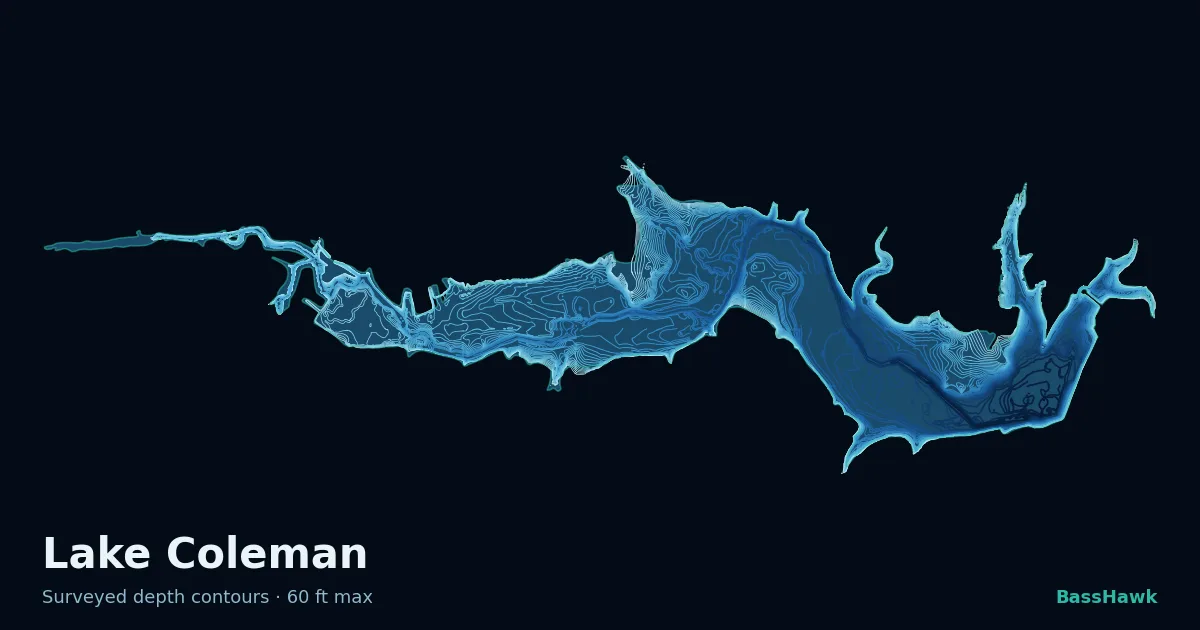
Hot water, thin bite, deep structure and shade, topwater at first light only.
Water's sitting in the low 90s, upper summer heat. That's the worst of it for largemouth on this lake. Bass are deep and lethargic, buried in shade and cool water near structure, barely moving except at dawn and dusk when light is low and the water's a hair cooler. Pressure's falling before some weather rolls in, which will help the evening bite, but the midday hours are a washout. The pool's down nearly 4 feet, so the timber and the docks that hold fish are in steeper, tighter pockets. Catch them early before the sun climbs, or late when they look up again. In between, you're grinding deep structure with finesse baits and small profiles just to get reaction strikes.
The day's game plan
Where to fish
- Main Lake Rocky Points — 6 to 20 feet, depending on point structure · Hard bottom with rocks, gravel, quick drop-off to deeper water.
Bass stage here in the morning before pulling deeper. Points funnel movement between shallow and deep water. Rocky banks collect shade and cooler water in the summer heat. - Channel Ledges and Swings — 12 to 25 feet · Defined creek channel with hard bottom, bend and edge structure, proximity to timber.
The main highway bass use to move between the flats and the deepest sanctuary. Channel bends create current breaks and concentrate bass. Summer bass retreat here when the flats get too hot. - Dock and Timber Complex — 8 to 20 feet, with immediate deep water access · Standing timber, driftwood, boat dock pilings, brush near the structure.
Docks provide shade. Timber offers vertical structure and cover. When the water's scorching, bass bury tight to this cover. Docs with lights at night attract baitfish and bass follow. - Secondary Points Near Creek Arms — 6 to 15 feet · Hard bottom, rocky, some scattered timber, quick access to 20+ feet.
Transition zone in morning and evening. Bass begin shallow feeding as light drops and pressure falls. More numerous smaller fish here than on main lake primary points.
What to throw
- Buzzbaits (topwater) — 3/8 oz · White, Chartreuse · n/a (Early morning (first 1.5 hours after sunrise) and evening (1 hour before sunset).)
Cast near cover edges and rocky points. Retrieve steady and deliberate, not fast. Let it gurgle and push water without skipping. Work it tight to timber and dock pilings. - Scope Minnow (crankbait) — 2.5 in to 3 in · Natural shad, silver · 1/2 oz (Morning bite (8:30 AM to 11:00 AM) when bass are transitioning to deeper water.)
Cast and crank it at a steady pace along points and channel ledges. Deflect it off rocks and structure. Let it dive to 12 to 18 feet depending on the cast distance. - Drop Shot Rig (finesse worm) — 3 to 4 in · Green Pumpkin, Watermelon, Red Bug · 1/16 to 1/4 oz sinker (Midday and transition periods (11:00 AM to 5:30 PM) near deep timber and channel ledges.)
Tie a small drop shot rig with 12 to 18 inches of fluorocarbon leader below the sinker. Drag it slowly along the bottom near structure or fish it vertically. Work it with tiny hops and long pauses. - Shaky Head Jig — 3 in worm · Green Pumpkin, Black, Black-Blue · 1/8 oz jig head (Midday grind (11:00 AM to 3:00 PM) and late afternoon.)
Cast near timber, brush, and dock pilings. Shake it slowly while dragging along the bottom with minimal movement. Let it sit for 3 to 5 seconds, then move 1 to 2 feet and repeat. - Small Swimbait — 3 to 4 in · Shad, Natural · 1/4 oz (Late afternoon and evening (3:00 PM to 7:45 PM) as water cools slightly.)
Cast along channel ledges and rocky points. Swim it at a steady pace just off the bottom. Keep tension consistent and vary retrieve speed slightly to find what's working.
How to work it
- Work the Rocky Points — Early morning through late morning, then again in the evening. Topwater at dawn and dusk, finesse during the rest. · Main lake points with hard bottom and quick drop-offs to deeper water.
Cast along the rocky shoreline points and ledges. Start shallow (6 to 8 feet) at dawn and work deeper as the sun climbs. Drag bottom-contact baits and deflect them off rocks to trigger strikes. - Fish the Channel Swing — Midday and late afternoon when bass have pulled from the flats to the nearby deep water. · Where channel ledges intersect with secondary points and flats.
Identify where the creek channel bends near a flat. Position yourself to drag a drop shot or shaky head along the ledge. The outside bend holds bigger fish. Fish vertically if the depth is consistent. - Dock Pilings and Shade — Midday for finesse, early morning and evening for topwater if bass are active. · Docks with 15 to 20 feet of water nearby, particularly those with standing timber.
Cast right along the pilings and underside of docks, especially those with deep water immediately adjacent. Work finesse baits in the shade. If bass are present, they're buried tight to the structure. - Slow Drag in Timber — Midday grind and late afternoon when bass are deep and holding tight. · Dead timber and brush in 15 to 25 feet of water.
Position the boat uptide or upwind of standing timber. Drag a drop shot or shaky head slowly through the thickest wood. Pause between short movements. Let the bait sit 3 to 5 seconds in dense areas.
Pro tips
- When pressure's falling before a front like today, the evening bite can fire up faster than normal. If you get active fish around 6:00 PM to 7:30 PM, slow down and milk that window. The front arriving may kill the bite tomorrow, so capitalize on tonight.
- In water this hot, fluorocarbon leader is non-negotiable on finesse baits. Bass are spooked by thick line in clear water, especially when they're already lethargic. Drop from 10-pound to 8-pound fluorocarbon and you'll see an immediate uptick in strikes.
- The pool's down 3.9 feet, which means the docks are steeper and the timber is more isolated. Bite on the dock edges and timber piles themselves, not on the flats near them. Bass don't have shallow water access, so they're bunched tighter around the cover.
If conditions change
If a front blows through and the pressure spikes, expect a shutdown for 24 to 36 hours after it passes. Fish will bury in the thickest cover available. Switch to a 3-inch green pumpkin drop shot and a 1/8 oz head, and target only dense timber and dock pilings in the deepest water. Retrieve speed slows to a crawl. If the wind clocks to the north and stays up, the bite gets even slower but the northern banks may have slightly better conditions due to wind-driven current. If the water clarity drops from stain to mud because of rain or creek flow, upsize to vibrating crankbaits and spinnerbaits with a wider blade to displace more water. The largemouth lose sight, so vibration and silhouette matter more than color match. Conversely, if a clear sky and breeze push the water cleaner, downsize everything by 25 percent and lengthen your fluorocarbon leader to 18 to 20 inches.
Find more fish. This is a real report from that day's conditions — open the app for today's · free account