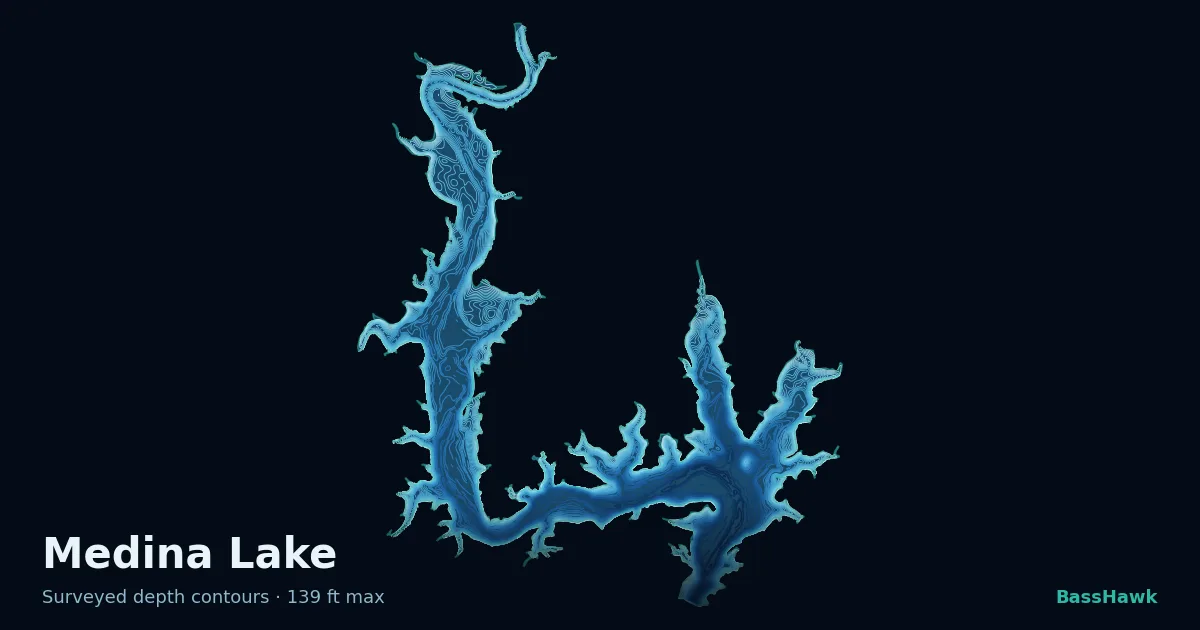
Brutal summer heat with falling pressure ahead of weather. Fish deep and slow, hunt shaded ledges at first light and last light only.
Water's 92 degrees and the bass are in survival mode. This is the toughest time of year on Medina, and the heat is absolute. They've pulled into the deepest, shadiest water available and are feeding hard first thing at sunrise and again a couple hours before dark. That pressure dropping ahead of some weather coming in is actually a bright spot, it'll get them more willing to bite for the next 12 to 18 hours. The lake is extremely low, so structure that would be 30 to 40 feet deep at normal pool is now the only shelter available, and the bass are stacked on it. Water clarity is lightly stained, which gives you a little cover but means they're still seeing everything, so natural colors and finesse work better than bright stuff. The moon is waning late, and the solunar periods are small windows, but they still matter when the rest of the day is locked down tight.
The day's game plan
Where to fish
- Main-lake drop-offs adjacent to creek channels — 20 to 32 feet, with hard bottom and rocky structure · Ledges, hard-clay breaks, rock outcrops, channel-swing edges
This is the primary summer sanctuary. Bass pull here from the shallower creek arms because it offers immediate access to deep, cool water and proximity to the baitfish that stage on the adjacent shallow structure. The hard bottom concentrates forage and gives bass stable hunting positions. - Creek-arm channels and inside bends — 12 to 22 feet on the break, shallower (6 to 12 feet) on the inside bend flats · Soft bottom transitions to hard bottom, standing timber, rock ledges bordering the channel
Creek channels funnel bass movement and concentrate baitfish. The inside bends offer shade and current breaks where bass rest during the day. As the sun angle drops in evening, bass slide into these areas to feed. The proximity to deep water (the channel itself) makes these perfect staging zones. - Rocky outcrops and limestone shelves — 15 to 28 feet depending on the outcrop's location · Hard limestone bottom, undercut banks, crevices, natural shade
Medina's rocky bottom is the signature feature. Bass key on rock because it concentrates crawfish, provides ambush shade, and offers thermal refuge. In extreme heat, the rocky walls and undercuts create the coolest, shadiest pockets available. This is where the best fish hide when the lake is locked down.
What to throw
- Finesse worm on drop shot — 5 in · Natural (smoke, watermelon, green pumpkin) · 3/16 oz (Early morning and midday on deep structure, anytime the bite is locked down tight)
Vertical fishing along ledges and drop-offs, short hops with long pauses. Let it fall on slack line and set the hook on feel. - Jig and craw — Bait 4-5 in · Natural crawfish (brown, tan, dark green), jig head in black or brown · 3/16 to 1/2 oz depending on depth (Morning through afternoon on deep structure, any time you need a reaction bite from inactive fish)
Cast to structure, let it roll down the break or skip it tight to timber. Work with slow hops, pauses of 5 to 10 seconds between movements. - Lipless crankbait — 2.5 in · Silver, pearl white, natural shad · 1/2 to 3/4 oz (Late afternoon into evening when pressure is falling and fish are waking up)
Cast out and retrieve with steady, deliberate pace. Let it tick bottom, let it rattle, work it down structure edges. Short pauses, then resume. - Shad-imitating swimbait on jighead — 4 to 5 in · Silver, pearl, natural shad · 3/16 to 1/4 oz (Evening and dusk, anytime fish are transitioning from deep to shallow water)
Cast and retrieve with a slow, steady roll. Let the tail action do the work. No twitching, no stop-and-go, just smooth glide down structure and along creek channels. - Spinnerbait with single Colorado blade — n/a · White or chartreuse blade, white or pearl skirt · 3/8 to 5/8 oz (Late afternoon, evening, and dusk as pressure falls and fish transition)
Slow-roll down structure edges or burn it near the surface at dusk. Let the blade thump, don't rip it. Steady retrieve with occasional pauses.
How to work it
- Deep vertical jigging — Midday through early afternoon when the heat is peaked and bass are lock-jawed tight to structure · Main-lake drop-offs, creek channel ledges, rock outcrops in 20 to 32 feet
Drop a 1/4 to 1/2 oz jig straight down on deep ledges and humps. Work the jig with short 6 to 8 inch lifts, pause 5 to 10 seconds between lifts. Set the hook on feel. - Slow-rolling crankbaits and bladed baits — Late afternoon and evening when fish are transitioning and pressure is falling · Ledges, channel breaks, rock outcrops, anywhere with hard bottom
Cast out parallel to structure, retrieve just fast enough to feel the bottom tick. Let the bait deflect off rocks and timber. Pause briefly, resume steady speed. No violent jerks. - Skip-pitching jigs to shade — Morning through afternoon when light is intense and bass are buried in the tightest cover · Underneath standing timber, rocky outcrops with undercut banks, any shaded shelter
Make short pitches 15 to 20 feet into the shadiest overhangs, roots, and timber crevices. Skip the jig so it lands softly. Let it fall on slack line. Dead-stick it for 20 to 30 seconds, then pick it up and pitch again. - Topwater at first and last light — Sunrise (7:02 to 7:45 AM) and sunset (7:45 to 8:19 PM), especially around the solunar major at 1:49 PM if it coincides with cloud cover · Shallow creek arms, creek-channel bends, flats adjacent to deep water in 4 to 12 feet
Work a small plug (2 to 2.5 inches) with slow pops and long pauses. Let it sit quiet for 2 to 3 seconds between pops. Focus on creating sound and small disturbance, not commotion.
Pro tips
- The pressure is falling, which is good news. Falling pressure for the next 12 to 18 hours will gradually make bass more willing to bite. That window is your best bet today. Fish hard early, grind the midday, then capitalize on the pressure boost in the evening. Tomorrow when the front actually arrives and pressure spikes, expect a multi-day shutdown.
- In severe drawdowns like this, the normally deep structure becomes the only structure. Bass have nowhere else to go. They're stacked tighter than usual on ledges and drops because there's no shallow refuge. This means less searching and more grinding. One good ledge might hold 20 to 30 fish. Fish one area thoroughly before moving.
If conditions change
If clouds roll in and the sun gets blocked, the bite will stretch shallower and longer. Move up into the 14 to 18 foot zone and stay there longer, because the lower light buys you more time before the deep refuge becomes necessary. If the wind picks up, use it. Wind-blown banks oxygenate water and push baitfish, making them slightly more active. Pivot to any main-lake banks facing the wind direction. If the pressure continues falling faster than expected and the weather is getting closer, the evening bite could fire up earlier and stronger, so prioritize dusk over midday. If a cold front actually rolls through today or tonight and pressure spikes back up after sunset, expect tomorrow to be a dead day, so maximize tonight's window no matter how late you have to fish.
Find more fish. This is a real report from that day's conditions — open the app for today's · free account