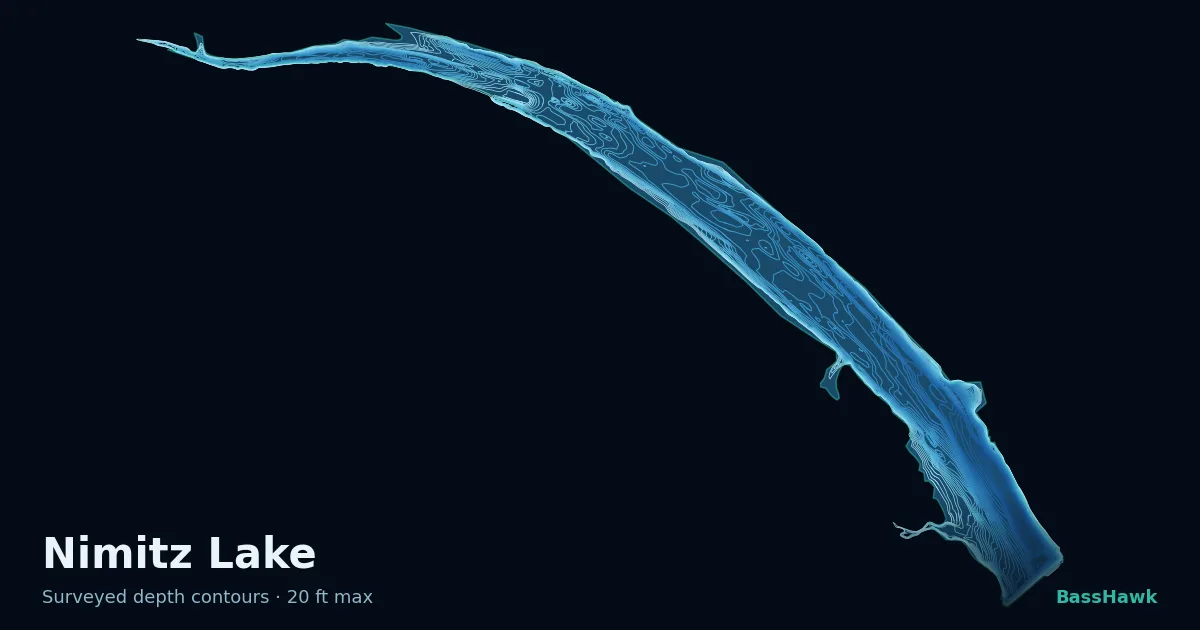
Brutal midday heat pushes bass deep and tight. Early light and evening are the only real windows. Fish tight shade and the deepest available structure.
Water's sitting at 90 degrees, which means the bass are stressed and uncomfortable during the day. This time of year they're either tucked in the thickest shade they can find or pulled out to the deepest, coolest water available. On a small lake like Nimitz you don't have a lot of deep refuge, so bass concentrate hard on whatever shade and structure exists. The pressure is dropping ahead of some weather, which should fire them up a bit during early light and again in the evening, but midday is basically dead water. Work the low-light windows hard and forget the middle of the day unless you're fishing dock shade or the deepest holes on the lake. Clear skies and bright sun will keep them buried until the sun gets lower.
The day's game plan
Where to fish
- Dam Structure and Pilings — 2 to 12 feet depending on how far out from the dam · concrete dam face, rock riprap, any pilings or bracing. Shade from the dam itself.
On a small lake, dam structure is a magnet for bass. Provides shade, current break if water moves, and deep access nearby. Early morning light here is prime. - Shaded Banks (Northwest Facing) — 2 to 8 feet along the bank, dropping to deeper water offshore · Trees, brush, root systems, rocks. Focus on areas where trees create heavy shade.
Northwest-facing banks stay in shade longer in afternoon and evening. Bass use shade as a travel corridor and feeding zone during heat. Work these banks at dawn and dusk. - Deepest Hole on the Lake (likely near dam) — 15 to 25 feet if available · soft bottom, possibly timber or old creek channel
In extreme heat, bass retreat to the deepest, coolest, most oxygenated water available. On a small lake this is your refuge zone during midday. Fish a blade bait or jig dragged along bottom. - Dock and Pier Shade — 1 to 6 feet directly under pilings · wooden or metal dock structure, pilings, shade cast on water
Docks are always fishing magnets, especially in summer. They create shade, cover, and structure in one spot. Work the pilings and skip baits underneath. Accessible from shore.
What to throw
- Green Pumpkin Finesse Worm — 4 in · green pumpkin · 1/16 oz jig head (Early morning, dusk, and anytime in heavy shade or deep timber)
Texas rig or jig head, dragged slowly along bottom or worked through shade in short 6-inch hops. Let it sit on the bottom for 10 seconds between moves. - Blade Bait (Vibrating Shad) — 2.5 in · white or chrome · 1/4 to 1/2 oz (Midmorning through late afternoon when bass are deep and less willing to chase)
Cast and count down to bottom. Steady medium retrieve, keeping the blade vibrating and in contact with the structure. Work along ledges and drop-offs. - Drop Shot Rig — 2 in soft plastic body · green pumpkin or natural shad · 1/16 to 1/8 oz sinker on the tag end (Midday in the deadest periods, or whenever bass are refusing other presentations)
Dead-stick it in one spot, letting it hang 18 to 24 inches above the bottom. Twitch it every 30 seconds or soak it for a minute between twitches. Work vertical over deep holes or tight to timber. - Topwater (Pencil Popper or Walking Bait) — 2 to 3 in · white, chartreuse, or dark junebug · n/a (Evening and dusk, anytime in low light)
Deliberate jerks and twitches creating a wake and slight side-to-side motion. Pause 3 to 5 seconds between jerks, especially in low light. Focus on shade lines and near structure. - Small Spinnerbait — 1/4 oz · white blade, dark skirt (black or junebug) · 1/4 oz (Late afternoon, evening, and night when pressure is dropping)
Slow roll along the bottom or around timber, keeping the blade thump steady but not fast. Bump it off structure. Work it more at dusk and after dark.
How to work it
- Shade-Line Fishing — Early morning until about 9 AM, and again from 5:30 PM through dark · Any bank with overhanging trees or any structure that creates shade. Docks with pilings. Dam structure.
Cast parallel to the shadow cast by trees, docks, and banks. Work the edge between sunlit water and shade, moving your bait slowly through the shadow. Early morning and dusk are peak times. - Skip Casting — Midday when you need to reach shade that open water can't access. Especially effective from shore. · Under docks, under fallen trees, into hollow logs, beneath brush hanging over the bank
Cast low and hard so the bait skips across the water surface into tight spaces like under docks or overhanging brush. Let it settle and work it slowly upward with twitches. - Dragging and Pausing — Morning through late afternoon when bass are not aggressive but willing to eat a bait presented right on their nose · Deep timber, channel ledges, bottom breaks, anywhere bass are holding tight
Cast to structure, drag the bait along the bottom for 2 to 3 feet, pause for 5 to 10 seconds, then repeat. Feel for any take. Let gravity do the work. - Vertical Jigging — Midday heat when bass refuse horizontal presentations · Deep holes near the dam, tight timber tangles, ledge edges
Position over deep structure or a hole and drop a small jig straight down. Work it with short lifts and drops, keeping it tight to bottom. Minimal casting, maximum precision.
Pro tips
- On a small lake like this, every dock and piece of structure matters. Bank fishing and kayak access are your friends in hot weather because you can get into tight shade from shore that a boat can't reach. Skip casting is the key technique. Practice getting baits under docks with finesse.
- Water temp at 90 is near the survival line for bass. They're not feeding for fun, they're feeding out of instinct during the only windows they're comfortable. Early morning and dusk are not optional, they're mandatory. Abandon the idea of a midday bite and either fish deep structure on dragged baits or move to evening light. The fish that bite midday bite because you've put a meal directly in front of their face, not because they're actively hunting.
- Falling pressure before the weather is a real advantage. Use the early morning window hard because the bite will fire up. Don't waste that window on slow fishing. Be ready at first light with a good pattern and cover water with purpose.
If conditions change
If a front blows through and pressure rises sharply with clearing skies, the bite shuts down hard midday and early afternoon. Shift entirely to the thickest cover available, downsize everything to 2-inch finesse baits, and fish slow right on the cover. The post-front window is brutal on small lakes. If wind picks up and begins pushing water, that actually helps because moving water holds more oxygen. Work the windward bank with a slightly faster retrieve and topwater more aggressively in low-light windows. If water begins to clear further (less likely given the limestone water), switch to more natural, translucent colors and stay deeper. If algae bloom muddies the water significantly, upsize to darker colors like black and junebug, and fish bladed baits for maximum thump and vibration.
Find more fish. This is a real report from that day's conditions — open the app for today's · free account