Today's fishing report for Bellwood Lake, Texas: live water temperature, pool level, and a bite score for today — refreshed every morning. Further down is a complete BassHawk guide report for Bellwood Lake from Friday, August 21, 2026 — every area, bait and hour of the game plan, nothing held back — so you can see exactly what lands in the app each day.
TODAY'S BITE98PRIMEpeak for today, out of 100modeled from this morning's forecast
WATER TEMP73°F+1.0°F in 6 dayssatellite imagery
POOL LEVEL−2.9 ft−0.4 ft in 14 daysbelow normal pool · estimated from nearby gauged lakes
Measured Thursday, October 29, 2026 · refreshed daily · where our data comes from · bite score modeled from today's forecast — the hour it peaks, and the week ahead, are in the app · the guide report reads these for you
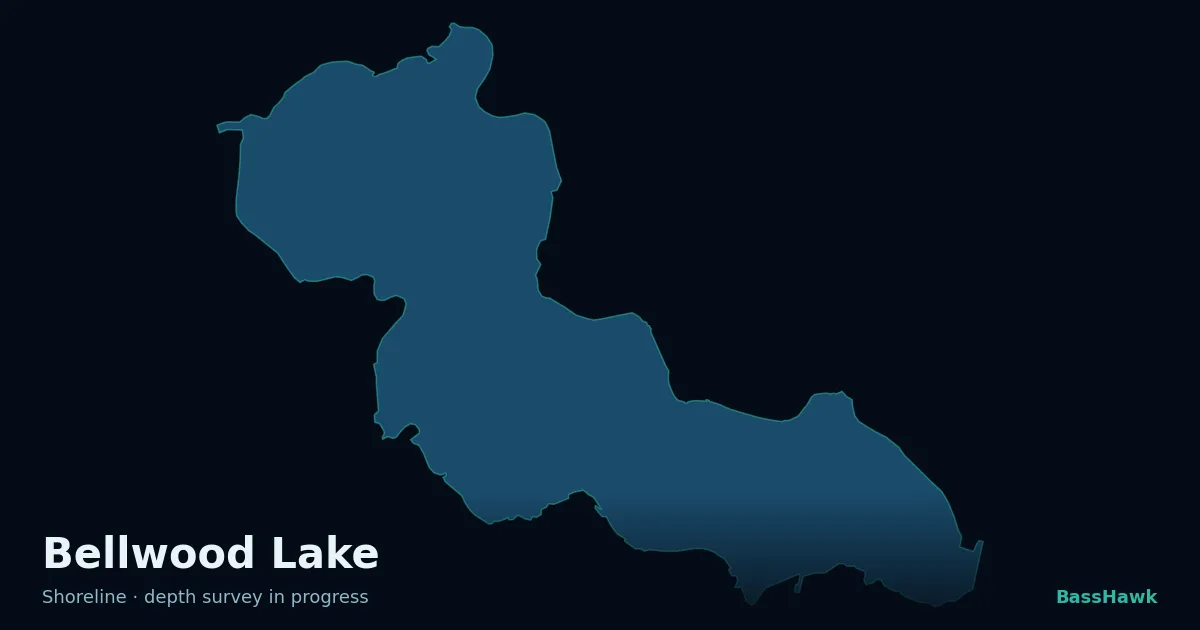
Bellwood Lake shoreline — depth survey in progress
The fishery
Bellwood Lake — Smith County, TX. 160 acres, 25 ft at its deepest. Known for its ShareLunker research fishery. A City of Tyler water-supply lake on Indian Creek, dammed in 1894 and held at a fixed 426 ft spillway crest that barely moves. TPWD manages it for trophy largemouth: a 16-inch MAXIMUM length limit, and heavy stocking since 2009 with Florida-strain fish, ShareLunker offspring and retired adult ShareLunker females. The lake record is 12.75 lb, taken 1 March 2026 on a spinnerbait. It is shallow — mean depth under 9 ft, with the only water past 20 ft against the dam — so cover is the structure: roughly 70% of the shoreline carries native emergent vegetation (bulrush, giant cutgrass, maidencane, arrowhead), and the drowned Indian Creek channel is the one reliable depth line. Threadfin shad are abundant year-round. Access is a single ramp on the north shore off Bellwood Lake Drive; the south bank belongs to The Cascades and is private.
Species
Largemouth bass · White crappie · Black crappie · Channel catfish · Bluegill · Redear sunfish · Longear sunfish
On BassHawk
Everything below points at one goal — finding the most, and the biggest, largemouth bass on Bellwood Lake.
Lake mapFull nautical-dark lake map with curated fishing spots and structure.
Daily guide reportA fresh report for Bellwood Lake every day — where the bite is, what's working, what changed.
Real-time conditionsLive water temp, pool level, weather, an hour-by-hour bite score — and the week ahead scored with the best window flagged.
Wind arrowsLive wind across the lake, direction and mph, so you can find the windblown banks and points where the bait is stacking up.
Routed trip plansA timed, routed fishing plan built for the day you're going — launch to last cast.
Lake Over TimeHigh-resolution aerial photos at and every level between, with the one closest to today's pool marked.
Mud linesSatellite-tracked water clarity — see where the mud line sets up before you launch.
Waypoints & logSave your own waypoints, log catches, and carry them across devices.
Mapped on BassHawk
Creek channels from the USGS National Hydrography Dataset, the national stream map.
1named creek channel (USGS NHD)
Lake Over Time
A high-resolution aerial photo of Bellwood Lake (2016), labeled with how high or low the water was that day. Sharp enough to see stumps, rock and grass lines.
DrawdownNo sharp photo of Bellwood Lake below full pool yet.
Today's poolBellwood Lake is 2.9 ft below full pool this morning. No sharp photo at that level yet.
Scrub every photo over the map in the app: Maps › Lake Over Time.
Getting on the water
Boat Ramp
What a guide report looks like
A complete, real report for Bellwood Lake — nothing held back, from 2 months ago. It ran on that day's conditions, and conditions have moved since. Today's is in the app.
SAMPLE GUIDE REPORT · FRIDAY, AUGUST 21, 2026
Early light and the solunar window is your best window, work the shallow edges hard before the sun takes over.
WATER 80°FAIR 78°FWIND 6 MPH WSWSEASON SUMMERPOOL -1.2 FT
Water's 80 degrees, warm and stable in summer pattern. Bellwood's a shallow lake with vegetation edges wrapping most of the shoreline, and right now the bass are split between early shallow feeding and pulling back to slightly deeper edges and open water for the heat of the day. The pressure's rising after dropping overnight, so the bite is settling into a normal summer rhythm, not fired up but steady. Light's your main tool today. When the sun is high and bright, the fish pull back from the shallow margins and tuck into the thickest cover or slip out to the weedline and deeper water. Early in the morning before the sun climbs, they're willing to hunt shallow along the vegetation. If clouds move in or if there's enough wind to break the light, that shallow window stretches out, but under clear bluebird sun like today, expect the shallow bite to fade fast and the real action to shift to deeper edges and structure later in the day when the light softens again.
The day's game plan
EARLY MORNING · 6:49 AM to 8:00 AM
Shallow vegetation edges and margins along the north and west shorelines, 2 to 4 feet deep, working the cutgrass and bulrush lines where open water meets cover.
5-inch green pumpkin finesse worm on a 1/8 oz shakey head, dead-sticked and dragged slowly along the weed edge. Fish it close to the cover, in the gaps and along the breaks.
Bass are shallow in early light feeding on shad and baitfish in and around the vegetation. The vegetation edge IS the structure on this lake, and they're aggressive before the sun climbs. Work it slow and tight to the cover. The solunar major window at 5:40 AM stacks with sunrise, so this early period is loaded.
MORNING · 8:00 AM to 10:30 AM
Secondary breaks along the vegetation line, 4 to 6 feet, and the inside turns where the weedline transitions from shallow to slightly deeper water, still north and west bank.
1/2 oz chartreuse lipless crankbait with a steady retrieve about a foot off the bottom, bouncing through the shallow breaks. Short aggressive pulls with brief pauses.
As the sun climbs, the shallow bite tightens but doesn't shut off completely. Fish are still willing to chase a faster bait near the weedline. The lipless crankbait covers ground and triggers reaction strikes on fish that haven't yet committed deep. Water's still cool enough in early morning that they're looking up.
MIDDAY · 10:30 AM to 2:30 PM
Off the vegetation edges onto open flats 6 to 8 feet deep, and any slight bottom transition or harder-sand-patch visible on a sounder. Target the open water adjacent to the weedline rather than in it.
Small finesse approach: 4-inch pearl white drop shot on a 1/16 oz jig, soaked vertically or dragged very slowly just off bottom in the deeper pockets. Work it methodically, not fast.
Midday heat and high sun push bass away from shallow cover. They've pulled back to slightly deeper, more open water where the light is softer and they have escape room. They're not gone, but they're lazy and picky. Your presentation needs to be slower, smaller, and right on the bottom or suspended where they're sitting. The solunar major at 1:11 PM is in this window, which can spark a brief window of better feeding, but it's short.
LATE AFTERNOON · 2:30 PM to 5:00 PM
Vegetation edges 3 to 5 feet, working the same shallow margins you started with but focusing on the thickest, densest cover. Especially the north and west bank cutgrass where it's heaviest.
3/8 oz black and blue spinnerbait with a Colorado blade, retrieved steady and slow with a deflection off cover every two or three feet. Let it thump through the cover.
As afternoon wears on the sun angle starts to drop and the shallow water begins to cool slightly. Bass that pulled deep begin thinking about sliding back up. The vegetation is thickest on the north and west, and a slow spinnerbait with blade thump gives them an easy meal in heavy cover without a long chase. You're hitting the same shallow edges as early morning but with a darker, more subtle presentation and slower cadence.
EVENING · 5:00 PM to 7:00 PM
Shallow vegetation margins and the immediate open-water breaks 3 to 6 feet adjacent to heavy cover, all shorelines. The solunar minor at 8:44 PM is coming soon, so set up slightly deeper on structure near the vegetation.
5-inch junebug finesse worm on a 3/16 oz Texas-rigged jig, pitching it tight to cover and working it with small hops and pauses. Dragging slowly along any hard bottom transitions near the weedline.
Light is dropping fast, and bass become more aggressive. They're moving back into shallower water and feeding harder than midday. Junebug color is a natural dark profile in low light. Pitch-and-drag style fishing lets you work the exact edge where cover meets open water. The solunar minor window at 8:44 PM is coming into play, so position yourself on structure that will stay good as the light dims further.
DUSK · 7:00 PM to 7:59 PM (sunset)
Shallow vegetation 2 to 4 feet and the open margins just outside it, entire shoreline but especially dense cover areas where the cutgrass is thickest.
6-inch watermelon red flake finesse worm on a 1/4 oz Texas rig, pitched and worked slowly, or swapped to a 1/2 oz white spinnerbait with Colorado blade for a faster, more active retrieve if you want to cover water.
Final light window of the day, bass are aggressive and feeding in shallower water. Low light means they don't spook easily, so you can fish closer to the bank and work cover more aggressively. This is strong bite time. Watermelon is a natural color that works in low light, and a slightly heavier rig keeps you in contact with cover and bottom.
NIGHT · 7:59 PM onward
Shallow vegetation and heavy cover 2 to 4 feet where the cutgrass and bulrush are densest, north and west shorelines. Stay tight to structure.
Slow dark presentation: 5-inch black finesse worm on 1/8 oz shakey head, fished dead-stick and dragged very slowly along cover. Or switch to a 3/8 oz black spinnerbait with Colorado blade, steady slow retrieve with frequent pauses to let it thump in place.
Bellwood at night is a cover-and-structure game. Bass move fully shallow and tight to vegetation. They hunt by feel and lateral line in the dark, so vibration matters and visibility doesn't. Black profiles create the best silhouette against faint above-water light. The solunar major at 12:44 AM (technically tomorrow but overlapping into deep night) means night bite can stay active. Fish slowly, stay shallow, stay on the cover.
Where to fish
North and West Shoreline Vegetation Edges — 2 to 6 feet · Native emergent vegetation: bulrush, giant cutgrass, maidencane, and arrowhead forming a dense continuous edge along most of the northern and western banks. This IS the primary structure on this lake. Seventy percent of Bellwood's shoreline is vegetation-lined, and the north and west sides hold the thickest giant cutgrass. This is where shad and baitfish congregate, where bass hunt in shallow water early and late, and where the most predictable shallow bite lives. The vegetation edge is your repeatable pattern all season.
Open-Water Deep Pockets 6 to 8 Feet — 6 to 8 feet · Soft-bottom sand and silt areas with slight depressions or hard transitions, adjacent to the vegetation edge but outside the dense cover. These are the transition zones where bass pull when sun is high. When midday heat and bright sun force bass away from shallow cover, they don't go deep, they go to the nearest open water with some relief from light and an escape route back to cover. Bellwood is shallow with a mean depth under nine feet, so these pockets are where the fish stage during the heat. They're less aggressive but more predictable than covering the whole water column.
Creek Channel and Dam Structure — 8 to 15 feet minimum · The old Indian Creek channel that drains into the dam. This is the deepest, most stable water on the lake and the primary escape route for bass on hot days. While most of Bellwood is shallow, the creek channel into the dam is where the oldest, deepest, most thermally stable water sits. Bass that are truly trying to escape the heat will tuck into the channel. This is a secondary pattern and deeper presentation territory, but it's where the big fish can hold when the shallow and mid-depth areas get too warm. Bellwood holds trophy genetics, so don't ignore the deep route in peak heat.
What to throw
Green Pumpkin Finesse Worm — 5 in · green pumpkin · 1/8 oz shakey head (early morning and dusk, low-light periods when bass are shallow and aggressive) dead-stick and drag slowly along vegetation margins and weed edges, fishing tight to cover
Chartreuse Lipless Crankbait — 2.5 in · chartreuse · 1/2 oz (morning hours as sun climbs, when bass are still willing to chase but starting to pull deeper) steady retrieve about a foot off bottom with short aggressive pulls and brief pauses, bouncing through breaks
Pearl White Drop Shot — 4 in · pearl white · 1/16 oz jig (midday when the sun is high and bright, fish are deeper and less aggressive) soaked vertically or dragged very slowly just off bottom, methodical and precise, minimal movement
Black and Blue Spinnerbait — n/a · black and blue · 3/8 oz (late afternoon as sun angle drops and bass think about moving back shallow) steady slow retrieve with blade deflections off cover every two or three feet, let the blade thump
Junebug Finesse Worm — 5 in · junebug · 3/16 oz Texas rig (evening as light drops, bass moving back to shallower water and becoming more aggressive) pitch-and-drag along hard transitions near weedline, small hops and pauses, work edges of cover
How to work it
Shallow Vegetation Edge Work — Early morning before sun, late afternoon as light angles down, evening and dusk. Avoid midday when sun is high. · North and west shorelines where the native emergent vegetation is heaviest, 2 to 4 feet deep Fish tight to the cutgrass and bulrush margins with short casts, working the transition where open water meets thick cover. Use finesse worms or light jigs and work them slowly right along the vegetation line.
Open-Water Drop-Shot Soaking — Midday when sun is high and bass are pulled back from shallow cover. Works in the afternoon window before the shallower evening bite. · Open water adjacent to vegetation edges, slight bottom transitions, soft-sand areas visible on sounder, middle of the lake away from thick cover Vertical approach: cast into deeper open-water pockets 6 to 8 feet and work the bait up and down slowly with pauses. Drag approach: move slowly along the bottom, dragging the light jig with your rod tip low and steady.
Spinnerbait Deflection Fishing — Late afternoon through evening. Works especially well as sun angle changes and bass become more active without full aggression yet. · Vegetation edges 3 to 6 feet deep, hard transitions near the weedline, slight bottom breaks in open water Retrieve steadily slow with the blade thumping through the water. Every two or three feet, aim the retrieve to deflect the bait off a piece of cover, rock, or deeper point edge. The deflection triggers reaction strikes.
Pro tips
Bellwood is a shallow lake with a simple basin and no complex cove system. The vegetation edge wraps nearly all the shoreline and IS your primary pattern. Once you locate the right depth and vegetation transition that holds bass in a given period, that same transition will repeat all around the lake. Find one fish, then look for three more at similar setups on the opposite bank or further along the same shoreline.
This lake was built for trophy genetics and is managed under a 16-inch maximum harvest rule to protect large fish. Fish caught over 16 inches must be released, and bass 24 inches or longer should be briefly held and weighed to see if they meet ShareLunker criteria. You'll encounter big fish here. The lake record sits at 12.75 pounds. Adjust your tackle and technique mindset accordingly, use heavier rods and leaders near structure, and don't horse smaller-diameter stuff through thick cover.
Solunar windows matter more on smaller water. Bellwood is only 160 acres and relatively deep-forage-rich with heavy vegetation, so baitfish are concentrated and available year-round. The solunar windows today at 5:40 AM and 1:11 PM are real edges, but they stack with other factors. Early morning window combines sunrise, the solunar major, and shallow feeding into one surge. The 1:11 PM major is in the middle of the hot midday slump and won't offset the sun and heat, but it can spark a brief tick upward. Don't skip the window, but weight it lightly against light, temperature, and cover.
If conditions change
If a front blows in and the pressure keeps rising, expect the bite to slow over the next 12 hours. Bass will pull tighter to the densest cover and become harder to locate. Downsize everything by one tier and fish slower: swap the 1/2 oz crankbait for a 3/8 oz, drop your finesse worms to 4 inches, and focus on pitching cover rather than covering water. Fish the thickest bulrush and cutgrass banks directly, not the open pockets. If the wind picks up and it's from the south or southwest, that's helping you, warming shallow water and pushing oxygen. Work the shallow vegetation even more aggressively and stay in it longer through the day. If the wind swings to the north or northeast, the shallow bite will tighten faster, so be ready to transition earlier to mid-depth edges and open-water presentations. If clouds roll in and shade the lake, the light window expands. Bass will stay shallow longer and the shallow bite extends deeper into what would normally be the hot midday period. If that happens, skip the drop-shot deep approach and stick longer with spinnerbaits and finesse worms on the vegetation edge. Water clarity on Bellwood is typically stained. If the lake muddies further from a rain event, shift to darker baits (black worms, black and blue spinnerbaits) and slightly larger sizes to displace more water and create more vibration.
Today's bite outlook for Bellwood Lake peaks at 98 out of 100 — prime. That score weighs water temperature, barometric pressure and its trend, wind, cloud cover, solunar windows and the pool trend against bass-behavior research. The hour it peaks, how the rest of the day scores, and the seven-day outlook with the best window flagged are in the BassHawk app.
What is the water temperature on Bellwood Lake right now?
Bellwood Lake is reading about 73°F, from satellite imagery data as of Thursday, October 29, 2026. The trend is +1.0°F in 6 days — which is usually the number that matters more than the reading. BassHawk refreshes it every day.
What is the lake level on Bellwood Lake?
Bellwood Lake is 2.9 ft below normal pool. The trend is −0.4 ft in 14 days. Falling water pulls bass off the flats and onto the first drop; rising water pushes them into flooded cover. The daily guide report factors the trend into where it sends you.
When do bass spawn on Bellwood Lake?
Largemouth on Bellwood Lake spawn by water temperature, not the calendar: they stage around 50–58°F, move up between 58 and 62°F, and bed through roughly 62–70°F, with the north banks and pockets warming first. Bellwood Lake is reading about 73°F today, and BassHawk tracks it daily with its two-week trend. The full temperature-by-phase table is in BassHawk's guide to bass spawning water temperature.
How deep is Bellwood Lake?
Bellwood Lake runs to about 29 ft at its deepest, across ~160 acres. BassHawk maps the shoreline, the structure and the access, and depth work on this lake is in progress.
Where can you launch a boat on Bellwood Lake?
Bellwood Lake has 1 public boat ramp mapped on BassHawk. The ramps are Boat Ramp. Every trip plan starts from the ramp you pick and routes the day from there.
What fish are in Bellwood Lake?
Largemouth bass, White crappie, Black crappie, Channel catfish, Bluegill, Redear sunfish, Longear sunfish. BassHawk is built for largemouth bass specifically — every report, plan and layer is pointed at finding the most, and the biggest, largemouth in Bellwood Lake.
Does BassHawk have a daily fishing report for Bellwood Lake?
Yes. Bellwood Lake gets a fresh BassHawk guide report every day: a headline read on the lake, an hour-by-hour game plan, the areas to run with the depth and structure to look for, what to throw, and how to work it. A complete real report from Friday, August 21, 2026 is reproduced further down this page — nothing held back — so you can see exactly what arrives. Today's is in the app, free to start.