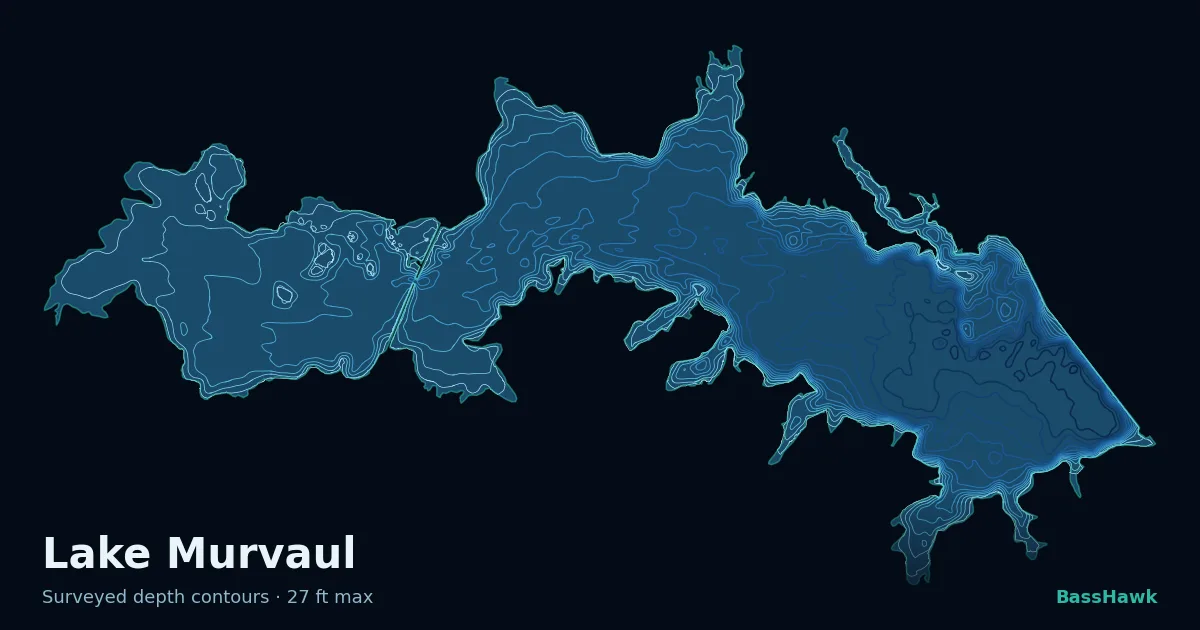
Summer heat shuts down the shallow bite. Stay deep and hunt the channels and timber edges at first light and late.
Water's sitting at 94 degrees, which means the bass have pulled out to their deepest, shadiest sanctuaries. In this kind of heat they're only going to chase in the early morning and the last couple hours before dark when the sun angle drops and it cools a hair. The lake's stained like it always is, which normally helps a reaction bite, but 94-degree water overrides that. You'll find fish on the creek channels, around deep timber, and on ledges where they can access both shallow shade and deep open water fast. Don't waste your day chunking shallow. The few that stay up will be buried in the thickest cover, in docks and under overhanging timber. Clear skies and no wind mean light penetration is brutal right now. Work early, work late, and target structure that lets bass escape down deep when the sun cranks up.
The day's game plan
Where to fish
- Main Lake Creek Channels — 8 to 28 feet, depending on position within the channel · Defined channel swings with inside bends, outside drop-offs, channel-floor timber, and hard bottom composition transitions
Channels are bass highways and rest areas. In 94-degree heat, bass stage deep in the channels early and late, and ride out the midday heat in the deepest holes and timber clusters along the channel edges. Inside bends and channel swings concentrate fish because they funnel movement and provide shade. - Main Lake Rocky Points — 4 to 16 feet depending on the point's profile · Rocky or hard-bottom points that drop off into the channel. Timber on or near the point. Riprap if present.
Bass stage on shallow points early and late, then pull off the point into deeper channel water as the sun rises and heat builds. Rocky points with adjacent timber and deep water access are premium staging areas. Early morning and dusk, bass hunt the point flats. Midday, they're positioned on the channel side of the point drop-off. - Timber-Lined Channel Edges — 12 to 25 feet · Standing timber along the channel break where shallow flats or points transition to the main channel. Dense timber clusters are best.
Timber provides shade and ambush cover. In summer heat, fish position tight to the wood on the channel side, using the timber as a rest spot and the proximity to deep open water as an escape route. The timber line creates a hard edge that concentrates bass vertically and horizontally. - Dock Structure on the Flats and Channel Edges — 2 to 12 feet, deeper if the dock is positioned over a drop-off · Boat docks, especially those with multiple pilings and shade. Best when positioned adjacent to the main channel or a deep water transition.
Docks provide overhead cover and shade. In hot water, bass move shallow to docks at dusk to hunt but position tight to the pilings on the deeper water side. The transition from dock to open water is where they ambush. Shadowy pilings and the channel-side of docks are the high-percentage targets.
What to throw
- Squarebill Crankbait — 2 to 2.5 in · Black or dark chartreuse · n/a (Early morning, evening, and dusk when bass are moving between shallow and deep or feeding on transitions)
Steady moderate retrieve parallel to structure and timber lines, keeping contact with the bottom and letting it deflect off wood. - Bladed Jig — n/a · Black, bluegill, or chartreuse · 1/2 oz to 3/4 oz (All day, but especially midday deep work and evening transitions)
Slow drag along the bottom around timber, vertical work around stumps, and steady wobble retrieves in shallow zones. Let it fall on slack line. - Topwater Walk-the-Dog — 4 to 5 in · Black or dark green · n/a (Dusk and early evening when light is dropping and bass are moving shallow to feed)
Walk it side to side over the flats with a steady twitch and pause rhythm. Keep it moving to create commotion and silhouette. - Texas-Rigged Worm — 4 to 7 in · Dark green, green pumpkin, or junebug · 1/4 oz to 3/8 oz (Midday deep work around timber and dusk shallow skipping around docks)
Skip it under docks and overhanging timber. Work it slowly with a gentle drag and short hops on the bottom around deep timber. Use a drop shot presentation in midday heat. - Swim Jig — n/a · Dark green, black, or bluegill · 3/8 oz to 1/2 oz (Evening and dusk around dock structure and timber-lined banks)
Cast tight to docks and banks, retrieve with a steady wobble that keeps the jig at depth around the pilings and timber. Work the channel side of docks where bass ambush.
How to work it
- Tight-to-Timber Deep Work — Midday when the sun is high and water is hottest. Use this technique anytime the bite slows and the fish are buried deep. · Main creek channels, timber-lined channel edges, and the densest timber clusters on main lake points in 15 to 28 feet
Position your boat on the channel edge or deep side of the timber cluster. Make vertical casts into the wood with a 3/4 ounce bladed jig or Texas-rigged worm. Let it fall on slack line, then rip it up 2 to 3 feet slowly, pause, and repeat. Work the bottom hard and pick apart every opening. - Channel Swing Transition Fishing — Early morning, late afternoon, and evening when bass are moving between depth zones · Any inside bend of a main creek channel where it meets a flat or point
Work the inside bends of the creek channel where the bottom transitions from channel floor (15 to 22 ft) to the shallow flat (6 to 12 ft). Cast a medium diving crankbait or bladed jig across the transition zone and retrieve parallel to the depth change. The bass stage here waiting to move shallow or deep. - Dock Pilings and Riprap Reaction Hunting — Evening and dusk when light is dropping and bass are moving shallow to ambush · Docks and riprap on the main lake points and around creek arms, especially where they're adjacent to deeper water
Make short, precise casts with a swim jig or bladed jig to the shadowy side of dock pilings and along riprap structure. Keep the boat positioned so you're casting parallel to the structure, not perpendicular. Work a 1 to 2 second pause and short retrieve that keeps the jig in the strike zone tight to the cover. - Drop Shot Bottom Scanning — Midday and early afternoon when the bite is tight and bass are inactive · Deep timber-lined channels and the densest brush in 20 to 28 feet of water
Use a 4 inch worm on a drop shot rig with a small tungsten weight. Keep the jig tight to the bottom and make short lifts (6 to 12 inches) with pauses. Let it sit on bottom for 5 to 10 seconds between movements. Cover ground slowly, working the bait directly above the deepest timber holes.
Pro tips
- In 94-degree water, early light and late light are the only real bites. Don't waste midday energy chunking shallow. Run to the deepest timber and channel structure, work it methodically, and rotate back out at 3 PM. Two solid hours of quality early fishing beats eight hours of grinding in the heat.
- Dark colors dominate today. Black, black and blue, dark green, and junebug all cut through the bright glare and stained water better than bright patterns. Save the chartreuse and white for low-visibility conditions or a specific trigger. In this sun and heat, silhouette and contrast rule.
If conditions change
If the pressure drops and wind builds from the south, expect an extended shallow bite through midday because the wind will cool the water surface and push baitfish around the banks and dock structure. Shift to reaction baits and cover more water shallower. If a front rolls in and pressure rises with clearing skies, the shutdown will be even more severe. Fish even earlier and later, and go darker and slower with finesse presentations on the tightest timber. If the clarity improves and the stain clears, drop to 4 inch finesse worms and smaller crankbaits (2 inch), lengthen your leader, and focus on natural colors. If the water muddies from runoff, go even darker (black, black and blue) and upsize the blade on your jigs to create more thump.
Find more fish. This is a real report from that day's conditions — open the app for today's · free account