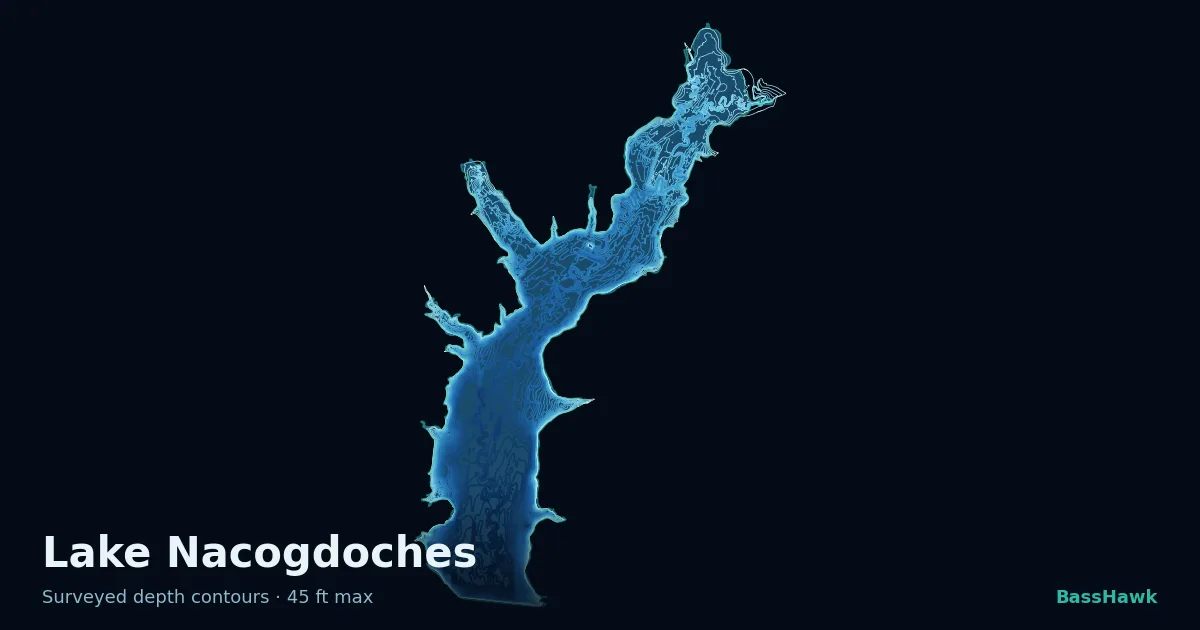
Deep creek channels and channel swings 15-22 feet in a Carolina rig or medium crankbait. Summer heat has them locked offshore.
Water's sitting at 91 degrees, which is peak summer stress water. The bass have pulled out deep to stay comfortable and find more oxygen around the creek channels. This is the tightest daytime bite of the year. Your windows are early morning before the heat fully sets in, and after the sun starts dropping late afternoon into dark. The lake stays stained, which means the water column doesn't get as much light penetration, so the bass don't need as much cover to feel secure. The pressure is holding steady, so there's no feeding surge from a pressure drop, but stable conditions mean predictable patterns. During the blazing midday heat, the bite almost shuts down except on the absolute deepest hard structure near the channels.
The day's game plan
Where to fish
- Creek Channel Swings — 15-22 feet on hard bottom, 20-26 feet in timber bends · Inside bends with current breaks, channel walls, hard bottom (shell, gravel), standing timber
This is the year-round refuge for bass in summer. The channels are highways between shallow and deep water, and the hard bottom holds schools of 15-20 bass stacked up. Early morning reports confirm 15-20 fish schools holding here consistently. This is your primary target depth and area right now. - Secondary Main Lake Points — 12-18 feet on the point itself, dropping to 20-26 feet on the channel side · Hard bottom (shell, clay, gravel), minimal timber, clean transitions
Points funnel bass movement and concentrate them during staging and feeding. The early light and late light hours see good activity here. Bass use these as staging areas between deep structure and shallow feeding zones. School up in groups of 8-15 fish. - Shallow Hydrilla and Grass Edges — 4-12 feet along the grass line, with deep water access within 50-100 feet · Vegetation edge, timber interspersed with grass, hard bottom at the grass base
Baitfish congregate around shallow vegetation during low light and evening. Bass hunt the edges aggressively from late afternoon through night. This is where the evening and dusk topwater bite lives. The thermocline is deeper now but vegetation still holds cooler water and more oxygen. - Deep Timber on Creek Arms — 20-26 feet, deepest timber available within each tributary · Standing timber, dense root systems, hard bottom where timber anchors
Quality bass hold here during midday when the open water is too hot and too light. Less pressure from boat traffic and fewer anglers fishing deep timber means bigger fish feel safe. If you're willing to pick apart this cover during the dead midday hours, you can catch quality fish when everyone else is off the water.
What to throw
- Medium Diving Crankbait — 2.5 to 3.5 in · Watermelon red, chartreuse back, or shad · n/a (Early morning, late afternoon, and evening. Bass are more willing to chase during lower light.)
Steady retrieve, 10-15 feet deep early morning and late afternoon. Work the edges of channel swings and points. Tick the bottom on hard spots without snagging. - Carolina Rig with Worm — 6 to 8 in · June bug, black, watermelon red, or green pumpkin · 3/8 oz to 3/4 oz sinker (All day, but especially midday on deep timber and early morning on channel swings. This is the pattern setup that stacks the most consistent bass.)
Drag it slowly along channel bottoms and hard structure. Pause for 2-3 seconds every 15-20 feet. Let it soak on timber and shell bottom. Work it methodically, not fast. - Topwater Walking Plug — 2 to 3 in · Black, dark purple, or dark shad · n/a (Dusk and night, especially the last hour before dark and the first 2 hours after sunset.)
Steady side-to-side walk with a 6-inch cadence. Work it slowly late evening and at night. Fast walk during dusk for more commotion. Keep it in the strike zone over shallow edges and hydrilla. - Spinnerbait — 3/8 oz to 1/2 oz · White or chartreuse skirt, white or gold blade · n/a (Evening and early morning around vegetation. Can work midday on the deepest offshore structure.)
Steady medium to fast retrieve, working it over and around vegetation edges and timber. Cast toward the bank and burn it out. Also works on slow drag over deep channel bottoms early morning. - Bladed Jig — 2 to 2.5 in · Black, chartreuse, or white · 3/8 oz (Dusk and evening for shallow work. Early morning on deeper channels. Night bite when water is cooler.)
Fast retrieve over shallow grass and timber. Also works as a slow drag over deep structure. Vary the speed and let it flutter on the fall when you pause.
How to work it
- Dragging a Carolina Rig on Channel Bottoms — All day, but especially early morning, late afternoon, and night. This is the primary pattern in summer heat. · Creek channels and channel swings in 15-22 feet, especially on hard bottom like shell or gravel. Inside bends where the current breaks.
Cast the rig 30-40 feet uptide or upchannel, let it settle, then drag it 15-20 feet in short pulls with your rod tip. Pause for 2-3 seconds, then drag again. Work methodically and pick apart the same 50-yard stretch multiple times rather than covering miles. - Covering Water with Moving Baits at First and Last Light — Early morning (first two hours after sunrise) and evening/dusk (last three hours before dark). This is when bass are most aggressive and will chase a lure. · Shallow hydrilla edges, creek arms, secondary points, timber in 4-15 feet.
Cast crankbaits, spinnerbaits, or topwater near cover (grass, timber, banks) and work them with a steady retrieve. Move the boat and cover new water every 5-10 casts rather than soaking one spot. Bass are more willing to chase when light is low. - Picking Apart Deep Timber with a Heavy Rig — Midday when the open water is unbearably slow. Only the biggest bass in the thickest cover will bite during the heat peak. · Deep timber on creek channels in 20-26 feet, especially the thickest cover you can find.
Position the boat tight to the timber, make short 15-20 foot casts, and work a heavy Carolina rig or jigging spoon one stick at a time. Let the bait rest on each piece of wood for 3-5 seconds. Don't rush. Fish every log and branch. - Working Secondary Points and Channel Transitions — Early morning and late afternoon are best, but these areas can hold bass all day if the water stays deeper than 15 feet. · Secondary points near creek arms, places where shallow flats drop into 15-20 feet, inside channel bends.
Cast uptide of the point or channel edge and let the current or your drift carry the bait into the break. Work a crankbait, Texas rig, or Carolina rig across the transition zone. These are highway spots where bass funnel between shallow feeding areas and deep structure.
Pro tips
- When you locate a school of 15-20 bass on a channel swing in early morning, pick 3 or 4 off and then move. The school will hold tight but your pressure spooks them. Come back to the same spot 30 minutes to an hour later. The bass reset and you can get another fish or two. This is how guides stack numbers in early morning without fishing one spot to death.
- Water temp at 91 degrees kills the midday bite harder than most anglers realize. The absolute worst hours are 12 noon to 3 PM. Rather than grinding deep timber those hours, stay mobile and run baits in the evening starting at 5 PM. You'll catch more and better fish in two hours of evening bite than five hours of midday grind. Respect the heat.
- In stained summer water, a Carolina rig with a black or June bug worm and a 1/2 oz sinker lets you fish deep structure without getting snagged as much as a crankbait. The sinker's weight gives you bottom feel and the worm is more snag-resistant than a hard lure. If you're fishing timber, Carolina rig is your safest bet for staying in the zone without constant hang-ups.
If conditions change
If a front rolls through and the pressure starts dropping, the bite usually fires up 12-24 hours before it arrives. You'll see explosive early morning and late afternoon bites before the storm. If the pressure rises after the front clears and it stays bluebird sunny and calm, the midday bite shuts down even more. Stay deeper, go heavier, fish slower, and fish the thickest cover. If wind picks up from the south or southwest, the wind blown banks can hold more baitfish and the shallow edges come alive slightly earlier than forecast. If clouds build and block the sun, extend your morning window an extra hour because the bass don't get as much light pressure. If the water clarity muddies from summer algae or run-off, go brighter colors like chartreuse and white, and fish baits with more vibration like spinnerbaits and bladed jigs. If the water clears unexpectedly, downsize everything, switch to natural colors like watermelon and shad, and fish slightly shallower because the bass can see better and feel more exposed.
Find more fish. This is a real report from that day's conditions — open the app for today's · free account