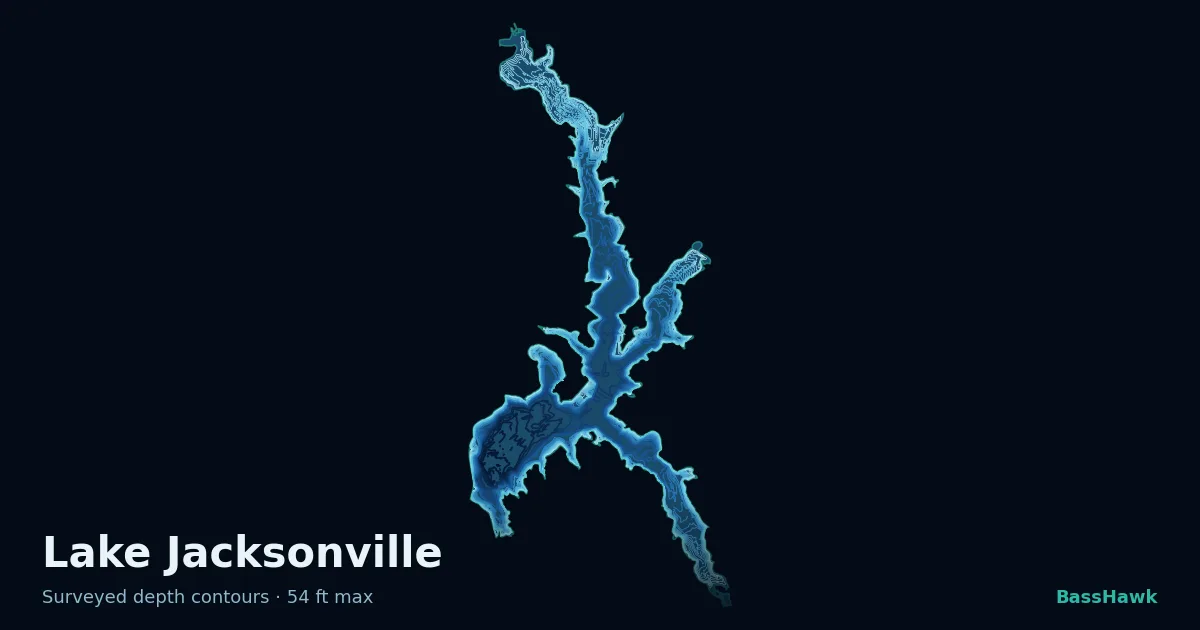
Heat is locked in and the bite is tough, but deep brush and rock in 12-18 feet will hold the better ones.
August on Jacksonville is always a grind, and today's no different. Water's sitting at 95 degrees, which means the bass are deep and lazy. They're not looking to chase anything far, so anything more than a few feet away from hard structure isn't worth your time. The lake's running clear, which is typical for summer here, so they can see your bait coming from a distance. That's good for finesse presentations and bad for reaction baits. Pressure is steady and holding, so you're not getting any feeding boost from a front rolling in. The sun's going to be absolutely brutal all day with no clouds. Early and late bites will be your best shot, and the deep brush piles and rocky points are going to be where the fish hunker down to stay comfortable.
The day's game plan
Where to fish
- Dam (Riprap Face) — 2 to 18 feet depending on proximity; riprap in 2 to 8 feet, drop-off beyond · Rock-lined shoreline with hard bottom transitions and deep water access
Consistent year-round, holds positioned fish relating to the hard rock, excellent evening bite when bass move shallow, deep enough to hold fish all day if needed - Cat Creek and Byrd Branch (Creek Arms) — 2 to 12 feet, shallower than main lake · Softer cover and native vegetation when present, banks and shallow flats, dock cover
Best shallow and early-morning bite, softer cover preferred by some bass when main lake is all rock, less pressure than main lake, good dusk bite - Marina Island (and Adjacent Dropoffs) — 2 to 18 feet, quick transitions from shallow to deep · Hard bottom, rock substrate, steep drop-offs, available brush
Exemplifies Jacksonville's steep profile, quick depth changes concentrate migrating fish, holds both shallow and deep fish within casting distance, reliable rock and structure - Iron-Ore Points (Main Lake) — 6 to 20 feet, depending on point structure · Rocky hard bottom, prominent contours, secondary points near creek channels
Backbone of the fishery, consistent holding zones for positioned fish, good afternoon and late-afternoon bite as fish stage on shallower transitions, deep water access nearby
What to throw
- Finesse Worm (Texas Rig) — 4 to 5 inches · Green Pumpkin, Watermelon Red, Smoke · 3/16 oz to 1/4 oz (Shallow early morning, deep brush midday, evening banks, any time in clear water)
Drag slowly on bottom with occasional pauses, shake gently in place, skip under docks, work vertically over brush - Shaky Head Jig — 4 inches (body length) · Green Pumpkin, Natural Tan, Watermelon · 1/4 oz to 3/8 oz (Morning and late afternoon on rocky points, midday on brush piles)
Drag on bottom with constant shaking motion, pause and shake in place near structure, work along hard-bottom transitions - Spinnerbait — 1/2 oz · Black, Dark Blue, with dark trailer · 1/2 oz (Evening and dusk when bass move shallow, around hard cover and structure)
Cast long, retrieve steadily with the blade clipping cover and creating vibration, work around docks and dam riprap, increase speed if you get follows - Swimbait — 5 to 6 inches · Dark Shad, Natural Colors · 3/8 oz to 1/2 oz (jig head or weighted hook) (Early morning schoolers, afternoon suspending fish, evening shallow)
Cast and retrieve with steady swimming motion, work through suspended fish, fast retrieves to trigger schooling fish, slow retrieves for single fish on structure - Topwater Walk-the-Dog — 3 to 4 inches · Black, Dark Blue · n/a (Dusk and early night when light is low and bass move shallow)
Walk slowly with rhythmic pops and pauses, let it rest between movements, work shallow banks and dock areas, be patient with timing
How to work it
- Vertical Jigging — Midday when fish are stacked tight on structure · Deep brush in 15 to 22 feet, main lake brush piles and submerged timber
Drop a 3/8 oz finesse worm or small jig straight down on thick brush piles, keep it vertical or use slight lift-drop motions, let it fall on slack line, watch for line twitches - Slow Dragging — Morning, late afternoon, anytime you're targeting positioned fish on defined structure · Rocky points, hard-bottom transitions, dam riprap
Cast to structure or along a contour, drag a shaky head or finesse worm on bottom with steady rod movement, shake intermittently, cover 10 to 20 feet per cast - Skip Casting — Early morning and evening when fish are shallow · Docks and shallow cover in creek arms, especially Cat Creek and Byrd Branch
Keep the rod tip low and aim for a skip under docks or overhanging cover, let the bait bounce beneath the structure, keep tension light to avoid snagging - Schooling Response Fishing — Any time you see active surface feeding, especially early and late · Shallow banks, main lake points, anywhere baitfish stack
When you see baitfish or bass activity, cast a swimbait or topwater into the school, work it fast and cover water, expect multiple strikes in a short window, stay in the area until activity dies
Pro tips
- Learn the private brush piles. Jacksonville's lack of natural vegetation means man-made brush is disproportionately important. If you can identify where local anglers or the marina have sunk brush, you've found the summer pattern. Those piles hold deep fish all day and are your most reliable spots in the heat.
- Fish the 12 to 18 foot zone during peak heat. This is the sweet spot on Jacksonville. It's deep enough for the bass to escape the worst heat stress, but shallow enough that they don't need to go to extreme depths to stage. The rock substrate in this zone holds forage and structure. Start every hot day fishing this band and work shallower or deeper only when that pattern doesn't produce.
If conditions change
If a front moves through and pressure drops before arriving, expect a brief feeding spike in the hours before the rain. Throw reaction baits like spinnerbaits and chatterbaits around the dam and shallow points. If the front stalls and pressure rises after passing, the bite will shut down hard. Downsize everything to 3-inch finesse worms and drop shots, fish the densest brush you can find in 15 to 20 feet, and slow your retrieve to almost stationary. If the water gets stained from storm runoff or algae bloom, switch to dark colors like junebug or black, upsize to 6-inch worms, and fish slower with more vibration from the lure itself. If it clears even more than normal, downsize to 3-inch finesse baits and use fluorocarbon leader. If evening clouds build and the wind picks up from the south or west, that shallow dusk bite can extend another 30 to 45 minutes because the light stays diffused and the water stays cooler near the surface longer. Stay shallow longer in that case and work topwater or spinnerbaits past dark.
Find more fish. This is a real report from that day's conditions — open the app for today's · free account